ARAI Range vs Real-World EV Range: How to Calculate Your Actual Range
Quick Answer: Is ARAI Range the Same as Real-World EV Range?
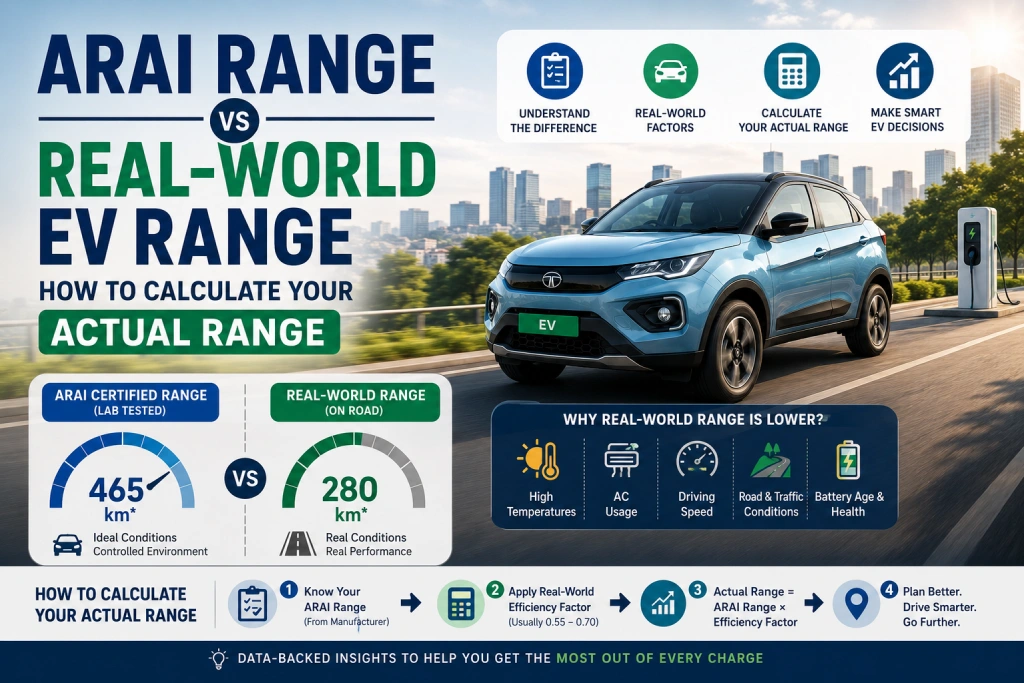
No. ARAI/MIDC range and real-world EV range are different measurements. ARAI/MIDC range is a certified result produced under a defined testing methodology. Real-world range depends on factors such as speed, acceleration, temperature, cabin cooling or heating, load, terrain and driving conditions. (eMobility ARAI)
Calculate your EV's real-world range using your actual battery size, efficiency and driving conditions.
Calculate Now| Range figure | What it means | Best use |
|---|---|---|
| MIDC certified range | Range measured under India's prescribed certification methodology | Comparing vehicles |
| C75 range | Tata's near-real-world range disclosure | Setting a practical expectation for Tata EVs |
| Independent test range | Range achieved under a publication's own test conditions | Understanding a particular test scenario |
| Personal calculated range | Range estimated from your battery energy and actual consumption | Planning your own driving |
Tata currently lists the Nexon.ev 45 with a 46.08 kWh battery, 489 km MIDC Part 1 + Part 2 certified range, and 350–375 km C75 range. (Tata Motors Electric)
The important point is that these numbers answer different questions. The 489 km figure is a standardized certified result; the 350–375 km C75 figure is Tata's disclosed near-real-world range; and your own range will depend on how efficiently your particular vehicle is driven.
For personal trip planning, actual energy consumption in kWh/100 km is more useful than simply subtracting an assumed percentage from the certified range.
What Does ARAI Range Actually Mean?
ARAI range is a certified electric-vehicle range figure measured using a prescribed testing methodology. It is intended to provide a standardized basis for range measurement and comparison; it is not a guarantee that every driver will achieve the same distance in everyday conditions. The relevant Indian standard is AIS-040, titled "Electric Power Train Vehicles — Method of Measuring the Range." (eMobility ARAI)
What is ARAI?
ARAI stands for the Automotive Research Association of India. AIS-040 is an Automotive Industry Standard published by ARAI on behalf of the Automotive Industry Standards Committee under the Central Motor Vehicle Rules technical framework. (eMobility ARAI)
For an EV buyer, the important distinction is between a certified test result and an individual driving result.
The certified range gives buyers a standardized number. Your actual range is affected by the conditions under which you operate the vehicle.
What is MIDC?
MIDC means Modified Indian Driving Cycle. Tata explains that its current reported range uses MIDC Part 1 and Part 2, representing urban and extra-urban driving respectively. (Tata Motors Electric)
Tata says that, beginning September 10, 2024, it would report the certified range of its EVs using the MIDC P1 + P2 test, covering both urban and extra-urban portions. (Tata Motors Electric)
That distinction matters when reading an EV specification sheet.
A number such as:
489 km MIDC Part 1 + Part 2
should be read as a certified range figure under the applicable test methodology, not as a promise that the vehicle will always travel 489 km between charges.
How Does the MIDC EV Range Test Work?
The MIDC range figure comes from a standardized testing procedure rather than an arbitrary real-world road test. AIS-040 specifies the method used for measuring electric powertrain vehicle range, providing a defined framework for the test. (eMobility ARAI)
The purpose of a standardized test is comparability.
If manufacturers tested vehicles using completely different routes, speeds, weather conditions and driving styles, comparing their published range figures would become much harder.
MIDC Part 1 and Part 2
Tata describes:
- Part 1 (P1): Urban driving
- Part 2 (P2): Extra-urban/highway driving
- P1 + P2: Combined certified range (Tata Motors Electric)
This is why current Tata specifications can show a vehicle's range as MIDC Part 1 + Part 2.
For the Nexon.ev 45, Tata lists:
- Battery: 46.08 kWh
- Certified MIDC P1 + P2 range: 489 km
- C75 range: 350–375 km (Tata Motors Electric)
The three figures should not be treated as interchangeable.
Why Is Real-World EV Range Different?
Real-world EV range varies because energy consumption changes with driving conditions. Speed, acceleration, temperature, cabin heating or cooling, vehicle load, terrain and the balance between city and highway driving can all affect the amount of energy an EV uses. (Alternative Fuels Data Center)
The U.S. Department of Energy's Alternative Fuels Data Center specifically notes that EV efficiency and driving range vary substantially according to driving conditions. It identifies extreme temperatures, highway travel, acceleration, heavy loads and significant inclines among the factors that can affect range. (Alternative Fuels Data Center)
That means two drivers can use the same EV and obtain different range figures.
Even the same driver can obtain different results on different days.
For example:
Driver A
- Mostly city driving
- Moderate speeds
- Light load
- Moderate climate-control use
Driver B
- Mostly highway driving
- Higher speeds
- Four occupants plus luggage
- Heavy air-conditioning use
- Significant gradients
The vehicles may have identical certified specifications, but their energy consumption can differ.
Nexon EV Example: 489 km MIDC vs 350–375 km C75
The Tata Nexon.ev 45 is a useful example because Tata publishes both a certified range and a C75 range.
Tata's current documentation lists the Nexon.ev 45 with a 46.08 kWh battery and 489 km certified MIDC Part 1 + Part 2 range. Tata also lists 350–375 km C75 real-world range. (Tata Motors Electric)
What does that comparison tell us?
It demonstrates why "claimed range" and "real-world range" should not be treated as identical concepts.
Tata describes C75 as a voluntary near-real-world range disclosure representing the range that 75% of customers can expect, based on historical usage data. Tata says the underlying data represents more than 4 billion cumulative kilometres driven by more than 1.65 lakh Tata.ev cars and SUVs on Indian roads. (Tata Motors Electric)
The comparison is therefore:
| Nexon.ev 45 metric | Published figure |
|---|---|
| Battery | 46.08 kWh |
| MIDC P1 + P2 | 489 km |
| Tata C75 | 350–375 km |
What do independent tests show?
Independent testing gives another useful perspective, but independent results should be attributed to the specific test methodology rather than presented as the universal range of every Nexon EV.
Autocar India's instrumented test of the Nexon EV 45 produced a 350 km mixed city/highway range. The publication reported average city efficiency of 7.9 km/kWh and highway efficiency of 7.67 km/kWh under its test conditions. (Autocar)
Autocar says its test was conducted in Eco mode, with two people in the car, recommended tyre pressures, a fixed route in Mumbai and the adjoining state highway, and climate control set to 22°C in full-auto Economy mode. (Autocar)
CarWale's separate test covered a predefined city-and-highway route and reported 329.7 km from a full charge. CarWale recorded ambient temperatures between 32°C and 37°C during the test and reported the vehicle's average consumption as 138 Wh/km at the end of the test. (CarWale)
These results illustrate an important point:
A real-world test result is always a result under particular test conditions.
It does not automatically become the guaranteed range of every owner.
What About the "26% Lower Than ARAI" Figure?
Using Tata's published C75 range midpoint gives a useful mathematical comparison.
The midpoint of 350–375 km is:
(350 + 375) ÷ 2 = 362.5 km
The difference between the 489 km certified figure and that midpoint is:
489 − 362.5 = 126.5 km
The difference as a percentage of the certified figure is:
126.5 ÷ 489 × 100 ≈ 25.9%
Therefore, Tata's published C75 midpoint is approximately 25.9% below the 489 km MIDC figure.
The calculation is based on Tata's published figures. (Tata Motors Electric)
However, 25.9% should not be presented as a universal "EV range loss."
It is a comparison between two different published range metrics for one vehicle.
Your own percentage difference can be different.
The Biggest Factors Affecting EV Real-World Range
Speed
Higher-speed driving can require more energy because aerodynamic drag increases as vehicle speed rises. The U.S. Department of Energy notes that highway travel typically requires more energy than city travel because of increased drag at higher speeds. (Alternative Fuels Data Center)
This is why a vehicle that performs efficiently in urban traffic can consume more energy when driven continuously at higher highway speeds.
Do not therefore assume:
City efficiency = highway efficiency
The two operating environments can produce different consumption.
City vs Highway Driving
EVs can benefit from regenerative braking during stop-and-go urban driving, while highway travel generally requires more energy to overcome aerodynamic drag at higher speeds. (Alternative Fuels Data Center)
City driving is not automatically better in every circumstance, because traffic, acceleration, road conditions and climate-control use still matter.
The important point is that the driving pattern affects consumption.
Acceleration and Driving Style
Rapid acceleration can reduce EV range compared with gradual acceleration because more energy is being demanded from the vehicle. The U.S. Department of Energy specifically identifies rapid acceleration as a factor that can reduce EV range. (Alternative Fuels Data Center)
Driving style therefore belongs in a personal range calculation.
A driver who frequently accelerates hard should not expect the same consumption as a driver using smoother acceleration under otherwise similar conditions.
Air Conditioning and Cabin Heating
Cabin heating and cooling use energy and can reduce EV range, particularly when the climate-control system has to work harder. The U.S. Department of Energy identifies heating and cooling as contributors to reduced EV range under extreme temperatures and advises drivers to account for heating or air-conditioning use when planning range. (Alternative Fuels Data Center)
For Indian EV owners, this is particularly relevant when estimating range for hot-weather driving.
However, the article should not claim a fixed rule such as:
"AC always reduces range by exactly 10%."
A fixed percentage would require evidence specific to a particular vehicle, climate and test condition.
Temperature
Temperature can affect EV range because extreme conditions increase energy requirements for battery operation and cabin conditioning. The U.S. Department of Energy specifically notes that extreme outside temperatures tend to reduce range because more energy may be required to heat or cool the cabin. (Alternative Fuels Data Center)
Temperature therefore belongs among the variables considered when planning a long journey.
Passenger and Cargo Load
A heavier vehicle requires more energy to move, so carrying additional passengers or cargo can reduce range. The U.S. Department of Energy identifies heavy loads as a factor with the potential to reduce EV range. (Alternative Fuels Data Center)
For example, a solo commute and a fully loaded family highway trip should not necessarily be expected to produce identical consumption.
Terrain and Inclines
Significant inclines can increase energy consumption and reduce EV range. The U.S. Department of Energy identifies driving up significant inclines as a condition that can reduce range. (Alternative Fuels Data Center)
Route planning should therefore consider terrain rather than relying exclusively on the vehicle's dashboard range estimate.
How to Calculate Your Own EV's Real-World Range
There are two useful approaches.
Method 1: Certified Range × Personal Range Factor
The first method starts with the manufacturer's certified figure.
Formula
Estimated real-world range = Certified range × Personal range factor
Suppose a user wants to model a 75% scenario for a vehicle with a 489 km certified range.
489 × 0.75 = 366.75 km
Rounded:
≈ 367 km
This is a calculator scenario, not a claim that every EV delivers 75% of its certified range.
The distinction matters.
A calculator should allow the user to change the personal range factor rather than hard-code one universal percentage.
Method 2: Usable Battery Energy ÷ Actual Consumption
For an individual owner, the actual-efficiency method is more useful.
Formula
Real-world range = Usable battery energy ÷ Energy consumption × 100
If usable battery energy is measured in kWh and consumption is expressed as kWh/100 km, the result is kilometres.
Example
Suppose:
- Usable battery energy = 40 kWh
- Actual consumption = 16 kWh/100 km
Then:
40 ÷ 16 × 100 = 250 km
Estimated range:
250 km
This is a mathematical example, not a specification for a particular EV.
Why this method is useful
The formula connects the two variables that matter most to the calculation:
- How much usable energy is available?
- How much energy does the vehicle consume per 100 km?
If your consumption changes, your estimated range changes.
For example, using the same 40 kWh of usable energy:
| Consumption | Calculated range |
|---|---|
| 12 kWh/100 km | 333.3 km |
| 14 kWh/100 km | 285.7 km |
| 16 kWh/100 km | 250.0 km |
| 18 kWh/100 km | 222.2 km |
| 20 kWh/100 km | 200.0 km |
These figures are mathematical outputs from the formula, not vehicle test results.
How to Build a More Accurate Personal EV Range Estimate
A useful calculator should collect more information than simply asking for the manufacturer's advertised range.
Step 1: Enter usable battery energy
Use the vehicle's usable battery energy where the manufacturer provides it.
Do not automatically assume that a vehicle's advertised battery-pack capacity is identical to the energy available for driving.
For the Nexon.ev 45, Tata's published technical specification lists a 46.08 kWh battery pack. (Tata Motors Electric)
The calculator should label the input carefully as either:
- Battery capacity
- Usable battery energy
depending on the data available for the specific vehicle.
Step 2: Enter actual energy consumption
Use the vehicle's measured consumption in:
kWh/100 km
The more representative the consumption data, the more useful the resulting estimate.
For an owner, averaging several trips can be more informative than using one unusually efficient or inefficient journey.
Step 3: Enter city/highway driving mix
A 100% city driving pattern can produce a different consumption profile from a 100% highway journey.
The calculator should therefore allow users to identify whether their expected trip is:
- Mostly city
- Mixed city/highway
- Mostly highway
The U.S. Department of Energy confirms that driving conditions affect EV efficiency and range. (Alternative Fuels Data Center)
Step 4: Enter average speed
Average speed provides additional context for the range estimate.
Higher-speed highway driving can require more energy because aerodynamic drag increases at higher speeds. (Alternative Fuels Data Center)
The calculator should not claim a fixed "X% range loss per 10 km/h" unless vehicle-specific test data supports such a relationship.
Step 5: Consider AC or heating usage
Climate-control use can affect energy consumption.
The calculator can therefore use a qualitative input such as:
- Low
- Moderate
- High
Rather than pretending that every vehicle loses exactly the same percentage when AC is used.
The DOE specifically advises EV drivers to account for heating and air-conditioning use when considering range. (Alternative Fuels Data Center)
Step 6: Consider passenger and cargo load
A lightly loaded vehicle and a heavily loaded vehicle can have different energy requirements.
The calculator should therefore provide an optional load adjustment.
Heavy loads are among the conditions identified by the DOE as capable of reducing EV range. (Alternative Fuels Data Center)
Step 7: Consider terrain
Flat routes and routes containing significant climbs should not automatically be treated as equivalent.
The DOE identifies significant inclines as another factor that can reduce EV range. (Alternative Fuels Data Center)
Step 8: Add an optional safety reserve
The calculator should allow the user to specify a reserve rather than assuming that the full theoretical calculated range is usable for trip planning.
For example, if the calculated range is 300 km and the user chooses a 10% reserve:
300 × 0.90 = 270 km
The resulting 270 km is a planning figure.
It is not a claim that the vehicle will necessarily stop at 270 km.
The DOE also recommends leaving additional range buffer when driving conditions include hilly terrain, heavy loads or significant heating/air-conditioning use. (Alternative Fuels Data Center)
Why You Should Keep a Range Buffer
Theoretical range should not automatically be treated as the distance you should plan to drive before charging. Conditions can change during a journey, and factors such as terrain, load, weather and climate-control use can alter energy consumption. (Alternative Fuels Data Center)
A practical trip plan should consider:
- Destination distance
- Available charging points
- Expected driving conditions
- Traffic
- Terrain
- Weather
- Passenger/cargo load
- Current battery state of charge
- Desired reserve
The purpose of a range buffer is not to make the EV appear less capable.
The purpose is to separate:
maximum calculated range
from
comfortable trip-planning range.
EV Range Calculator: What Should You Enter?
An effective EV range calculator should allow users to enter the variables that materially affect their expected range.
Recommended inputs
| Input | Why it matters |
|---|---|
| Usable battery energy | Determines available energy |
| Consumption in kWh/100 km | Determines how quickly energy is used |
| City/highway mix | Represents driving environment |
| Average speed | Helps represent speed-related consumption |
| AC/heating use | Represents climate-control demand |
| Passenger/load | Represents additional vehicle mass |
| Terrain | Represents route elevation demands |
| Driving style | Represents acceleration behaviour |
| Safety reserve | Converts theoretical range into a planning range |
The core calculation remains:
Range = Usable energy ÷ Consumption × 100
The additional factors should be treated as scenario inputs rather than fake precision.
Frequently Asked Questions
Is ARAI range the same as real-world range?
No. ARAI/MIDC range is a certified result obtained using a defined testing methodology, while real-world range varies with driving conditions. Speed, acceleration, temperature, climate-control use, load and terrain can all affect EV energy consumption and therefore actual range. (eMobility ARAI)
What is MIDC range?
MIDC is the Modified Indian Driving Cycle used for the applicable certified range testing. Tata describes MIDC Part 1 as the urban portion and Part 2 as the extra-urban portion, with current Tata EV range declarations using the combined P1 + P2 result. (Tata Motors Electric)
Why does highway driving reduce EV range?
Higher-speed highway driving can require more energy because aerodynamic drag increases with speed. The U.S. Department of Energy notes that highway travel typically requires more energy than city driving to overcome increased drag at higher speeds. (Alternative Fuels Data Center)
Does AC reduce EV range?
AC and heating can reduce EV range because cabin climate control uses energy. The amount of impact varies according to conditions and vehicle characteristics, so a universal fixed percentage should not be applied without supporting vehicle-specific evidence. (Alternative Fuels Data Center)
Does temperature affect EV range?
Yes. Extreme temperatures can reduce EV range because additional energy may be required for cabin heating or cooling and other temperature-related vehicle demands. (Alternative Fuels Data Center)
How can I calculate my EV's real-world range?
Use:
Real-world range = Usable battery energy ÷ Actual consumption × 100
For example, a hypothetical EV with 40 kWh of usable energy and consumption of 16 kWh/100 km would calculate to:
40 ÷ 16 × 100 = 250 km
The result is an estimate based on the supplied inputs.
What is the real-world range of the Nexon EV 45?
There is no single universal real-world number for every driver. Tata currently publishes a 350–375 km C75 range for the Nexon.ev 45. (Tata Motors Electric)
Independent tests have produced their own results under specified conditions. Autocar India reported 350 km in its instrumented mixed city/highway test, while CarWale reported 329.7 km under its test conditions. (Autocar)
These figures should be understood as results from different methodologies rather than contradictory universal claims.
What is the Nexon EV 45's ARAI/MIDC range?
Tata currently lists the Nexon.ev 45 with a 489 km certified MIDC Part 1 + Part 2 range. Tata's current specification page also identifies the vehicle as having a 45 kWh battery, while the technical brochure specifies the battery pack at 46.08 kWh. (Tata Motors Electric)
What is C75 range?
C75 is Tata's near-real-world range disclosure. Tata says the C75 figure represents the near-real-world driving range that 75% of customers can expect, based on historical usage data from Tata.ev vehicles and SUVs. Tata says that data covers more than 4 billion cumulative kilometres and more than 1.65 lakh vehicles. (Tata Motors Electric)
Can an EV exceed its certified range?
Actual driving range can differ from a certified figure because real-world energy consumption varies. The important distinction is that the certified number is produced under a standardized test methodology, whereas real-world operation involves variable speed, traffic, temperature, load, terrain and driving behaviour. (eMobility ARAI)
The certified number should therefore be used as a standardized reference rather than a precise prediction for every journey.
Should I use a fixed percentage to estimate real-world range?
A fixed percentage can be used as a scenario, but it should not be presented as a universal rule. A more personalized approach is to use actual energy consumption in kWh/100 km and usable battery energy. Different operating conditions can produce different consumption levels. (Alternative Fuels Data Center)
Key Takeaways
- ARAI/MIDC range is a certified test result, not a guarantee of everyday range. (eMobility ARAI)
- MIDC Part 1 represents urban driving and Part 2 represents extra-urban driving in Tata's explanation of the current P1 + P2 reporting approach. (Tata Motors Electric)
- The Tata Nexon.ev 45 is currently listed with a 489 km MIDC P1 + P2 range and a 350–375 km C75 range. (Tata Motors Electric)
- Independent testing can produce different results because each test has its own route, speed, climate and testing conditions. Autocar India reported 350 km, while CarWale reported 329.7 km in their respective Nexon EV 45 tests. (Autocar)
- Speed, acceleration, temperature, climate control, load and terrain can affect EV range. (Alternative Fuels Data Center)
- There is no scientifically justified universal "EV range reduction percentage" that applies to every driver and vehicle.
- The most useful personal calculation is based on usable battery energy and actual energy consumption.
- A practical trip plan should include a range buffer, particularly when conditions can increase energy consumption. (Alternative Fuels Data Center)
Conclusion: Stop Asking "What Is the Real-World Range?" and Calculate Yours
The difference between an EV's certified range and its everyday range is not necessarily evidence that one number is "wrong."
The two numbers answer different questions.
ARAI/MIDC tells you what the vehicle achieved under a standardized certification methodology. (eMobility ARAI)
C75, where provided by the manufacturer, is intended to communicate a more practical range expectation based on real-world usage data. Tata uses C75 to communicate the near-real-world range expected by 75% of customers. (Tata Motors Electric)
Independent tests tell you what a particular vehicle achieved under a particular test protocol. For example, Autocar India's Nexon EV 45 test produced 350 km, while CarWale's test produced 329.7 km under its own conditions. (Autocar)
But none of those figures can perfectly predict your individual driving.
Your most useful number comes from your own energy consumption.
Use:
Real-world range = Usable battery energy ÷ Actual consumption × 100
Then consider your expected speed, city/highway mix, climate-control use, load and terrain.
That turns the question from:
"Why doesn't my EV give the advertised range?"
into:
"What range can my EV realistically deliver under my driving conditions?"
Calculate Your EV's Real-World Range
Use the EV Calculator to estimate your practical range from battery energy, consumption and driving conditions rather than relying on a single advertised number.
Compare your calculated range with the manufacturer's certified MIDC range.
Calculate NowExternal Authority References
- ARAI — AIS-040 (Rev.1):2015, Electric Power Train Vehicles — Method of Measuring the Range — primary technical source for the Indian range-testing methodology. ARAI AIS-040 Range Measurement Standard
- Tata.ev — Nexon.ev 45 technical brochure — primary source for the 46.08 kWh battery, 489 km MIDC P1 + P2 range and 350–375 km C75 range. Tata Nexon.ev 45 Technical Brochure
- Tata.ev — Driving Range Declaration — source for Tata's explanation of MIDC P1/P2 and C75 methodology/data basis. Tata.ev Driving Range Declaration
- U.S. Department of Energy — Alternative Fuels Data Center — independent government source for factors affecting EV efficiency and range. DOE Alternative Fuels Data Center: All-Electric Vehicles
- Autocar India — Nexon EV 45 real-world range test — independent test result and methodology. Autocar India Nexon EV 45 Range Test
- CarWale — Nexon EV 45 real-world range test — independent test result and test-condition data. CarWale Nexon EV 45 Range Test
Publishing Accuracy Note
The article deliberately does not state that "the Nexon EV gives only 240 km in real life." No authoritative source located for this article supports presenting 240 km as the normal Nexon.ev 45 real-world range.
The article also deliberately avoids unsupported fixed statements such as "AC reduces range by exactly 10%" or "highway driving reduces range by exactly 30%." The authoritative sources establish that these factors affect EV range, but the magnitude depends on the vehicle and operating conditions. (Alternative Fuels Data Center)