Battery Swapping vs Home Charging: Which Actually Saves More Money in India?
Quick Answer
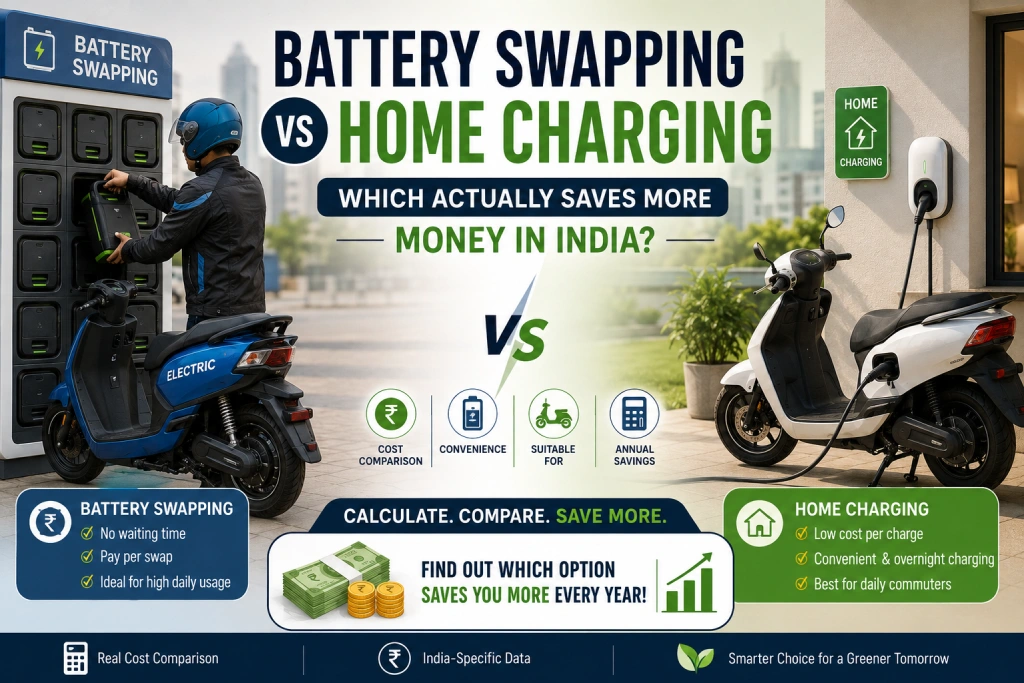
Battery swapping is not automatically cheaper than home charging in India. The financially better option depends on the electricity tariff, vehicle efficiency, swap price, kilometres obtained per swap, battery ownership model and how heavily the vehicle is used.
For commercial electric vehicles, especially high-utilisation two- and three-wheelers, swapping can have an economic advantage because replacing a depleted battery can reduce vehicle downtime and can separate battery ownership from the vehicle. A 2026 CEEW/IBSA/CII report says battery swapping can reduce downtime and lower upfront vehicle costs through Battery-as-a-Service (BaaS), and reports more than 3,000 swapping stations serving more than 250,000 EVs with more than 350,000 batteries in circulation in India. (CEEW)
However, lower downtime does not automatically mean lower energy cost. Home charging can be cheaper when the vehicle owner already owns the battery, has reliable access to home charging and pays a relatively low electricity tariff.
The correct comparison is therefore:
Home charging cost/km versus battery-swapping cost/km, followed by a separate comparison of battery ownership, replacement, charging infrastructure and downtime.
The two core formulas
Home charging cost/km
Electricity used per km × effective electricity tariff
Battery swap cost/km
Swap price ÷ kilometres obtained per swap
The calculator on this page should let users replace every major assumption with their own numbers rather than relying on an India-wide assumed swap price.
| Factor | Home charging | Battery swapping |
|---|---|---|
| Main energy payment | Electricity | Swap fee and/or BaaS fee |
| Battery ownership | Usually part of vehicle ownership | May be separated through BaaS |
| Main financial variable | Electricity tariff + vehicle efficiency | Swap price + kilometres per swap |
| Infrastructure | Home electrical connection + charger | Compatible swap network |
| Downtime | Depends on charging system and charging duration | Battery exchange can be very rapid |
| Battery replacement risk | Generally associated with owner | May be shifted to service provider |
| Network dependency | Relatively low where home charging is available | High |
| Potential strongest use case | Reliable home charging | High-utilisation commercial EVs |
Battery Swapping vs Home Charging: What's the Difference?
Battery swapping is an EV energy model in which a depleted battery is exchanged for a charged battery instead of waiting for the vehicle's battery to recharge. Battery-as-a-Service can separate the battery from the vehicle purchase, allowing the customer to pay for battery energy or battery access through a service arrangement. CEEW's 2026 research identifies reduced downtime and lower upfront costs through BaaS as important potential advantages of battery swapping. (CEEW)
Home charging uses electricity from a domestic connection to recharge the vehicle's battery. The vehicle owner normally carries the battery ownership cost and is responsible for the charging equipment and electricity used.
The distinction matters because the two models can shift costs between capital expenditure and operating expenditure.
Home charging
The basic model is:
Buy vehicle + buy battery → install/use charger → pay electricity cost → eventually replace battery if required.
Battery swapping
The model can instead be:
Buy or finance swap-compatible vehicle → access battery through a swapping/BaaS arrangement → pay swap/service charges → use charged batteries from the network.
The exact commercial arrangement varies by operator and vehicle.
Battery Smart, for example, describes its network as serving electric two-wheelers, three-wheelers and loaders and advertises battery supply and upkeep as part of its service model. Its website displayed 1,569+ swapping stations and 281,587+ batteries as of January 2026. These are company-reported figures. (Battery Smart)
How Much Does Home Charging Cost?
Home charging cost depends primarily on the vehicle's electricity consumption and the applicable electricity tariff. A vehicle that consumes more kWh per 100 km costs more to operate at the same electricity tariff.
The basic calculation is:
Energy required = Distance × Energy consumption ÷ 100
For example, if a vehicle's measured consumption is 10 kWh/100 km, travelling 100 km requires 10 kWh before separately accounting for charging losses.
The resulting electricity cost is:
Energy cost = Energy required × effective electricity tariff
The example above is a mathematical illustration, not an industry-average vehicle efficiency.
Charging losses matter
The electricity drawn from the grid can be greater than the energy ultimately stored in the battery. Therefore, a calculator should allow the user to enter charging losses rather than silently assuming that every unit drawn from the grid becomes stored battery energy.
A practical calculator can therefore use:
Effective energy required = Driving energy × (1 + charging-loss percentage)
The percentage should be user-editable rather than presented as a universal EV charging-loss assumption.
Electricity tariffs are location-specific
Electricity prices cannot be treated as one India-wide number.
Tamil Nadu provides a useful example. The Tamil Nadu Electric Vehicles Policy 2023 states that private charging stations at home are treated as domestic consumption under the applicable tariff category, while public/private charging stations and public battery-swapping stations supplied under LT are classified separately. (SIPCOT)
That distinction is important for a calculator because the correct electricity tariff depends on where the vehicle is charged and which tariff category applies.
Home charging has costs beyond electricity
A complete comparison can also include:
- Home charger purchase
- Charger installation
- Charger replacement, if applicable
- Electricity fixed charges attributable to charging, if the user wants to model them
- Battery purchase
- Battery replacement
- Financing costs
The calculator should allow users to switch these components on or off so that they can compare energy cost separately from total ownership cost.
How Much Does Battery Swapping Cost?
Battery-swapping cost is determined by the commercial arrangement rather than by a single national tariff. The most useful metric for comparison is the amount paid for the swap divided by the kilometres obtained from the exchanged battery.
The fundamental formula is:
Swap cost/km = Swap price ÷ kilometres obtained per swap
If a user pays ₹X for a swap and obtains Y kilometres, the cost is:
₹X ÷ Y per km
To express the same result per 100 km:
(₹X ÷ Y) × 100
This formula is more useful than quoting a national average because swap pricing, vehicle compatibility, battery capacity, range, subscription arrangements and network terms can differ.
What about BaaS?
Battery-as-a-Service, or BaaS, separates battery access or battery costs from the conventional vehicle purchase.
The model can potentially reduce the upfront amount paid for the vehicle because the battery is not necessarily purchased as part of the vehicle transaction. CEEW's 2026 report identifies lower upfront costs through separation of battery ownership as one of the potential advantages of swapping. (CEEW)
However, a lower upfront purchase price does not mean the battery becomes free.
The calculator therefore needs to account for:
- Swap charges
- Subscription/BaaS charges
- Deposits
- Battery access fees
- Vehicle price without battery
- Any other recurring battery-service cost
What Does Battery Swapping Cost Per 100 km?
There is no defensible single India-wide battery-swapping cost per 100 km without specifying the swap price and kilometres obtained per swap.
The calculation is straightforward:
Swap cost per 100 km = (Swap price ÷ kilometres per swap) × 100
For example, if the user's actual swap price is ₹X and the battery provides Y km, the calculator simply substitutes those values.
This is why the article should not present ₹120–150 per 100 km as an established India-wide battery-swapping price.
Historical commercial examples exist, but they should not be converted into current national averages. For example, a 2022 report on SUN Mobility's Maharashtra expansion quoted a company representative estimating a single swap at approximately ₹50–55 at that time, while also stating that pricing would differ between fleet owners and standalone EV users. That was a historical, location-specific estimate and should not be used as today's national swap price. (Mobility Outlook)
The safest approach is therefore:
Enter the actual price offered by your swapping provider and the kilometres obtained per swap.
Battery Swapping vs Home Charging Calculator
A useful calculator should compare the two systems using identical driving assumptions.
Vehicle inputs
Users should enter:
- Vehicle type: 2W or 3W
- Daily kilometres
- Operating days per month
- Operating days per year
- Energy consumption in kWh/100 km
- Battery capacity
- Vehicle purchase price
- Battery purchase price, where separately available
Home-charging inputs
Users should enter:
- Electricity tariff in ₹/kWh
- Charging losses
- Home charger cost
- Charger replacement cost, if applicable
- Fixed electricity cost attributable to charging, if applicable
Battery-swapping inputs
Users should enter:
- Swap price
- Kilometres obtained per swap
- Number of swaps required
- Monthly subscription/BaaS fee
- Battery/security deposit
- Vehicle price without battery
- Vehicle price with battery, where relevant
Ownership inputs
For a broader total-cost calculation:
- Analysis period
- Battery replacement cost
- Expected replacement year
- Financing cost
- Maintenance cost
The calculator should not silently convert assumptions into "industry averages".
Electric 3-Wheeler Example
Electric three-wheelers are one of the most relevant segments for a swapping-versus-charging comparison because India's current swapping ecosystem includes 3-wheelers, and commercial/high-utilisation applications are a major focus of the technology. Battery Smart explicitly lists electric 3-wheelers among the vehicle categories it serves, while CEEW's 2026 report identifies commercial and high-utilisation vehicles as important applications for battery swapping. (Battery Smart)
Instead of inventing a supposedly typical Indian 3-wheeler's efficiency, battery capacity or swap price, the calculator should let the operator enter actual vehicle and network data.
Scenario A — Home charging
Suppose the operator enters:
- Daily distance = D km
- Electricity consumption = E kWh/100 km
- Electricity tariff = T ₹/kWh
- Charging-loss adjustment = L
The approximate daily electricity requirement is:
D × E ÷ 100
After applying the user's charging-loss assumption:
D × E ÷ 100 × (1 + L)
The daily charging cost becomes:
Daily energy × T
Monthly cost becomes:
Daily charging cost × operating days
Scenario B — Battery swapping
Suppose the operator enters:
- Daily distance = D km
- Swap price = S ₹
- Kilometres per swap = K km
- Operating days = N
- Monthly BaaS fee = B ₹
The swap cost per kilometre becomes:
S ÷ K
Daily swapping cost becomes:
D × (S ÷ K)
Monthly swapping cost becomes:
D × (S ÷ K) × N + B
Compare the two models
The calculator can then display:
| Output | Home charging | Battery swapping |
|---|---|---|
| ₹/km | Calculated | Calculated |
| ₹/100 km | Calculated | Calculated |
| Monthly energy/service cost | Calculated | Calculated |
| Annual energy/service cost | Calculated | Calculated |
| Battery ownership cost | User input | User input/BaaS |
| Charger cost | User input | Network-dependent |
| 5-year cost | Calculated | Calculated |
| Difference | Calculated | Calculated |
This approach avoids pretending that one assumed vehicle or one swap price represents the entire Indian 3-wheeler market.
When Does Battery Swapping Become Cheaper?
Battery swapping becomes cheaper on direct energy cost when the effective swap cost per kilometre is lower than the effective home-charging cost per kilometre.
The comparison is:
Swap cost/km < Home charging cost/km
The break-even swap price can therefore be calculated as:
Break-even swap price = Home charging cost/km × kilometres obtained per swap
Example using variables
If a user's home-charging cost is H ₹/km and a swap provides K km, the maximum break-even swap price is:
H × K
A swap price below that level makes swapping cheaper on the energy/service-cost component, before considering other ownership or operating costs.
A swap price above that level makes home charging cheaper on the same direct energy-cost basis.
But total cost can produce a different answer
The energy-cost comparison does not capture:
- Battery acquisition
- Battery replacement
- Charger installation
- BaaS fees
- Financing
- Downtime
- Network access
- Vehicle utilisation
For commercial users, downtime can have economic value.
NITI Aayog's battery-swapping analysis illustrates this point through utilisation sensitivity. In the cited ride-hailing model, point charging remained the more affordable option at low and medium utilisation rates below 100 km/day, while battery swapping became the most economical option at daily utilisation of 140 km and above under the report's stated assumptions. Those figures belong to that specific model and should not be interpreted as a universal break-even point for every Indian EV. (NITI Aayog)
The same NITI Aayog analysis also found that changing the assumed battery-swapping energy price changed the utilisation threshold at which swapping became attractive. (NITI Aayog)
That is exactly why an interactive calculator is more useful than a single headline price.
The Hidden Cost: Battery Ownership
Battery ownership can materially change the comparison because home charging and swapping may allocate battery costs differently.
With a conventional EV purchase, the buyer may pay for the battery upfront and later bear the economic consequences of battery replacement or degradation.
With a BaaS model, the battery may be separated from the vehicle purchase and accessed through a service arrangement.
CEEW's 2026 research identifies the separation of battery ownership from vehicle ownership as one reason swapping can reduce upfront costs for EV users. (CEEW)
But the cost has not disappeared.
It may instead appear through:
- Swap charges
- Monthly BaaS fees
- Subscription payments
- Battery access charges
- Other service terms
Why battery replacement should not be guessed
Battery life varies according to battery chemistry, thermal management, operating conditions, charging patterns, usage and other factors.
Therefore, the calculator should not assume a universal battery life such as five, seven or eight years unless the specific vehicle or a credible source supports that assumption.
Instead, let users enter:
- Battery cost
- Replacement year
- Replacement cost
That makes the calculation transparent.
What About Downtime?
Downtime is one of the strongest reasons to examine swapping separately from electricity cost.
CEEW's 2026 battery-swapping report says swapping can replace a depleted battery in under three minutes and identifies reduced vehicle downtime as a major potential advantage. (CEEW)
The report also identifies commercial fleets and high-utilisation vehicles as particularly relevant applications because prolonged charging can interfere with vehicle utilisation. (CEEW)
This distinction matters for a commercial 3-wheeler.
If a vehicle generates income while operating, time spent unavailable can have an economic value.
However, that value should be entered into the calculator rather than assumed.
A useful optional input is:
Value of vehicle time = ₹ per hour
The calculator could then estimate:
Downtime cost = unavailable hours × value of vehicle time
This creates a broader comparison:
Energy/service cost + ownership cost + downtime cost
That calculation is more useful for fleet operators than simply comparing two electricity-related prices.
SUN Mobility, Battery Smart and Bounce Infinity
India's swapping ecosystem includes multiple business models and vehicle categories. Company-reported figures should be distinguished from independent market estimates.
SUN Mobility
SUN Mobility has developed battery-swapping systems aimed at multiple vehicle categories. A 2022 report on its Maharashtra expansion stated that its technology was compatible with electric two-wheelers, three-wheelers and small four-wheelers and that the company offered battery-as-a-service and mobility-as-a-service models. (Mobility Outlook)
More recent industry reporting on Indofast Energy, the joint venture between IndianOil and SUN Mobility, reported around 1,200 stations across 22 cities in November 2025. Because that figure describes Indofast rather than necessarily the entire SUN Mobility ecosystem, it should not be casually presented as SUN Mobility's current nationwide station count. (HT Auto)
Battery Smart
Battery Smart's current website identifies electric two-wheelers, three-wheelers and loaders as supported segments. It also displays 1,569+ battery-swapping stations, 281,587+ batteries and 88,149+ EV drivers as of January 2026. These figures are company-reported. (Battery Smart)
Battery Smart also advertises a fully charged battery in two minutes. That is a company-stated service claim rather than a guarantee that every swap for every vehicle will take exactly two minutes. (Battery Smart)
Bounce Infinity
Bounce Infinity currently sells electric scooters with removable batteries. Its current website lists the e.1+, e.1LE and e.1 models and identifies removable/portable batteries as part of the product design. (Bounce Infinity)
Bounce's earlier company information also documented a swapping operation, including more than one million battery swaps across more than 200 stations at the time of that publication. Because that information is historical, it should not be used as a current station count. (Bounce Infinity)
The important lesson is that vehicle compatibility matters. A vehicle cannot automatically use any battery-swapping station merely because both products are electric.
Is Battery Swapping Better for High-Mileage 3-Wheelers?
High-mileage commercial EVs are among the strongest candidates for evaluating battery swapping, but high mileage alone does not prove that swapping is cheaper.
The reason is utilisation.
A vehicle that travels extensively every day may place a higher value on rapid energy replenishment and vehicle availability than a private vehicle that remains parked for long periods.
CEEW's 2026 research identifies commercial and high-utilisation vehicles as a key application for swapping and says swapping can reduce downtime while lowering upfront costs through BaaS. (CEEW)
NITI Aayog's earlier analysis similarly found that the relative economics change with utilisation and swapping assumptions. (NITI Aayog)
For a low-utilisation user
Home charging may be attractive when:
- The vehicle is parked for long periods.
- Reliable home charging is available.
- The battery is already owned.
- Electricity costs are favourable.
- The local swap network is inconvenient.
- Swap pricing is relatively high.
For a high-utilisation commercial user
Swapping may deserve closer consideration when:
- The vehicle travels many kilometres each day.
- Downtime directly affects revenue.
- Compatible stations are conveniently located.
- The swap price is competitive.
- BaaS reduces the initial battery-related capital requirement.
- Battery replacement responsibility is shifted through the service arrangement.
The conclusion should still come from the calculator.
Use the Calculator
The most useful comparison is not:
"Swapping costs ₹X and charging costs ₹Y."
The useful comparison is:
"Given my vehicle, kilometres, electricity tariff, battery cost and local swap price, which model costs less?"
Enter your home-charging assumptions
- Daily kilometres
- Operating days
- Vehicle efficiency
- Electricity tariff
- Charging losses
- Charger cost
- Battery cost
- Battery replacement assumption
Enter your swapping assumptions
- Swap price
- Kilometres per swap
- BaaS/subscription fee
- Vehicle price excluding battery
- Deposit
- Operating days
Get these outputs
- ₹/km
- ₹/100 km
- Monthly cost
- Annual cost
- 5-year energy/service cost
- Battery ownership cost
- Estimated total cost
- Difference between models
- Break-even swap price
- Break-even daily kilometres
Frequently Asked Questions
Is battery swapping cheaper than home charging?
Battery swapping can be cheaper under some operating conditions, but there is no universal winner. The result depends on swap price, kilometres per swap, electricity tariff, vehicle efficiency, battery ownership, BaaS fees and utilisation. NITI Aayog's analysis shows that utilisation and swapping costs can materially change the relative economics. (NITI Aayog)
How much does battery swapping cost in India?
There is no single India-wide battery-swapping price. The actual cost depends on the operator, vehicle, battery arrangement, swap pricing and service terms. The most reliable calculation is to enter the user's actual swap price and kilometres obtained per swap rather than using a national average.
What is the battery-swapping cost per km?
Battery-swapping cost per kilometre equals the swap price divided by the kilometres obtained from that swap.
Swap cost/km = Swap price ÷ kilometres per swap
For example, a user paying ₹X for a swap that provides Y kilometres has a calculated cost of ₹X/Y per kilometre. X and Y should be the user's actual values.
How much does it cost to charge an electric 3-wheeler at home?
The answer depends on the vehicle's electricity consumption and the applicable electricity tariff. Use:
Energy cost = km × kWh/100 km ÷ 100 × effective tariff
Charging losses should be incorporated into the user's effective energy requirement.
Is battery swapping worth it for an electric auto?
Battery swapping can be worth considering for an electric auto when utilisation is high, compatible stations are convenient and the battery-service cost is competitive. CEEW's 2026 research specifically identifies commercial and high-utilisation vehicles as important potential applications for swapping. (CEEW)
What is BaaS?
BaaS means Battery-as-a-Service. It is a model in which battery ownership or battery access is separated from the conventional vehicle purchase and provided through a service arrangement. CEEW identifies separation of battery ownership as a mechanism that can reduce upfront EV costs. (CEEW)
Who owns the battery in a battery-swapping model?
The answer depends on the commercial model. In a BaaS arrangement, the battery may be owned or managed separately from the vehicle by a battery-service provider. In other arrangements, the customer may own the battery. The vehicle contract and provider terms should therefore be checked before calculating total cost.
Does battery swapping reduce the upfront EV price?
Battery swapping can reduce upfront vehicle cost when the battery is separated from the vehicle purchase. CEEW's 2026 research identifies lower upfront costs through BaaS as one potential benefit of battery swapping. (CEEW)
A lower purchase price should not, however, be interpreted as a lower lifetime cost without including the recurring battery-service charges.
What is the break-even swap price?
The break-even swap price is the maximum swap price at which swapping has the same direct energy cost as home charging for the same kilometres.
Break-even swap price = Home charging cost/km × kilometres per swap
This calculation excludes other ownership and operating costs unless the calculator explicitly includes them.
Is battery swapping better for high-mileage EVs?
High-mileage EVs are a strong use case to evaluate for battery swapping because downtime becomes more economically important as utilisation rises. CEEW highlights commercial and high-utilisation vehicles as an important application, while NITI Aayog's analysis shows that utilisation changes the relative economics between point charging and swapping. (CEEW)
High mileage does not automatically make swapping cheaper; actual swap pricing and battery economics still matter.
Which companies offer battery swapping in India?
Battery-swapping and removable-battery offerings in India include companies such as Battery Smart, SUN Mobility and Bounce Infinity, although their business models and supported vehicles differ. Battery Smart currently identifies 2-wheelers, 3-wheelers and loaders as supported segments. (Battery Smart) SUN Mobility has documented compatibility with 2-wheelers, 3-wheelers and small 4-wheelers. (Mobility Outlook) Bounce Infinity currently sells electric scooters with removable batteries. (Bounce Infinity)
Can every EV use a battery-swapping station?
No. Battery-swapping systems depend on compatible battery dimensions, connectors, mounting systems, electrical characteristics, software and network arrangements. Users should confirm vehicle compatibility with the specific operator before assuming that a station can serve their EV.
Does battery swapping reduce downtime?
Battery swapping can reduce downtime because the depleted battery is exchanged rather than recharged in the vehicle. CEEW's 2026 report describes battery replacement in under three minutes and identifies reduced downtime as a major potential benefit. (CEEW)
The actual time experienced by a user can vary with station availability, queueing and the specific network.
What should be included in an EV total-cost calculation?
A comprehensive EV comparison can include energy/service cost, vehicle purchase price, battery cost, battery replacement, charging equipment, BaaS fees, financing, maintenance and the economic value of downtime. The exact components should be separately identified rather than hidden inside one assumed running-cost number.
Key Takeaways
- Battery swapping is not universally cheaper than home charging.
- Swap price and kilometres per swap determine the direct swapping cost per kilometre.
- Electricity tariff and vehicle efficiency determine the direct home-charging cost.
- Charging losses should be included rather than silently ignored.
- Battery ownership can materially change total cost.
- BaaS can reduce upfront battery-related expenditure by separating battery ownership from the vehicle. (CEEW)
- High-utilisation commercial EVs are an important use case for swapping because downtime can have economic value. (CEEW)
- NITI Aayog's analysis shows that utilisation and swapping assumptions can change which model is economically preferable. (NITI Aayog)
- There is no defensible universal ₹120–150/100 km swapping price for all of India.
- A user-specific calculator is more useful than a national assumed average.
- Network availability and vehicle compatibility are essential practical constraints.
- For a commercial 3-wheeler, compare energy cost, battery ownership and downtime—not energy price alone.
Conclusion
The question "Is battery swapping cheaper than home charging?" has no single answer for every EV owner in India.
For a vehicle with reliable home charging, an already-owned battery and favourable electricity costs, home charging can be the cheaper energy option.
For a heavily utilised commercial EV, battery swapping can become more attractive when rapid battery exchange reduces downtime, when compatible stations are conveniently available, and when BaaS or swapping charges are competitive. CEEW's 2026 research and NITI Aayog's earlier analysis both show why utilisation and operating assumptions matter to the economics. (CEEW)
The most important calculation is therefore not a headline national average.
It is:
Your home-charging cost/km versus your actual swap cost/km, followed by your battery ownership and utilisation costs.
Use your actual electricity tariff, vehicle efficiency, swap price, kilometres per swap and battery costs to determine the result.
Compare My Cost to see where your own break-even point lies.
External Authority Reference Suggestions
NITI Aayog — Battery Swapping / TCO Analysis
NITI Aayog's analysis is particularly useful for the article's utilisation and economic-comparison methodology. Its modelling demonstrates that the relative economics of point charging and battery swapping change with utilisation and swapping assumptions. (NITI Aayog)
NITI Aayog battery-swapping analysis
CEEW, IBSA & CII — 2026 Battery-Swapping Report
The June 2026 report is the strongest current research source used here for commercial/high-utilisation applications, BaaS, downtime and India's swapping ecosystem. (CEEW)
CEEW — Scaling Battery Swapping for India's EV Ambitions
Tamil Nadu Electric Vehicles Policy 2023
Useful when discussing Tamil Nadu's treatment of private home charging and charging/swapping tariff categories. (SIPCOT)
Tamil Nadu Electric Vehicles Policy 2023
Battery Smart
Useful for current company-reported network scale, supported vehicle categories and the operator's own swapping claims. (Battery Smart)
Battery Smart official website
SUN Mobility / Indofast
Use current operator reporting carefully and distinguish Indofast's network figures from SUN Mobility's broader corporate ecosystem. The November 2025 report cited approximately 1,200 Indofast stations across 22 cities at that time. (HT Auto)
Indofast/SUN Mobility network reporting
Bounce Infinity
Useful for current removable-battery product information. Historical swapping figures should be labelled as historical rather than current. (Bounce Infinity)
Bounce Infinity official website
Source-integrity note
I deliberately did not use the proposed ₹120–150/100 km figure as a factual India-wide benchmark, and I avoided inventing a "typical" 3-wheeler efficiency, battery life, battery price or electricity tariff. Those values materially affect the calculation and need either a user input or a vehicle/state-specific source. This follows the attached brief's requirement that numerical claims be sourced and assumptions not be presented as industry averages.
I also treated operator network sizes and swap-time statements as company-reported where applicable, rather than presenting marketing figures as independent industry statistics.