EV Charging Cost per Month in India: What 1,200 km Costs by State
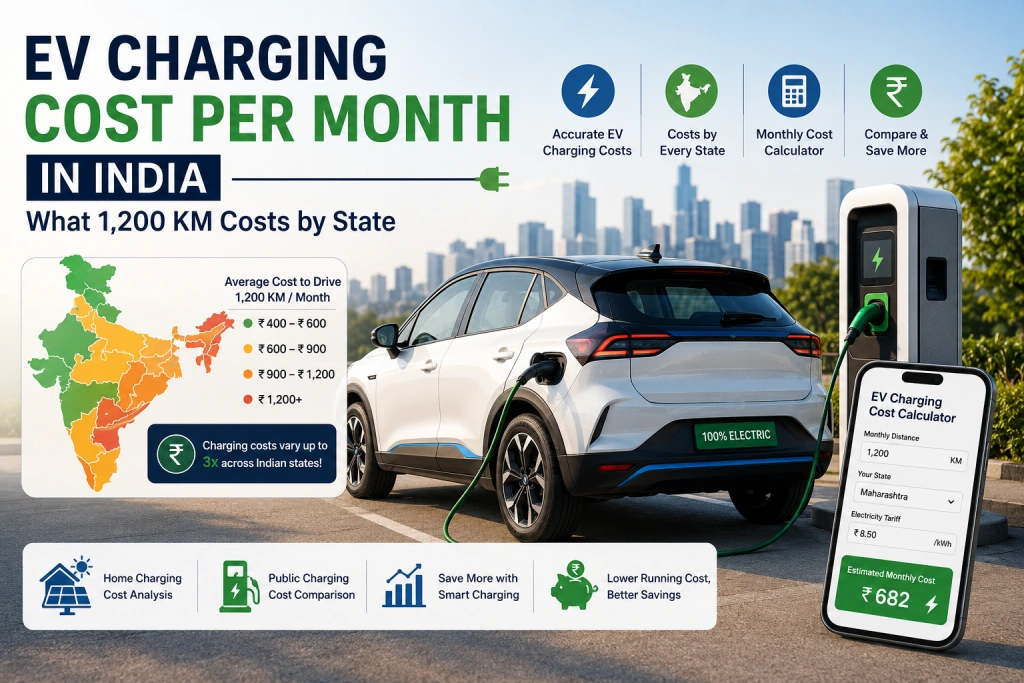
Data note: This article distinguishes notified EV charging tariffs from residential/home electricity tariffs. The state-wise comparison uses the Bureau of Energy Efficiency (BEE) India EV Digest tariff dataset referenced in the supplied brief. The BEE Digest reports state-specific EV tariff frameworks and separately discusses domestic, commercial and EV tariffs. For a genuinely current 2026 household-bill calculation, users should verify the applicable tariff order of their DISCOM and tariff category.
Quick answer: What does 1,200 km cost on an EV?
If an EV consumes 15 kWh per 100 km, driving 1,200 km requires 180 kWh of electricity before any separate charging-loss adjustment. At a purely illustrative electricity rate of ₹6/kWh, 180 kWh costs ₹1,080, or ₹0.90 per km. These are mathematical examples, not a claim that every EV or household uses 15 kWh/100 km or pays ₹6/kWh.
The important qualification is the tariff. A dedicated EV charging tariff is not automatically the same thing as the domestic tariff on a household electricity bill. BEE's India EV Digest separately examines domestic, commercial and EV tariffs, and notes that states use different tariff structures for EV charging.
Quick calculation
| Input | Example |
|---|---|
| Monthly driving | 1,200 km |
| EV consumption | 15 kWh/100 km |
| Electricity required | 180 kWh |
| Illustrative tariff | ₹6/kWh |
| Illustrative energy cost | ₹1,080 |
| Illustrative cost/km | ₹0.90 |
The 180-kWh figure follows directly from 1,200 × 15 ÷ 100. The ₹1,080 and ₹0.90/km figures are arithmetic based on the stated ₹6/kWh assumption.
What determines EV charging cost per month?
EV charging cost per month is the electricity expenditure associated with supplying the energy required for an EV's monthly driving. The basic calculation depends on distance driven, vehicle electricity consumption and the applicable electricity tariff. For home charging, the tariff category and household billing structure can materially affect the result.
A useful calculation starts with three questions:
- How far do you drive?
- How much electricity does your EV consume?
- What electricity tariff actually applies to the charging?
For a 1,200-km monthly driving pattern, a vehicle consuming 15 kWh/100 km needs 180 kWh before considering a separate charging-loss adjustment.
The tariff question is more complicated.
BEE reports that EV-specific tariffs vary between states and that states use different tariff designs. Some states use dedicated Public EV Charging Station categories, while others place EV charging under existing consumer categories. BEE also reports that some states use two-part tariffs containing demand and energy charges.
That means a state-wide “EV electricity price” should not automatically be interpreted as the price a residential EV owner will see on a home electricity bill.
How much electricity does an EV need for 1,200 km?
The electricity required for 1,200 km depends directly on the EV's consumption in kWh/100 km. The formula is monthly kilometres × electricity consumption ÷ 100. A vehicle consuming 12 kWh/100 km would require 144 kWh for 1,200 km, while one consuming 20 kWh/100 km would require 240 kWh.
1,200-km electricity scenarios
| EV consumption | Electricity required for 1,200 km |
|---|---|
| 12 kWh/100 km | 144 kWh |
| 14 kWh/100 km | 168 kWh |
| 15 kWh/100 km | 180 kWh |
| 16 kWh/100 km | 192 kWh |
| 18 kWh/100 km | 216 kWh |
| 20 kWh/100 km | 240 kWh |
These are calculation scenarios rather than manufacturer efficiency claims.
Why efficiency matters
At the same electricity tariff, a less electricity-efficient vehicle requires more purchased electricity for the same distance.
For example, the difference between 12 kWh/100 km and 20 kWh/100 km is:
- 144 kWh versus 240 kWh for 1,200 km.
- Difference: 96 kWh per month.
At an illustrative ₹6/kWh, that difference would mathematically equal ₹576 per month.
The ₹6/kWh figure is only a calculation assumption; the relevant real-world tariff must come from the user's applicable electricity tariff. The relationship between electricity consumption and monthly cost follows directly from the calculation method in the supplied brief.
State-wise notified EV charging tariffs
A state-wise EV tariff table is useful for comparing dedicated EV-charging electricity tariffs, but it should not be presented as a table of universal household charging costs. BEE's India EV Digest explicitly distinguishes EV tariffs from domestic and commercial tariffs, while the Ministry of Power has separately published state/UT information on tariffs applicable to Public EV Charging Stations.
The following comparison uses the BEE India EV Digest tariff dataset supplied in the original content brief. The calculation assumes 15 kWh/100 km and therefore 180 kWh/month. These are illustrative energy-cost calculations, not household electricity bills.
| State/UT | Notified EV tariff in supplied BEE dataset | 180 kWh illustrative energy cost |
|---|---|---|
| Andhra Pradesh | ₹6.70/kWh | ₹1,206 |
| Arunachal Pradesh | Not defined in cited table | — |
| Assam | ₹5.90–₹7.40/kWh | ₹1,062–₹1,332 |
| Bihar | ₹8.87/kWh LT | ₹1,597 |
| Chandigarh | ₹3.80/kWh LT | ₹684 |
| Chhattisgarh | ₹5.00/kWh | ₹900 |
| Delhi | ₹4.50/kWh LT | ₹810 |
| Goa | ₹4.70/kWh LT | ₹846 |
| Gujarat | ₹4.10/kWh LT | ₹738 |
| Haryana | ₹6.62/kWh LT | ₹1,192 |
| Himachal Pradesh | ₹5.82/kWh | ₹1,048 |
| Jammu & Kashmir | ₹5.10/kWh LT | ₹918 |
| Jharkhand | ₹5.80 rural / ₹6.15 urban | ₹1,044–₹1,107 |
| Karnataka | ₹5.00/kWh | ₹900 |
| Kerala | ₹5.50/kWh LT | ₹990 |
| Ladakh | ₹5.10/kWh LT | ₹918 |
| Lakshadweep | ₹7.80/kWh | ₹1,404 |
| Madhya Pradesh | ₹6.70/kWh LT | ₹1,206 |
| Maharashtra | ₹6.08/kWh LT | ₹1,094 |
| Manipur | Not defined in cited table | — |
| Meghalaya | ₹9.70/kWh LT | ₹1,746 |
| Mizoram | ₹8.20/kWh LT | ₹1,476 |
| Nagaland | Not defined in cited table | — |
| Odisha | ₹5.50/kWh | ₹990 |
| Puducherry | ₹5.53/kWh LT | ₹995 |
| Punjab | ₹6.00/kWh | ₹1,080 |
| Rajasthan | ₹6.00/kWh | ₹1,080 |
| Sikkim | ₹5.50/kWh | ₹990 |
| Tamil Nadu | ₹6–₹9/kWh | ₹1,080–₹1,620 |
| Telangana | ₹6.00/kWh LT | ₹1,080 |
| Tripura | ₹6.90/kWh | ₹1,242 |
| Uttar Pradesh | ₹6.20/kWh LT | ₹1,116 |
| Uttarakhand | ₹6.25/kWh | ₹1,125 |
| West Bengal | ₹6.00/kWh | ₹1,080 |
| Andaman & Nicobar Islands | ₹10.00/kWh | ₹1,800 |
| Dadra & Nagar Haveli / Daman & Diu | ₹5.10/kWh LT | ₹918 |
The state figures and corresponding 180-kWh calculations above reproduce the dataset supplied in the content brief.
Important source-date qualification: BEE's India EV Digest is a published reference document, not a live tariff database. BEE's current website continues to list the India EV Digest 2023 as a report, while the Ministry of Power has separately published a March 2025 state/UT table for Public EV Charging Station tariffs.
The Ministry of Power's March 2025 table, for example, lists LT Public EV Charging Station supply tariffs of ₹6.70/unit for Andhra Pradesh, ₹3.80 for Chandigarh, ₹4.50 for Delhi, ₹6.00 for Telangana and ₹6.00 for West Bengal.
Therefore, the table above should be treated as a notified-EV-tariff reference and not as a statement of current 2026 household electricity rates.
Why EV tariff and home electricity tariff are different
An EV charging tariff is a tariff category applicable to particular EV-charging arrangements; a domestic tariff is the tariff applicable to residential electricity consumption under the relevant state/DISCOM rules. The two should not be treated as interchangeable without checking the applicable tariff order. BEE's EV Digest specifically compares domestic, commercial and EV tariffs and reports substantial differences in tariff design across states.
A residential electricity bill can involve factors such as:
- consumption slabs;
- energy charges;
- fixed charges;
- tariff category;
- DISCOM;
- applicable subsidies or adjustments;
- regulatory changes.
The supplied brief identifies these factors as reasons a simple state-wide ₹/kWh assumption can produce a misleading home-charging estimate.
BEE also reports that EV tariff structures vary: some states use energy-only tariffs, while others use two-part structures containing demand and energy charges.
The better home-charging formula
For a simple calculator:
Monthly electricity required = monthly kilometres × EV consumption ÷ 100
Then:
Energy cost = electricity required × applicable marginal/applicable tariff
For a residential user, the crucial input is therefore the applicable household tariff, not automatically the state's dedicated EV charging tariff.
Tamil Nadu: home charging versus EV charging
Tamil Nadu provides a particularly clear example of why charging location and connection type matter. The Tamil Nadu Electric Vehicle Policy 2023 states that electricity for a private charging station at home is treated as domestic consumption and classified under LT Tariff I-A, while electricity supplied to Public/Private Charging Stations is classified separately under the relevant EV charging categories.
The policy states that, under the prevailing tariff framework referenced by the policy, the domestic tariff applies to a private charging station at home and is classified as LT Tariff I-A. It separately identifies LT Tariff VII and HT Tariff V for Public/Private Charging Stations and public battery-swapping stations depending on supply level.
The Tamil Nadu government currently maintains an official TNEV resource page listing the TN Electric Vehicle Policy 2023 among its EV policy documents.
What this means for a Chennai EV owner
A Chennai household should not simply take a published public EV tariff and multiply it by the car's monthly electricity consumption.
Instead, the calculation should identify the electricity arrangement being used:
- Existing household electricity connection.
- Separate EV charging connection, if applicable.
- Applicable domestic or EV tariff category.
- Household consumption and relevant tariff structure.
- Actual electricity consumed for charging.
The Ministry of Power's published EV-charging guidance similarly states that owners can use an existing electricity connection to charge an EV at home and that domestic electricity rates apply to charging EVs at home.
Delhi: why ₹8.50/kWh is not a universal home rate
Delhi's ₹8.50/kWh figure should not be used as a universal household EV-charging rate. The Ministry of Power's state-wise Public EV Charging Station table lists Delhi's EV supply tariff at ₹4.50/unit for LT and ₹4.00/unit for HT in the March 2025 government data. Residential electricity is a separate tariff matter.
Delhi's electricity tariffs are determined through DERC proceedings and tariff orders rather than a single state-wide household number. DERC's official records include FY 2025-26 tariff proceedings and orders for Delhi distribution licensees.
Therefore:
₹4.50/kWh EV supply tariff ≠ universal Delhi home-charging cost.
Likewise:
₹8.50/kWh ≠ a universal Delhi household charging tariff.
A calculator should instead use the applicable residential tariff structure for the user's connection.
Karnataka: why ₹7.80/kWh should not be treated as a generic home rate
The ₹7.80/kWh figure in the original content brief should not be presented as Karnataka's universal home-charging rate. The BEE EV Digest distinguishes domestic and EV tariff categories, while the government state-wise EV tariff material lists Karnataka's EV charging tariff separately.
The original brief specifically identifies ₹5/kWh as the BEE comparison figure for Karnataka's EV charging category and reports a separate domestic tariff range.
The lesson is broader than Karnataka:
An EV calculator should allow users to enter the tariff actually applicable to their charging connection instead of hard-coding one number for an entire state.
How to calculate your real EV charging cost
A practical EV charging calculator should ask for monthly distance, vehicle efficiency, charging source and the applicable electricity tariff. The calculator can then estimate electricity consumption, monthly energy cost, cost per kilometre, cost per 100 km and annual electricity expenditure.
Step 1: Enter monthly distance
Example:
1,200 km/month
Step 2: Enter EV efficiency
Example:
15 kWh/100 km
The calculator then calculates:
1,200 × 15 ÷ 100 = 180 kWh/month
This is arithmetic based on the user-selected inputs.
Step 3: Select charging source
The calculator should distinguish:
- Home charging
- Public charging
- Mixed charging
This matters because the applicable tariff and pricing structure can differ by charging arrangement. The Ministry of Power's guidance separately addresses residential charging and public charging arrangements.
Step 4: Enter the applicable tariff
For home charging, the best input is the user's actual applicable residential tariff or a verified state/DISCOM tariff lookup.
For a dedicated EV charging connection, the calculator should use the applicable EV tariff.
Step 5: Calculate energy cost
At an illustrative ₹6/kWh:
180 kWh × ₹6 = ₹1,080
That example does not include fixed charges, other bill components or a charging-loss adjustment.
Step 6: Calculate cost per kilometre
₹1,080 ÷ 1,200 km = ₹0.90/km
Again, ₹0.90/km is an illustrative result based on the stated assumptions.
Does charging loss affect EV cost?
Yes. The electricity drawn from the grid can differ from the energy ultimately stored in the vehicle battery. A consumer-facing calculator can therefore provide an optional charging-loss or charging-efficiency adjustment rather than assuming that battery energy and electricity purchased from the grid are identical.
For example, if a calculator deliberately uses a 10% loss assumption, grid electricity could be represented as:
Grid electricity = battery energy required ÷ 0.90
For 180 kWh of battery energy:
180 ÷ 0.90 = 200 kWh
At ₹6/kWh, that hypothetical 10%-loss scenario would be:
200 × ₹6 = ₹1,200
The 10% loss is a calculator assumption, not a universal claim about all EVs, chargers or charging conditions. The supplied brief specifically recommends presenting such an adjustment as an assumption.
EV charging cost versus petrol cost
Electricity cost alone is not the same as total vehicle ownership cost. A useful EV-versus-petrol comparison should first compare energy cost per kilometre and can then expand the calculation to other ownership expenses such as servicing, insurance, tyres, financing, depreciation and charging equipment.
For an EV:
Energy cost/km = electricity cost ÷ kilometres driven
For a petrol car:
Fuel cost/km = petrol price × fuel consumption per kilometre
A meaningful comparison therefore needs user-specific inputs rather than an unsupported universal “EVs cost X% less” claim.
A comprehensive calculator can compare:
| Cost component | EV | Petrol/diesel |
|---|---|---|
| Energy/fuel | Electricity | Petrol/diesel |
| Cost/km | Calculated from tariff and efficiency | Calculated from fuel price and efficiency |
| Routine servicing | User-specific | User-specific |
| Insurance | User-specific | User-specific |
| Tyres | User-specific | User-specific |
| Financing | User-specific | User-specific |
| Depreciation | User-specific | User-specific |
| Charging equipment | Potential EV cost | Not applicable in the same form |
The article should not assign generic rupee values to these additional ownership costs unless current, authoritative data is supplied.
Which state is cheapest for EV charging?
There is no single cheapest state if “charging cost” means a household's actual home electricity bill. Residential tariffs depend on the applicable consumer category, tariff structure and, where relevant, DISCOM and consumption slab. If the comparison instead means a notified EV charging tariff, the BEE and Ministry of Power datasets show substantial variation between states and UTs.
Within the BEE dataset reproduced in the supplied brief, examples include:
- Chandigarh: ₹3.80/kWh LT
- Gujarat: ₹4.10/kWh LT
- Delhi: ₹4.50/kWh LT
- Karnataka: ₹5.00/kWh
- West Bengal: ₹6.00/kWh
- Andaman & Nicobar Islands: ₹10.00/kWh
At 180 kWh/month, those mathematical examples become ₹684, ₹738, ₹810, ₹900, ₹1,080 and ₹1,800 respectively.
The Ministry of Power's March 2025 table independently lists Chandigarh at ₹3.80/unit LT, Gujarat is not included in that particular table, Delhi at ₹4.50/unit LT, Karnataka at ₹5.00/unit, Telangana at ₹6.00/unit and West Bengal at ₹6.00/unit.
These figures describe EV/public-charging electricity supply tariffs in the cited government datasets, not the total price necessarily paid by a household at home.
Frequently Asked Questions
How much does an EV cost to charge for 1,200 km?
An EV consuming 15 kWh/100 km requires 180 kWh for 1,200 km. At an illustrative ₹6/kWh, the mathematical energy cost is ₹1,080. The actual home-charging cost depends on the tariff applicable to the user's electricity connection and any relevant billing components.
How many electricity units does an EV need for 1,200 km?
At 15 kWh/100 km, an EV requires 180 kWh, or 180 electricity units, for 1,200 km before a separate charging-loss adjustment. At 12 kWh/100 km the requirement is 144 kWh, while at 20 kWh/100 km it is 240 kWh.
What is the EV charging cost per kilometre in India?
There is no single national ₹/km figure. The result depends on the vehicle's electricity consumption and the applicable electricity tariff. For example, 15 kWh/100 km at ₹6/kWh mathematically produces ₹0.90/km before other bill components or charging-loss adjustments.
Is the EV charging tariff the same as the home electricity tariff?
Not necessarily. BEE distinguishes domestic, commercial and EV tariffs, while government EV-charging guidance separately addresses residential charging. Users should identify the tariff category applicable to their charging arrangement.
Which state has the cheapest EV charging tariff?
The answer depends on the dataset and tariff category being compared. In the BEE dataset reproduced in the supplied brief, Chandigarh has an LT EV tariff of ₹3.80/kWh, while Gujarat is ₹4.10/kWh and Delhi ₹4.50/kWh. These are notified EV-tariff comparisons, not universal household rates.
What is the EV charging tariff in Tamil Nadu?
The supplied BEE-based dataset lists Tamil Nadu at ₹6–₹9/kWh for the comparison. However, Tamil Nadu's EV Policy 2023 states that a private charging station at home is subject to the domestic tariff and classified as LT Tariff I-A, while Public/Private Charging Stations are treated separately.
What is the EV charging tariff in Delhi?
The Ministry of Power's March 2025 state/UT table lists Delhi's Public EV Charging Station supply tariff at ₹4.50/unit for LT and ₹4.00/unit for HT. Those figures should not be interpreted as a universal residential electricity rate.
What is the EV charging tariff in Karnataka?
The BEE comparison referenced in the supplied brief lists Karnataka's EV charging category at ₹5/kWh. The brief also distinguishes this from domestic electricity tariffs, demonstrating why an EV tariff should not automatically be used as a household rate.
Does home EV charging use a separate tariff?
It depends on the charging arrangement and applicable rules. Ministry of Power guidance states that owners can use an existing residential connection for home charging and that domestic electricity rates apply. The same guidance also provides for separate metered connections with dedicated EV charging tariffs.
Does charging loss affect EV running cost?
It can. Electricity drawn from the grid and energy stored in the battery are not necessarily identical. A calculator can therefore include an optional charging-loss assumption. The percentage should be treated as a calculation assumption rather than a universal real-world value.
How do I calculate EV electricity cost per kilometre?
First calculate electricity required: monthly kilometres × EV consumption ÷ 100. Then multiply electricity consumption by the applicable tariff and divide the resulting cost by kilometres driven. For the illustrative 1,200-km, 15-kWh/100-km and ₹6/kWh example, the result is ₹0.90/km.
How much does an EV add to the monthly electricity bill?
There is no universal amount. The additional electricity requirement depends on driving distance and vehicle efficiency, while the resulting bill depends on the applicable household tariff structure. A 1,200-km/month driver using 15 kWh/100 km would require 180 kWh before charging-loss adjustment.
Is EV charging cheaper than petrol?
The answer depends on electricity tariff, EV efficiency, petrol price and petrol-car fuel efficiency. A reliable comparison should calculate energy/fuel cost per kilometre using the user's actual inputs rather than assuming a universal saving percentage.
Should I use the EV tariff or domestic tariff for home charging?
Use the tariff applicable to the actual residential charging arrangement. Government guidance states that domestic electricity rates apply to EV charging at home when using the residential arrangement, while separate dedicated EV connections can have dedicated EV charging tariffs.
Key takeaways
- 1,200 km at 15 kWh/100 km requires 180 kWh before a charging-loss adjustment.
- ₹6/kWh × 180 kWh = ₹1,080 is a mathematical example, not a universal Indian EV charging bill.
- A notified EV tariff should not automatically be treated as a household home-charging tariff. BEE distinguishes domestic, commercial and EV tariff categories.
- Residential electricity costs can depend on tariff category and billing structure.
- Tamil Nadu's EV Policy 2023 specifically states that private home charging is treated under domestic consumption/LT Tariff I-A.
- The Ministry of Power states that EV owners can charge at home using an existing connection and that domestic electricity rates apply.
- EV efficiency matters: at 1,200 km, 12 kWh/100 km requires 144 kWh while 20 kWh/100 km requires 240 kWh.
- A useful calculator should use the user's distance, efficiency, charging source and applicable tariff.
- Charging loss can be included as an optional calculator assumption rather than a universal percentage.
- State-wise EV tariff tables are useful for comparison, but they should not be presented as current universal household electricity rates.
Calculate your EV charging cost
Driving 1,200 km a month? Don't rely on a generic ₹/kWh number.
Enter:
- Monthly kilometres
- EV efficiency
- State/DISCOM
- Electricity tariff
- Charging type
- Optional charging-loss assumption
The calculator can return:
- Monthly electricity consumption
- Monthly energy cost
- Cost per kilometre
- Cost per 100 km
- Annual electricity expenditure
External authority references
Bureau of Energy Efficiency — India EV Digest
BEE's India EV Digest provides state-specific EV tariff analysis and discusses the distinction between domestic, commercial and EV tariff structures.
Ministry of Power — State-wise EV charging tariff information
The Ministry of Power's March 2025 Lok Sabha annexure provides state/UT-level electricity supply tariffs for Public EV Charging Stations.
Ministry of Power — State-wise EV charging tariff data
Ministry of Power — Residential EV charging guidance
The Ministry's EV charging guidance states that EV owners can use existing residential electricity connections and that domestic electricity rates apply to home charging.
Tamil Nadu Electric Vehicle Policy 2023
Tamil Nadu's policy specifies the tariff treatment for private home charging and distinguishes it from Public/Private Charging Station tariff categories.
Tamil Nadu Electric Vehicle Policy 2023
Delhi Electricity Regulatory Commission
DERC maintains the official repository of Delhi tariff proceedings and orders, including FY 2025-26 tariff matters.