EV Charging in Apartments: What Your Housing Society Can (and Can't) Block
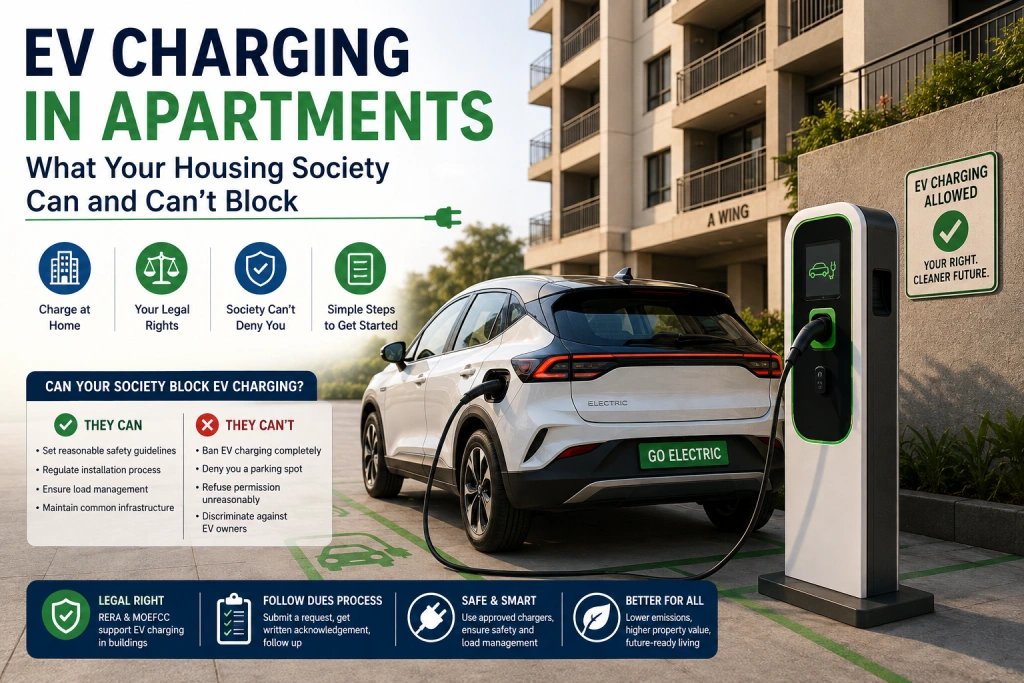
Buying an EV is one thing. Charging it every night when you live in an apartment is another.
For an independent house with a private driveway, home charging can be relatively straightforward. Apartment residents face a different problem: the parking space may be designated for one resident, while electrical panels, cable routes, basement areas and other infrastructure can involve the wider building.
That creates a common question:
Can a housing society simply say no to an EV charger in your apartment parking space?
The answer is more nuanced than either “the society can ban it” or “the resident has an absolute right to install anything.”
The Ministry of Power's Guidelines for Installation and Operation of Electric Vehicle Charging Infrastructure-2024 expressly cover EV charging infrastructure in private parking spaces and semi-restricted locations including Group Housing Societies. The guidelines also specifically address private charging points in designated parking spaces, residential electricity connections, increased sanctioned load and community charging. (Power Ministry of India)
So the practical question is not simply whether an RWA can “block EV charging.” It is whether the proposed charger can be installed safely, with an appropriate electricity and metering arrangement, in the resident's designated parking space, while complying with applicable requirements.
Important: This article explains the national EV-charging framework and practical implementation issues. It is not legal advice. State electricity regulations, DISCOM procedures, fire-safety requirements, building rules and registered apartment/society documents may also matter in a particular case.
Quick Answer: Can a Housing Society Stop You From Installing an EV Charger?
The Ministry of Power's 2024 guidelines expressly provide for private EV charging stations in residents' designated parking spaces within Group Housing Societies. The same framework also provides for electricity through the resident's meter or a separate sub-meter and addresses increased sanctioned load. That does not remove applicable electrical, safety, local or property-related requirements. (Power Ministry of India)
Calculate your apartment EV charging cost
Calculate NowWhat the national framework says
| Question | What the 2024 Ministry framework says |
|---|---|
| Does it cover Group Housing Societies? | Yes. (Power Ministry of India) |
| Can residents install private chargers in designated parking? | The guidelines expressly provide for private charging points in designated parking spaces. (Power Ministry of India) |
| Can existing electricity be used? | Yes, residential owners can use their existing electricity connection for EV charging. (Power Ministry of India) |
| Is a separate connection possible? | Yes, the residential provisions address a separate metered connection with a dedicated EV charging tariff. (Power Ministry of India) |
| What if sanctioned load is insufficient? | The owner is to apply to the distribution licensee for an increase in sanctioned load. (Power Ministry of India) |
| Can a society establish community charging? | Yes, in consultation with the distribution licensee. (Power Ministry of India) |
| Does common parking have an EV provision? | For common parking for at least 20 vehicles, the guidelines provide for a minimum 10% allocation for community EV chargers if feasible, in consultation with the distribution licensee. (Power Ministry of India) |
What Are the 2024 Ministry of Power EV Charging Guidelines?
The Guidelines for Installation and Operation of Electric Vehicle Charging Infrastructure-2024 are the Ministry of Power's national framework for EV-charging infrastructure. The guidelines were issued on 17 September 2024 and state that they supersede earlier versions. Their applicability expressly includes private parking spaces and semi-restricted locations such as Group Housing Societies. (Power Ministry of India)
The framework is important for apartment residents because it does not treat EV charging as exclusively a public-charging issue.
The applicability section expressly includes:
- private parking spaces;
- office buildings;
- educational institutions;
- hospitals;
- Group Housing Societies;
- e-bus depots;
- commercial complexes and other public locations; and
- highways and expressways. (Power Ministry of India)
That means an apartment EV charger falls within a national charging-infrastructure framework rather than existing entirely outside government guidance.
The Ministry's own 2024–25 annual report also identifies the 2024 guidelines as the framework issued on 17 September 2024 to facilitate development of EV charging infrastructure. (Power Ministry of India)
Can You Install an EV Charger in Your Designated Apartment Parking Space?
Yes, the 2024 Ministry framework specifically addresses private EV charging stations in a resident's designated/allotted parking space within a Group Housing Society. The framework provides that electricity for such private charging points is to be supplied through the resident's meter or a separate sub-meter, depending on the option exercised under the framework. (Power Ministry of India)
This is one of the most important provisions for apartment EV owners.
The Ministry's community-charging provisions state that a Group Housing Society shall allow the owner of a flat or house, or another eligible consumer, to install a private charging point in the person's dedicated/allotted vehicle parking slot. The same provision addresses electricity supply through the resident's meter or separate sub-meter. (Power Ministry of India)
That is materially different from saying:
“Every resident can put a charger anywhere they want.”
The provision is specifically connected to a dedicated/allotted parking slot.
Why the parking arrangement matters
Before planning installation, determine what your apartment documents actually say about the parking space.
Questions worth checking include:
- Is the space specifically allotted to your flat?
- Is it described as designated parking?
- Is it common parking?
- Does the apartment documentation identify exclusive use?
- Does the proposed cable route cross common areas?
- Does installation require access to common electrical infrastructure?
The national EV-charging guideline addresses the charging point. It does not, by itself, resolve every question about ownership, title, allotment or use of a particular piece of property.
Does the RWA Have an Absolute Right to Refuse an EV Charger?
The national 2024 EV-charging framework should not be interpreted as giving an RWA an unlimited right to reject a private charger simply because the building is an apartment. At the same time, the framework should not be interpreted as giving a resident permission to ignore electricity, safety, load, parking or applicable local requirements.
The distinction matters.
The Ministry expressly says that residents can install private charging stations in their designated parking spaces. (Power Ministry of India)
Therefore, a statement such as:
“EV chargers are completely prohibited in our society.”
should not automatically be treated as the complete answer to a resident's request.
However, an actual installation may involve matters outside the charger itself, including:
- electrical capacity;
- sanctioned load;
- meter arrangement;
- cable routing;
- access to common infrastructure;
- electrical safety;
- building or fire-safety requirements;
- parking arrangements; and
- applicable society documents or local requirements.
The Ministry's framework itself recognizes that additional sanctioned load may be necessary and provides mechanisms for residential and community charging arrangements. (Power Ministry of India)
The better way to frame the dispute
Instead of asking only:
“Can the society ban my charger?”
ask:
“What specific technical, electrical, property or regulatory reason prevents this proposed charger from being installed in my designated parking space?”
That question turns a vague disagreement into a set of issues that can be documented and addressed.
Can You Use Your Existing Electricity Connection for EV Charging?
Yes. The Ministry of Power's residential charging provisions expressly allow owners to use their existing electricity connection to charge an EV at home. The same framework also provides an option to request a separate metered connection with a dedicated EV charging tariff. (Power Ministry of India)
This gives apartment residents more than one possible electricity arrangement.
Option 1: Existing electricity connection
The resident can use the existing residential electricity connection for EV charging. The Ministry's annual report also explicitly states that owners can use their existing electricity connection to charge EVs at home. (Power Ministry of India)
Option 2: Separate metered connection
The residential provisions allow owners to request a separate metered connection from the distribution licensee with a dedicated EV charging tariff. (Power Ministry of India)
Which arrangement is appropriate depends on the property's electrical configuration, the applicable DISCOM process and the resident's circumstances.
What Happens If Your Apartment's Sanctioned Load Is Not Enough?
If an EV charging station requires more power than the existing sanctioned load, the Ministry's residential charging provision says the owner should apply to the distribution licensee for an increase in sanctioned load. (Power Ministry of India)
This is why “Can I install a 7 kW charger?” is not purely a charger-shopping question.
The relevant question is:
Can the property's existing electrical arrangement accommodate the proposed charging load?
The Ministry framework specifically recognizes increased-load requirements for residential charging. It separately states that where community charging requires more power than the current sanctioned load, the Group Housing Society applies to the distribution licensee for an increase. (Power Ministry of India)
Sanctioned load is not the same as battery capacity
These terms should not be confused.
- Battery capacity describes the energy storage capacity of an EV battery, generally expressed in kWh.
- Charger power describes the rate at which electrical power can be delivered, generally expressed in kW.
- Sanctioned load concerns the electrical load approved for the consumer's electricity connection.
A resident therefore should not choose a charger solely by looking at battery capacity.
Can You Get a Separate Electricity Connection for EV Charging?
Yes. The 2024 Ministry framework provides for a separate metered residential connection with a dedicated EV charging tariff. The Electricity (Rights of Consumers) Amendment Rules, 2024 also established maximum timelines for new connections or modification of existing connections after a complete application, subject to the conditions specified in the rules. (Power Ministry of India)
The 2024 amendment to the Electricity (Rights of Consumers) Rules says the State Commission is to specify a maximum period, after a complete application, of no more than:
- 3 days in metropolitan areas;
- 7 days in other municipal areas; and
- 15 days in rural areas.
The rules provide a maximum of 30 days for rural areas of states and Union Territories with hilly terrain, and up to 90 days where extension of distribution mains or commissioning of new substations is required. (Power Ministry of India)
These are not promises that every apartment EV installation will receive a connection within those periods. The timelines apply under the rules to a complete application and their stated conditions.
The Ministry reiterated these timelines in a March 2026 parliamentary answer. (Power Ministry of India)
Private EV Charger vs Community EV Charger
A private EV charger is intended for an individual resident's vehicle and is specifically addressed in the 2024 framework for designated/allotted parking. A community EV charging station is a society-level facility intended for multiple residents or other authorised users and involves Group Housing Society coordination with the distribution licensee. (Power Ministry of India)
| Issue | Private charger | Community charger |
|---|---|---|
| Primary user | Individual resident | Multiple residents/authorised users |
| Typical location | Resident's designated/allotted parking | Society/common charging area |
| Electricity | Existing meter or separate sub-meter arrangement | Society/community electricity arrangement |
| Society involvement | Installation coordination may involve society infrastructure | Greater society-level coordination |
| Load | Resident applies for increased sanctioned load where necessary | GHS applies where community charging requires increased load |
| Charging charges | Resident's electricity consumption | GHS charging arrangement |
| Visitor charging | Not the defining purpose | Community station may accommodate authorised visitors |
The distinction comes directly from the Ministry's residential and Group Housing Society provisions. (Power Ministry of India)
Can a Housing Society Set Up Community EV Charging?
Yes. The Ministry's framework provides that Group Housing Societies can establish EV charging stations within their premises in consultation with the distribution licensee. Residents can decide the types and number of community chargers, and community charging stations may include provision for authorised visitor vehicles. (Power Ministry of India)
Community charging can be useful where individual parking spaces are difficult to wire or where several residents need access to charging.
The framework also addresses the electricity arrangements and sanctioned-load requirements for community charging. (Power Ministry of India)
The important point is that community charging is not the same thing as an individual resident's private charger.
A society deciding whether to develop common charging infrastructure therefore faces additional questions around:
- charger selection;
- electrical capacity;
- common-area infrastructure;
- electricity supply;
- charging fees;
- user access; and
- coordination with the distribution licensee.
What Does the 10% Common-Parking EV Provision Mean?
The 2024 framework states that a Group Housing Society, other residential property or other entity having common parking for at least 20 vehicles shall set aside a minimum 10% of its total common parking capacity, if feasible, for community EV chargers in consultation with the distribution licensee. (Power Ministry of India)
The phrase “if feasible” is critical.
It would be inaccurate to rewrite the provision as:
“Every apartment society must reserve 10% of its parking for EV chargers.”
The actual framework includes:
- common parking;
- at least 20 vehicles;
- a minimum 10% provision;
- an “if feasible” qualification; and
- consultation with the distribution licensee. (Power Ministry of India)
That makes the provision particularly relevant for large apartment complexes, but it should not be presented as an unconditional one-size-fits-all parking mandate.
What Can a Society Reasonably Require Before Installation?
A society may need to address practical installation issues when an EV charger uses common infrastructure or affects shared property. These can include cable routing, electrical safety, access to electrical infrastructure, load assessment and restoration of affected common areas. The precise legal status of each requirement depends on the applicable rules and society documents.
The Ministry framework establishes the charging infrastructure framework, but it does not provide a single nationwide checklist saying that every society must demand exactly the same documents from every resident.
That distinction is important.
Practical issues to resolve
1. Parking
Confirm the exact designated or allotted parking space.
2. Charger specification
Provide the proposed charger's technical specifications rather than simply saying “I want an EV charger.”
3. Electrical load
Check whether the existing sanctioned load is sufficient. The Ministry expressly addresses increased sanctioned load where required. (Power Ministry of India)
4. Metering
Clarify whether the charger will use:
- the resident's existing meter;
- a separate sub-meter; or
- another applicable electricity arrangement.
The Ministry framework expressly addresses the existing-meter/sub-meter options for private charging in GHS parking. (Power Ministry of India)
5. Cable route
Document where the cable will run and whether common property is involved.
6. Electrical safety
The installation should be assessed against applicable electrical and safety requirements rather than assuming that any cable-and-plug arrangement is acceptable.
7. Local requirements
Check applicable building, fire-safety, municipal and electricity requirements where relevant.
The national Ministry framework should therefore be treated as the starting regulatory framework, not as a substitute for every state and local rule.
What If Your Society Says “EV Chargers Are Not Allowed”?
If your RWA or society management rejects the request, avoid turning the first response into a confrontation.
Instead, create a written record.
Step 1: Ask for the refusal in writing
Ask the society to state exactly why the proposed charger cannot be installed.
A verbal “no” does not tell you whether the problem is:
- parking;
- electrical load;
- cable routing;
- safety;
- common-property access;
- a society rule; or
- something else.
Step 2: Ask which rule or bylaw is being relied upon
Ask for the specific provision in the registered society/apartment rules or other applicable document.
Do not assume that every statement made by a committee member represents a legally binding rule.
Step 3: Submit the charger specifications
Provide:
- charger model;
- rated power;
- electrical requirements;
- proposed installation location;
- proposed cable route;
- meter arrangement; and
- installer information where relevant.
This makes the request technically reviewable.
Step 4: Clarify the parking status
Identify whether the parking is:
- designated;
- allotted;
- common;
- shared; or
- governed by another arrangement.
The Ministry's private-charging provision specifically refers to designated/allotted parking spaces. (Power Ministry of India)
Step 5: Check sanctioned load
If the proposed charging requirement exceeds the current sanctioned load, the Ministry framework directs the owner toward an application to the distribution licensee for increased sanctioned load. (Power Ministry of India)
Step 6: Clarify electricity metering
Determine whether the proposal will use the existing meter or another permitted metering arrangement.
The 2024 framework expressly addresses existing residential connections and separate metered connections. (Power Ministry of India)
Step 7: Address safety and cable routing
If the society's objection concerns common-area wiring or safety, ask for the specific technical issue and address it through an appropriate installation plan.
Step 8: Consult the DISCOM where necessary
Where the issue concerns:
- sanctioned load;
- electricity connection;
- metering;
- connection modification; or
- electricity supply,
the distribution licensee becomes an important part of the process. The Ministry framework repeatedly assigns electricity-supply and load-related functions to the distribution licensee. (Power Ministry of India)
Step 9: Check state and local requirements
If a genuine dispute remains, identify the applicable state electricity regulations, society framework and local requirements before deciding on further escalation.
Do not assume that the national guideline alone determines the outcome of every apartment dispute.
How Much Does EV Charging in an Apartment Cost?
There is no single India-wide apartment EV charging cost that can accurately be applied to every resident. The electricity cost depends on the electricity consumed and the applicable tariff, while installation cost depends on the specific electrical and physical installation.
For a transparent calculation, use:
Charging cost
Charging cost = Electricity consumed (kWh) × Applicable electricity tariff (₹/kWh)
For example, if a calculation uses 30 kWh of electricity and the user's applicable tariff is ₹8/kWh, the electricity component would be:
30 × ₹8 = ₹240
That is a mathematical example, not a claim that ₹8/kWh is India's apartment electricity tariff.
The actual tariff should come from the applicable electricity provider/tariff order.
Why a generic “India EV charging price” is misleading
Residential electricity tariffs can differ according to:
- state;
- distribution licensee;
- consumer category;
- consumption structure; and
- applicable tariff order.
Therefore, an apartment EV charging calculator should allow the user to enter the actual applicable tariff instead of forcing every user into a national average.
Apartment EV Charging Calculator: What Should You Enter?
A useful calculator should not hide its assumptions.
Recommended inputs
- Battery capacity
- Current battery state of charge
- Target state of charge
- Charger power
- Electricity tariff
- Charging-efficiency/loss assumption
- Charging sessions per month
- Average kilometres driven per month
- Vehicle energy efficiency, where available
Recommended outputs
- Energy added per session
- Estimated electricity consumption
- Estimated cost per session
- Estimated monthly charging cost
- Estimated annual charging cost
- Estimated charging time
- Estimated electricity cost per kilometre
Energy Required
If the calculator uses a charging-efficiency input:
Charging electricity required = Energy added to battery ÷ Charging efficiency
The efficiency value should be an explicit calculator input or clearly identified assumption.
The calculator should not silently insert a universal charging-efficiency percentage and present the result as an exact measurement.
Charging Time
For a simplified estimate:
Charging time ≈ Energy to be added ÷ Charger power
For example, if a calculation assumes 20 kWh of energy needs to be added and a charger operates at 5 kW, the simplified estimate is:
20 ÷ 5 = 4 hours
This is an estimate, not a guarantee of actual vehicle charging time.
Actual charging behaviour can depend on the vehicle, charger, battery state and charging characteristics.
Common EV Charging Mistakes Apartment Owners Make
1. Assuming parking automatically means electrical access
A designated parking space and the building's electrical infrastructure are not necessarily the same property or system.
The Ministry framework specifically connects private charging to designated/allotted parking, while electricity supply is handled through the applicable meter/DISCOM arrangements. (Power Ministry of India)
2. Installing the charger before checking sanctioned load
The Ministry framework explicitly addresses increased sanctioned load where residential EV charging requires more power than the existing sanctioned load. (Power Ministry of India)
3. Treating every charger as identical
Charger power is expressed in kW, while battery capacity is expressed in kWh.
A charger with a higher rated power can have different electrical requirements from a lower-powered charger.
4. Ignoring cable routing
A charger located in a parking bay may still require wiring to travel through other areas of the building.
That makes cable routing a practical issue even where the parking itself is designated.
5. Using public-charging prices to estimate home charging
A home-charging calculation should use the applicable electricity tariff and actual consumption.
Public charging fees and residential electricity costs are different calculation inputs.
6. Assuming the national guideline overrides every local rule
The Ministry framework provides the national charging-infrastructure framework, but a real installation can also involve state electricity regulations, DISCOM procedures, building requirements, fire-safety requirements and society documents.
The article should therefore never tell readers:
“The Ministry guideline means your society's rules no longer matter.”
That is too broad.
7. Treating a verbal refusal as the final answer
If the society says no, request the reason in writing.
A written response makes it easier to identify whether the actual issue is:
- technical;
- electrical;
- property-related;
- safety-related; or
- based on a society rule.
What Should Housing Societies Do as EV Ownership Grows?
A society with multiple EV owners may eventually need more than one ad-hoc charger installation.
The Ministry framework specifically allows Group Housing Societies to establish community EV charging stations in consultation with the distribution licensee and allows residents to determine the types and number of community chargers under the framework. (Power Ministry of India)
A practical society-level policy can therefore address:
- Private charger applications
- Designated parking verification
- Electrical-load assessment
- Cable routing
- Metering
- Safety
- Community charging
- Visitor charging
- Charging fees
- Future charging demand
The 2024 framework also provides for community charging in common parking and includes the 10% provision where the specified conditions and feasibility requirement apply. (Power Ministry of India)
Why Apartment Charging Is Becoming a Bigger Infrastructure Question
NITI Aayog's EV-charging infrastructure planning material identifies apartment buildings and private/semi-public parking areas as locations relevant to private and semi-public EV charging. (NITI Aayog)
That is important because apartment charging is not merely a consumer convenience issue.
It is also an infrastructure-planning issue involving:
- parking;
- electrical capacity;
- charging locations;
- metering;
- distribution infrastructure; and
- management of shared facilities.
The Ministry's 2024 framework similarly distinguishes private, semi-restricted and public charging locations. (Power Ministry of India)
Frequently Asked Questions
Can a housing society stop you from installing an EV charger?
The Ministry of Power's 2024 framework expressly provides for residents to install private EV charging stations in their designated/allotted parking spaces within Group Housing Societies. However, installation remains subject to applicable electricity, sanctioned-load, safety, parking and other relevant requirements. (Power Ministry of India)
Can I install an EV charger in my designated apartment parking?
The 2024 Ministry framework expressly addresses private EV charging points in a resident's dedicated/allotted vehicle parking slot within a Group Housing Society. Electricity supply can be provided through the resident's meter or a separate sub-meter according to the framework. (Power Ministry of India)
Can I use my existing electricity meter for EV charging?
Yes. The Ministry's residential charging provision allows owners to use their existing electricity connection to charge an EV at home. The framework also provides for a separate metered connection with a dedicated EV charging tariff. (Power Ministry of India)
Can I get a separate electricity connection for EV charging?
Yes. The residential provisions of the 2024 Ministry framework allow an owner to request a separate metered connection with a dedicated EV charging tariff from the distribution licensee. (Power Ministry of India)
What happens if my sanctioned load is insufficient?
If the EV charging station requires more power than the current sanctioned load, the Ministry's residential provision says the owner should apply to the distribution licensee for an increase in sanctioned load. (Power Ministry of India)
Does an apartment society have to provide a community EV charger?
The national framework provides that Group Housing Societies may establish community EV charging stations in consultation with the distribution licensee. The framework does not support the blanket statement that every apartment complex must provide one community charger for every apartment. (Power Ministry of India)
What does the 10% common-parking EV provision mean?
For a Group Housing Society or other entity with common parking for at least 20 vehicles, the 2024 framework provides for a minimum 10% of total common parking capacity to be set aside for community EV chargers if feasible, in consultation with the distribution licensee. (Power Ministry of India)
Can community EV chargers be used by visitors?
The Ministry framework says community EV charging stations at GHS premises may have a provision for charging authorised visitor vehicles. (Power Ministry of India)
Who pays for electricity used by a private EV charger?
For a private charging point, electricity is supplied through the applicable resident meter or separate sub-meter arrangement under the framework. The actual billing arrangement depends on the electricity connection and applicable tariff structure. (Power Ministry of India)
Does the Ministry guideline mean RWA permission is never required?
No such blanket conclusion should be drawn. The national framework expressly addresses private charging in designated parking, but an installation may also involve society/common infrastructure, parking arrangements, electricity supply, safety and applicable local requirements. The precise approval process should therefore be checked against the relevant society documents and local framework. (Power Ministry of India)
How do I calculate apartment EV charging cost?
Use the basic formula electricity consumed × applicable electricity tariff. For a more useful estimate, calculate the energy added to the battery, account for the calculator's stated efficiency assumption, and multiply the resulting electricity consumption by the user's actual applicable tariff.
How long will an EV take to charge at home?
A simplified estimate is energy to be added ÷ charger power. Actual charging time can differ from the simplified calculation because vehicle and charger characteristics and charging behaviour can affect the charging process.
What should I do if my society refuses my EV charger request?
Ask for the refusal in writing, request the specific rule or reason relied upon, provide the charger and installation details, clarify the parking arrangement, check sanctioned load and metering, and consult the distribution licensee where the issue concerns electricity supply or load. If a dispute remains, check the applicable state and local mechanisms rather than assuming the national guideline alone determines the outcome.
Key Takeaways
- The Ministry of Power's 2024 EV-charging guidelines expressly apply to private parking spaces and Group Housing Societies. (Power Ministry of India)
- The framework expressly addresses private EV charging points in designated/allotted parking spaces. (Power Ministry of India)
- Residential owners can use an existing electricity connection for EV charging. (Power Ministry of India)
- A separate metered residential connection with a dedicated EV charging tariff is also provided for. (Power Ministry of India)
- Additional sanctioned load must be addressed where the existing load is insufficient. (Power Ministry of India)
- Community charging is different from an individual private charger. (Power Ministry of India)
- Group Housing Societies can establish community charging stations in consultation with the distribution licensee. (Power Ministry of India)
- The common-parking provision refers to at least 20 vehicles and a minimum 10% allocation where feasible. (Power Ministry of India)
- The 10% provision should not be presented as an unconditional requirement for every apartment complex. (Power Ministry of India)
- A national EV-charging guideline does not eliminate the need to consider applicable electricity, safety, building, fire, local and society requirements.
- Charging cost should be calculated using the user's applicable electricity tariff rather than an unsupported national average.
Bottom Line: Can Your Housing Society Block Your EV Charger?
The strongest answer is not “No, an RWA can never stop you.”
That would go beyond what the national framework establishes.
The equally broad statement — “Yes, the society can ban any charger it wants” — is also not an accurate description of the 2024 Ministry framework.
The Ministry of Power expressly provides for private EV charging stations in residents' designated/allotted parking spaces within Group Housing Societies. The framework also addresses existing electricity connections, separate metered connections, sanctioned-load increases and community charging. (Power Ministry of India)
The practical test is therefore:
Can the proposed charger be installed safely and with an appropriate electricity and metering arrangement in the resident's designated parking space while complying with applicable requirements?
If the answer is yes, a resident has a substantially clearer basis for requesting installation than simply arguing that “EV charging is a right.”
If the society objects, ask for the objection in writing, identify the specific technical, property, safety or regulatory issue, and address that issue one by one.
And before estimating what the charger will cost you every month, use your actual electricity tariff, expected energy consumption and charging pattern rather than relying on a generic “₹X per km” claim.
Calculate Your Apartment EV Charging Cost
If you already know your:
- battery capacity,
- current state of charge,
- target state of charge,
- charger power,
- electricity tariff and
- expected monthly charging sessions,
Check your charger power, charging time and electricity consumption
Calculate NowExternal Authority References
1. Ministry of Power — Guidelines for Installation and Operation of Electric Vehicle Charging Infrastructure-2024
This should be the primary regulatory source for the article. It covers private parking, Group Housing Societies, residential charging, sanctioned load, private charging points and community charging. (Power Ministry of India)
Ministry of Power — EV Charging Infrastructure Guidelines 2024
2. Ministry of Power — Electricity (Rights of Consumers) Amendment Rules, 2024
Relevant to electricity-connection timelines and consumer electricity rights. (Power Ministry of India)
Electricity (Rights of Consumers) Amendment Rules, 2024
3. NITI Aayog — EV Charging Infrastructure Planning
Useful supporting source for the role of apartment buildings and private/semi-public parking in EV charging infrastructure planning. (NITI Aayog)
NITI Aayog — EV Charging Infrastructure Planning
4. Ministry of Power — Annual Report 2024–25
Useful government confirmation of the 17 September 2024 guidelines and their broader charging-infrastructure provisions. (Power Ministry of India)
Ministry of Power Annual Report 2024–25
Source-integrity note on the Deloitte statistic
I have not used the supplied brief's “70% / 41%” Deloitte 2025 figures as a factual claim in the finished article, because I could not independently verify that exact India denominator/wording from the primary 2025 Deloitte material retrieved during this research.
The available 2025 Deloitte study source retrieved here does establish India-specific charging concerns and identifies a sample of 882 Indian respondents for the cited question, but it does not substantiate the exact “70% / 41%” formulation supplied in the prompt. (Future Mobility Board)
That is deliberate: for a 100%-data-backed article, an attractive statistic should be omitted rather than published when its exact denominator cannot be independently verified.
This also means the article above is safer to publish from a source-integrity perspective than simply reproducing every numerical claim in the original brief.