How to Charge Your EV During Solar Hours — and Calculate Your Annual Savings
Quick Answer
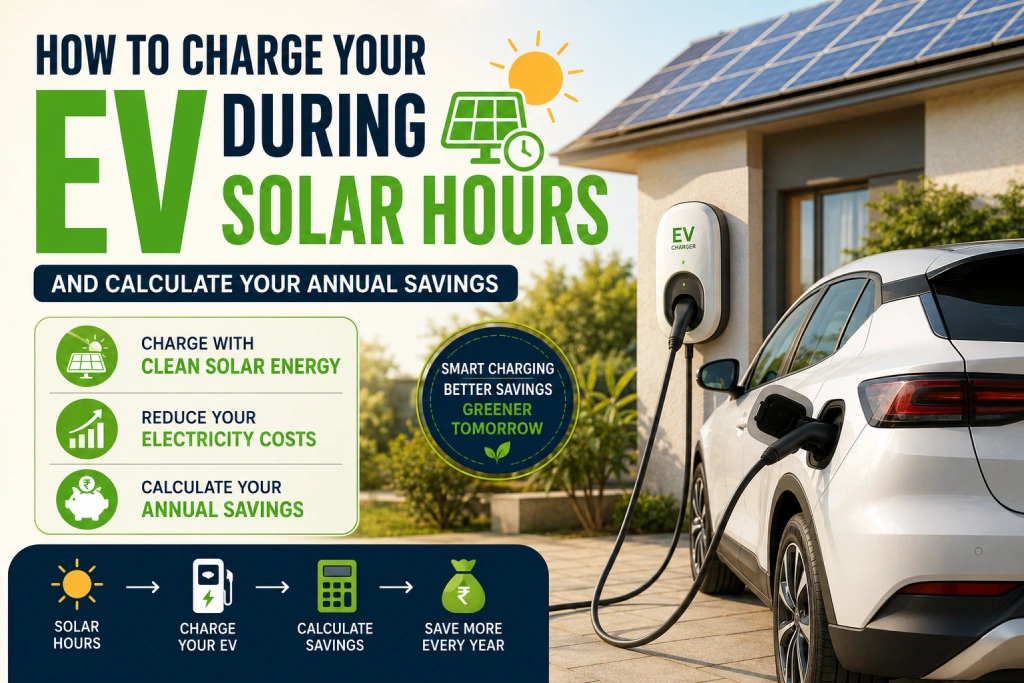
EV charging during solar hours means charging during the 9 AM–4 PM solar-hour window specified in India's 2024 EV charging infrastructure guidelines. For EV charging stations, the Ministry of Power's framework provides for electricity supply at 0.7× Average Cost of Supply (ACoS) during solar hours and 1.3× ACoS during non-solar hours, subject to the applicable tariff framework. The provision should not be interpreted as an automatic 30% discount on every household electricity bill.
For a home EV owner, the actual saving depends on the electricity connection and tariff that applies to the charging arrangement. The Ministry states that residential owners may use an existing electricity connection for EV charging or opt for a separate metered connection with a dedicated EV charging tariff.
| Question | Short answer |
|---|---|
| What are India's EV solar hours? | 9 AM–4 PM under the 2024 EV charging framework. |
| What does 0.7× ACoS mean? | Electricity supplied to applicable EV charging stations during solar hours is priced at 70% of ACoS under the central framework. |
| What is the non-solar multiplier? | 1.3× ACoS under the same framework. |
| Does every home automatically receive a 30% discount? | No. Residential charging arrangements and applicable tariffs must be considered separately. |
| Is solar-hour charging the same as rooftop-solar charging? | No. Solar-hour charging concerns the applicable charging-tariff window; rooftop solar concerns electricity generated by a PV system. |
| Is ₹40,000 annual saving guaranteed? | No. ₹40,000 is best treated as a calculator-generated scenario rather than a universal saving. |
Use the Solar + EV Calculator: enter your actual kilometres, EV efficiency, applicable tariff and solar contribution instead of assuming a fixed saving.
What Are India's EV Solar Charging Hours?
Solar hours for EV charging are the 9 AM–4 PM period identified in the Ministry of Power's 2024 EV charging framework. The framework uses this period for a lower electricity-supply tariff for applicable EV charging stations, with the stated objective of encouraging EV charging during solar hours.
The Ministry of Power issued the Guidelines for Installation and Operation of Electric Vehicle Charging Infrastructure-2024 on 17 September 2024. The guidelines replaced earlier versions and apply to EV charging infrastructure in private, semi-restricted and public locations, as well as relevant power utilities and government agencies.
The important point for EV owners is that "solar hours" describes a tariff/incentive period; it does not mean that every EV automatically receives electricity directly from a solar panel between those hours.
There are two separate ideas:
1. Grid electricity during applicable solar hours
An EV charging station covered by the applicable tariff framework can receive electricity at the solar-hour rate specified by the guidelines. The central framework states that the Distribution Licensee will charge 0.7× ACoS from 9 AM to 4 PM and 1.3× ACoS during the remaining hours.
2. Electricity from rooftop solar
A homeowner with rooftop photovoltaic generation can use generated electricity for EV charging, depending on the home's solar system, charging setup, metering arrangement and applicable state rules.
That is a different economic mechanism from the 0.7× ACoS tariff.
Therefore, an EV owner should not put "solar-hour tariff" and "rooftop solar" into the same calculation without first identifying which electricity source is actually supplying the vehicle.
What Does 0.7× ACoS Actually Mean?
ACoS means Average Cost of Supply. A 0.7× ACoS tariff means 70% of the applicable Average Cost of Supply, while 1.3× ACoS means 130% of ACoS. The Ministry's 2024 framework specifies these multipliers for electricity supplied to EV charging stations, with 9 AM–4 PM designated as solar hours.
The tariff provision is stated as follows in the Ministry's 2024 framework:
- EV charging-station electricity supply is a single-part tariff.
- The tariff is not to exceed ACoS under the specified framework through 31 March 2028.
- The Distribution Licensee charges 0.7× ACoS during solar hours.
- The Distribution Licensee charges 1.3× ACoS during non-solar hours.
- EV charging stations require separate metering arrangements for accurate consumption and tariff application.
The mathematics is straightforward
If:
ACoS = ₹10/kWh
then:
0.7 × ₹10 = ₹7/kWh
and:
1.3 × ₹10 = ₹13/kWh
The ₹10/kWh figure in this example is not an Indian national tariff. It is an illustrative calculator input.
The mathematical difference between ₹10 and ₹7 is ₹3/kWh, or 30% of the hypothetical ₹10 ACoS.
However, that arithmetic does not mean that every household EV owner automatically pays 30% less for every unit of electricity.
The underlying tariff provision is specifically framed around EV charging stations, while the Ministry separately addresses residential EV charging arrangements.
Does the 0.7× ACoS Rule Apply to Home EV Charging?
Not as a blanket 30% household-electricity discount. Residential EV charging has separate provisions. The Ministry states that residential owners may use their existing electricity connections for EV charging or opt for a separate metered connection from the Distribution Licensee with a dedicated EV charging tariff.
This distinction is essential.
Public EV charging stations
The 2024 guidelines establish the 0.7× ACoS and 1.3× ACoS structure for electricity supplied to EV charging stations. The charging station must have separate metering arrangements so consumption can be recorded and the applicable tariff applied.
Residential EV charging
The Ministry states that residential owners may use:
- an existing electricity connection; or
- a separate metered connection with a dedicated EV charging tariff.
The Ministry's annual report similarly states that building/office owners can request a separate metered connection with a dedicated EV charging tariff, while existing electricity connections can also be used for charging EVs at workplaces or homes. It separately states that domestic electricity rates apply to EV charging at home.
Community charging
The framework also addresses community charging. Residents in group housing societies and other eligible residential arrangements can have private charging points in designated parking spaces, while community charging tariffs are subject to the applicable Distribution Licensee provisions.
Why this distinction matters
Suppose a homeowner sees the statement:
"EV charging costs 0.7× ACoS during solar hours."
The homeowner should not immediately calculate:
"Therefore, my household electricity bill will fall by 30% if I charge my car from 9 AM to 4 PM."
That conclusion does not follow automatically from the government provision.
The correct approach is:
- Identify the electricity connection being used.
- Identify the applicable tariff category.
- Determine whether the EV charging tariff framework applies.
- Determine the applicable solar-hour rate.
- Calculate the proportion of charging that can actually occur in the relevant period.
- Compare the resulting cost with the alternative charging period.
Solar-Hour Grid Charging vs Rooftop Solar
Solar-hour grid charging and rooftop-solar EV charging are different cost mechanisms. Solar-hour grid charging can reduce the electricity-supply tariff where the applicable EV tariff provides a lower solar-hour rate. Rooftop solar can reduce the amount of grid electricity purchased by using electricity generated by the PV system.
| Charging method | Primary mechanism | Main question for the calculator |
|---|---|---|
| Grid charging during applicable solar hours | Lower applicable tariff | What tariff applies during the charging window? |
| Grid charging outside solar hours | Applicable non-solar tariff | What is the alternative tariff? |
| Rooftop-solar charging | Use of generated PV electricity | How much solar electricity is actually available for EV charging? |
| Scheduled charging | Move charging to a preferred period | Can the EV/charger schedule charging? |
| Solar + scheduled charging | Align charging with PV generation | How much EV consumption can coincide with solar generation? |
Rooftop solar does not automatically equal zero charging cost
A rooftop solar system has a generation profile, and the amount of electricity available for EV charging depends on the actual system and operating conditions.
Therefore, a calculator should not simply enter:
"Rooftop solar = 100% free EV charging."
Instead, it should ask how much of the EV's charging energy is expected to come from the rooftop solar system.
For example, if a calculator user chooses:
Rooftop solar contribution = 40%
that should be treated as a user-entered assumption, not a claim that a typical Indian rooftop solar system will supply 40% of EV energy.
How Much Can You Actually Save?
There is no single annual EV solar-hour saving that applies to every Indian EV owner. Savings depend on annual kilometres, vehicle energy consumption, the applicable electricity tariff, the proportion of charging shifted into the relevant period and, where applicable, rooftop-solar contribution.
The most useful approach is therefore a calculator rather than a universal savings claim.
Step 1: Calculate annual driving
If monthly driving is:
1,500 km/month
then annual driving is:
1,500 × 12 = 18,000 km/year
This is a derived calculation, not an external statistic.
Step 2: Calculate electricity consumption
If the user enters an EV efficiency of:
15 kWh/100 km
then:
18,000 × 15 ÷ 100 = 2,700 kWh/year
Again, 15 kWh/100 km is an illustrative calculator input, not a claim about all EVs.
Step 3: Calculate charging cost
If the applicable electricity cost entered by the user is:
₹8/kWh
then:
2,700 × ₹8 = ₹21,600/year
This is a derived calculation based entirely on the illustrative inputs.
Step 4: Model solar-hour charging
If the calculator assumes that 60% of charging energy is supplied under a lower applicable solar-hour tariff, the calculator should separately calculate:
- energy charged during the solar-hour period;
- energy charged outside that period;
- applicable tariff for each period;
- total annual charging cost.
The calculation should not assume that 60% solar-hour charging is achievable for every EV owner.
Can EV Charging Really Save ₹40,000 a Year?
₹40,000 per year can be reached mathematically under a sufficiently high annual energy requirement and a sufficiently large tariff difference, but the Ministry's EV charging guidelines do not establish ₹40,000 as a typical or guaranteed annual saving for EV owners.
The ₹40,000 figure should therefore be presented as a calculator scenario.
Illustrative ₹40,000 calculation
Assume:
- Hypothetical ACoS: ₹10/kWh
- Solar-hour tariff: 0.7× ACoS
- Difference: 30%
- Hypothetical saving: ₹3/kWh
The ₹10/kWh figure is an illustrative assumption.
The ₹3/kWh result is derived arithmetic:
₹10 × 30% = ₹3/kWh
To obtain ₹40,000 of annual savings:
₹40,000 ÷ ₹3 = 13,333.33 kWh/year
Now assume an illustrative EV consumption of:
15 kWh/100 km
Required annual driving becomes:
13,333.33 ÷ 15 × 100 = approximately 88,889 km/year
Monthly driving becomes:
88,889 ÷ 12 = approximately 7,407 km/month
These figures are derived from the stated assumptions. They are not national driving averages, nor are they claims about a particular EV.
What does the example demonstrate?
It demonstrates why the ₹40,000 headline should not be interpreted as:
"Every EV owner can save ₹40,000 simply by charging between 9 AM and 4 PM."
The actual result depends heavily on:
- annual kilometres;
- EV efficiency;
- applicable ACoS;
- applicable EV charging tariff;
- percentage of charging shifted to the relevant tariff period;
- rooftop-solar contribution, if any.
The Ministry establishes the 0.7×/1.3× framework; it does not establish a universal ₹40,000 annual saving.
Solar + EV Charging Calculator
The EVCalculator.in Solar + EV Calculator should be designed around the user's actual inputs rather than a single national tariff assumption.
Recommended inputs
| Input | Unit | Treatment |
|---|---|---|
| Monthly driving | km/month | User input |
| EV efficiency | kWh/100 km | User input / verified vehicle data |
| Electricity tariff | ₹/kWh | User/DISCOM input |
| Solar-hour charging share | % | User assumption |
| Rooftop-solar contribution | % | User assumption |
| Charging losses | % | User assumption |
| Applicable EV tariff multiplier | × ACoS | Applicable tariff framework |
Recommended outputs
Annual kilometres
Monthly kilometres × 12
Annual electricity requirement
Annual kilometres × EV efficiency ÷ 100
Annual charging cost
Annual electricity requirement × applicable electricity cost
Potential solar-hour tariff saving
Annual electricity charged under the relevant tariff × difference between comparison tariffs
Cost per kilometre
Annual charging cost ÷ annual kilometres
Why the calculator should separate tariff savings from solar savings
The calculator should have separate fields for:
Solar-hour tariff saving
and
Rooftop-solar contribution.
The 0.7× ACoS provision should not automatically be applied to rooftop-solar energy.
For rooftop solar, the important question is how much electricity generated by the PV system is actually used by the EV rather than purchased from the grid.
For grid charging, the important question is which tariff applies to the charging electricity.
Keeping the two mechanisms separate makes the calculation easier to audit and reduces the risk of overstating savings.
How to Schedule Your EV Charging
The practical way to optimise EV charging costs is to first identify the applicable tariff, then determine when the vehicle is parked, check rooftop-solar availability if applicable, and schedule charging only when the vehicle and charging equipment support the required scheduling function.
Step 1: Check your applicable electricity tariff
Do not use a generic national residential tariff.
CEA publishes electricity tariff and duty information by state and category, illustrating why tariff assumptions need to be tied to the applicable state/DISCOM framework.
For example, CEA's 2025 tariff publication contains separate Tamil Nadu categories for domestic consumption and public EV charging, including a time-slot structure for public EV charging.
The lesson is more important than the example:
Your calculator should use the tariff applicable to your charging arrangement, not an arbitrary national average.
Step 2: Check when the EV is parked
A charging schedule is useful only if the EV is physically connected during the desired period.
For a commuter, workplace charging may occur during daytime hours.
For another owner, the vehicle may be away from home throughout the day.
The calculator should therefore allow the user to model an achievable charging share rather than assuming 100% solar-hour charging.
Step 3: Check rooftop-solar generation
If rooftop solar is installed, identify when PV generation is available and how much of that generation can realistically be directed to EV charging.
Step 4: Set the charging schedule
Where the vehicle or charger provides scheduled-charging functionality, the user can configure the preferred charging period.
The availability of particular scheduling functions is equipment-dependent and should be checked against the vehicle and charger documentation.
Step 5: Set the target state of charge if supported
Some vehicles and chargers provide configurable charging targets or departure schedules. Whether a particular feature exists depends on the equipment.
Step 6: Compare actual consumption with the calculator
After a month of charging, compare:
- actual kilometres;
- actual charging energy;
- actual electricity cost;
- solar contribution;
- charging timing.
That comparison is more useful than relying permanently on an initial estimate.
Smart EV Charging in India
Smart charging is an EV-energy-management approach in which charging can be shifted or controlled according to factors such as timing, electricity prices, energy availability or grid conditions. For an individual EV owner, the practical value depends on whether the vehicle, charger and electricity tariff provide a usable incentive to shift charging.
The 2024 Ministry guidelines explicitly seek to encourage EV charging during solar hours.
The idea behind scheduled charging is simple:
Charge when the electricity cost or energy source is more favourable, provided the vehicle does not need to be charged immediately.
For a rooftop-solar owner, that can mean trying to align EV charging with available PV generation.
For an EV charging-station operator, it can mean responding to the applicable tariff structure.
The important limitation is that smart charging is not itself a guaranteed savings percentage.
A charger cannot create a saving if:
- there is no applicable tariff difference;
- the vehicle cannot be connected during the preferred period;
- the charging arrangement is not eligible for the assumed tariff;
- the vehicle needs charging immediately;
- rooftop-solar generation is unavailable when charging is scheduled.
Common Mistakes When Calculating EV Solar-Charging Costs
Mistake 1: Assuming every EV owner receives 0.7× ACoS
The central tariff provision is framed around electricity supplied to EV charging stations. Residential charging has separate provisions concerning existing connections and dedicated EV connections.
Mistake 2: Treating 9 AM–4 PM as free solar electricity
The 9 AM–4 PM period is a defined solar-hour tariff/incentive window. It does not mean that every EV connected during those hours is physically powered by rooftop solar.
Mistake 3: Assuming a 30% household electricity-bill reduction
0.7× ACoS is 30% below ACoS mathematically, but the actual consumer saving depends on whether the relevant tariff applies and how much electricity is charged under it.
Mistake 4: Using one national electricity tariff
CEA publishes tariff information by state and consumer category, so the applicable tariff should be identified rather than replaced with a single nationwide assumption.
Mistake 5: Applying the tariff multiplier to rooftop solar
Rooftop-solar consumption should be modelled as solar electricity used by the EV, not automatically as 0.7× ACoS electricity.
Mistake 6: Assuming 100% of EV charging can occur during solar hours
The achievable share depends on vehicle usage, parking availability, charger configuration and the user's charging routine.
Mistake 7: Treating ₹40,000 as guaranteed
₹40,000 is a possible mathematical scenario under particular assumptions, not a government-established annual saving.
Frequently Asked Questions
What are solar hours for EV charging in India?
The Ministry of Power's 2024 EV charging framework defines solar hours for its tariff provision as 9 AM to 4 PM. The framework provides a 0.7× ACoS electricity-supply tariff for applicable EV charging stations during solar hours and 1.3× ACoS during non-solar hours.
What does 0.7× ACoS mean for EV charging?
0.7× ACoS means the applicable electricity-supply rate is 70% of Average Cost of Supply. The mathematical difference from ACoS is 30%, but the provision should not be interpreted as an automatic 30% discount on every residential electricity bill.
Are EV charging hours 9 AM to 4 PM every day?
The Ministry's 2024 framework identifies 9 AM–4 PM as solar hours for the tariff provision. Actual tariff application depends on the applicable charging arrangement and tariff framework.
Does the 0.7× ACoS tariff apply automatically to home EV charging?
No automatic universal 30% household discount should be assumed. The Ministry states that residential owners may use existing electricity connections or opt for a separate metered connection with a dedicated EV charging tariff.
Can I use my existing home electricity connection to charge an EV?
Yes. The Ministry states that residential owners may use existing electricity connections for EV charging. The Ministry also provides for a separate metered connection with a dedicated EV charging tariff.
Can I charge my EV directly from rooftop solar?
An EV can be supplied by electricity generated by a rooftop PV system when the system and charging configuration support that arrangement. The financial calculation should consider actual solar generation, EV consumption, self-consumption and applicable metering rules rather than assuming that all EV electricity will come from solar.
Is charging an EV during the day always cheaper than charging at night?
No universal conclusion should be made for every home. The applicable tariff depends on the charging arrangement and state/DISCOM framework. The central EV charging framework specifically provides a lower multiplier during its defined solar hours for applicable EV charging stations, but residential charging must be assessed separately.
How much electricity does an EV use per month?
There is no single figure applicable to every EV. A calculator can estimate monthly electricity requirement from the user's monthly kilometres and vehicle efficiency:
Monthly electricity = monthly kilometres × kWh/100 km ÷ 100
The EV efficiency should be entered from the vehicle's relevant specification or the user's measured consumption.
How much does it cost to charge an EV at home?
The cost depends on the electricity tariff applicable to the home charging arrangement and the amount of electricity consumed. The Ministry states that domestic electricity rates apply to EV charging at home under the existing-connection arrangement described in its guidance.
Can smart charging automatically charge my EV during solar hours?
It can only do so if the particular vehicle, charger or energy-management system supports the required scheduling or control functionality. The availability of smart-charging features is equipment-dependent.
Can an EV owner really save ₹40,000 a year?
It is mathematically possible under sufficiently high electricity consumption and a sufficiently large tariff difference, but ₹40,000 is not a guaranteed or typical saving established by the Ministry's EV charging guidelines. Use your actual annual kilometres, EV efficiency and applicable tariff to calculate the result.
Key Takeaways
- 9 AM–4 PM is the solar-hour period specified in the Ministry of Power's 2024 EV charging framework.
- The framework specifies 0.7× ACoS during solar hours and 1.3× ACoS during non-solar hours for electricity supplied to applicable EV charging stations.
- The 0.7× ACoS provision should not be presented as an automatic 30% discount on every household electricity bill.
- Residential EV owners may use an existing electricity connection or opt for a separate metered connection with a dedicated EV charging tariff.
- Solar-hour grid charging and rooftop-solar charging are different mechanisms.
- State and DISCOM tariff differences mean the calculator should use the user's applicable tariff rather than a universal national number. CEA publishes state/category tariff information.
- ₹40,000/year should be presented as a calculator scenario, not a guaranteed EV-owner saving.
- The most reliable calculation starts with actual kilometres, EV efficiency, tariff and charging pattern.
Conclusion: Calculate Before You Assume
Charging an EV during solar hours can be financially interesting, but the correct calculation starts with the tariff that actually applies to your charging arrangement.
India's 2024 EV charging framework establishes a 9 AM–4 PM solar-hour period and a 0.7× ACoS electricity-supply multiplier for applicable EV charging stations, with 1.3× ACoS during non-solar hours.
Residential charging requires additional care because the Ministry separately provides for use of existing electricity connections and dedicated EV connections.
Rooftop solar creates another potential source of savings, but rooftop-solar consumption should be calculated separately from tariff-based savings.
That is why a calculator is more useful than a blanket promise.
Calculate Your EV Charging Cost With Solar-Hour Charging
Find out how much you could save by charging your EV during the applicable lower-cost period. Enter your monthly kilometres, EV efficiency, electricity tariff and solar contribution in the EVCalculator.in Solar + EV Calculator.
Calculate Your EV Cost Per km
Compare your calculated EV electricity cost per kilometre with your current petrol or diesel running cost.
External Authority References
- Ministry of Power — Guidelines for Installation and Operation of Electric Vehicle Charging Infrastructure-2024: official Ministry material covering the 0.7×/1.3× ACoS framework, solar hours, metering and charging-station tariffs.
- Ministry of Power — EV charging / residential charging clarification: official material stating that residential owners may use existing electricity connections or opt for separate metered connections with dedicated EV charging tariffs.
- Ministry of Power — Annual Report 2024–25: official government source summarising residential, workplace and charging-station tariff provisions.
- Central Electricity Authority — EV Charging Guidelines: official CEA EV charging resource.
- Central Electricity Authority — Tariff and Duty of Electricity Supply in India: official source for state/category electricity tariff information.
- CEA 2025 tariff publication: includes state-level tariff tables, including separate Tamil Nadu domestic and public-EV-charging categories.
Editorial note: All arithmetic examples in this article using ₹10/kWh, 15 kWh/100 km, 1,500 km/month, 60% charging share or similar values are explicitly illustrative/user-entered assumptions. They are not presented as national averages or official government statistics. The ₹40,000 scenario is a derived mathematical example rather than a guaranteed consumer saving.