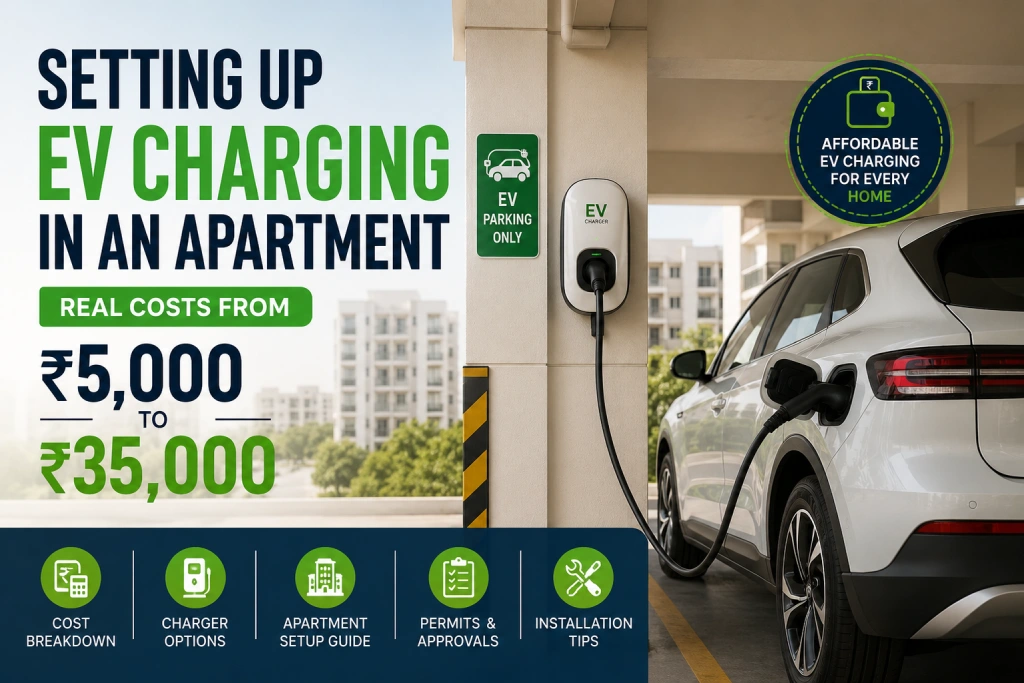
Setting Up EV Charging in an Apartment: Real Costs from ₹5,000 to ₹35,000+
Quick answer
How much does it cost to install an EV charger in an apartment in India?
There is no single India-wide apartment EV charger installation price. The final bill depends on the charger, cable distance, electrical work, protection equipment, earthing, metering, sanctioned load and any civil work required. A current Indian installation guide from Zevpoint lists a ₹30,000–₹35,000 price range for a 7.5 kW AC wallbox and a ₹35,000–₹55,000 example total after electrical work, possible load enhancement and earthing.
A low-cost charging setup can therefore be very different from a complete 7.4–7.5 kW wallbox installation. The useful question is not simply “How much does an EV charger cost?” but “How much will it cost to connect the charger safely from my electricity supply to my apartment parking space?”
| Cost factor | Why it affects the bill |
|---|---|
| Charger/EVSE | Model and charging power |
| Cable | Distance between electricity supply and parking |
| Conduit/trunking | Cable-routing method |
| Electrical protection | Site-specific electrical design |
| Installation labour | Installation complexity |
| Earthing | Existing electrical infrastructure and site requirements |
| Metering | Existing connection vs separate metered arrangement |
| Sanctioned load | Whether existing electrical capacity is sufficient |
| Civil work | Basement, wall and cable-routing requirements |
Important: ₹5,000–₹35,000 should be treated as a starting budgeting range for some installations, not as a universal price range or a ₹35,000 maximum. Published 7.5 kW installation examples can exceed ₹35,000.
What is apartment EV charging installation?
Apartment EV charging installation is the process of connecting an electric vehicle charging point to an electricity supply and installing the associated electrical and physical infrastructure needed to charge the vehicle at its designated parking location.
The Ministry of Power's Guidelines for Installation and Operation of Electric Vehicle Charging Infrastructure-2024 expressly apply to EV charging infrastructure in private parking spaces and semi-restricted locations including Group Housing Societies. The guidelines were issued on 17 September 2024 and superseded the earlier Ministry of Power EV charging guidelines.
For an apartment owner, the installation can involve much more than mounting a charger on a wall. The electrical route from the supply connection to the parking bay may require cable, protection equipment, conduit or trunking, installation labour and, depending on the site, changes to earthing, metering or sanctioned load.
How Much Does EV Charger Installation Cost in an Apartment?
The cost of an apartment EV charging installation depends on the equipment and the electrical path between the electricity connection and the vehicle. Current published Indian installation guidance illustrates the variation: Zevpoint lists a 7.5 kW AC wallbox at ₹30,000–₹35,000, electrical work and materials at ₹3,000–₹5,000, possible DISCOM load enhancement at ₹500–₹5,000, and earthing at ₹3,000–₹8,000. Its resulting example total is ₹35,000–₹55,000.
That means the same charger can produce different installed costs in different apartments.
The major cost components
1. Charger or EVSE
The charger is the most visible part of the installation, but it is not necessarily the complete installation cost.
As one current market example, Zevpoint lists a 7.5 kW AC wallbox at ₹30,000–₹35,000 in its installation guide. This is a vendor-published price range, not an official national price benchmark.
2. Cable
Cable cost depends partly on how far the electricity supply is from the parking location.
A parking bay immediately adjacent to the relevant electrical connection can have a shorter cable route. A basement parking bay that requires a longer route can require more cable and more installation work.
Zevpoint specifically identifies the distance between the distribution board and charger location as a factor affecting wiring costs.
3. Conduit or trunking
Apartment installations may require a physical route for the charging cable through the building or parking area. The exact method depends on the building and the route available.
The cost should therefore be evaluated together with cable length rather than as a universal per-installation charge.
4. Electrical protection
EV charging is an electrical load, so the installation needs appropriate protection and equipment selected for the charging system and site.
BIS's current EV conductive-charging standards cover areas including protection against electric shock, overload and short-circuit protection, emergency disconnection and cable-related requirements.
The correct protection arrangement should therefore be determined by the applicable standards, charger specifications and electrical installation rather than by assuming that one protection-device combination applies to every apartment.
5. Installation labour
Labour depends on the physical complexity of the installation.
A straightforward installation with a nearby electrical connection can be simpler than an installation requiring a long basement route, additional mounting work or coordination through common areas.
Zevpoint currently lists ₹3,000–₹5,000 for electrical work and materials in its example home installation. This is a vendor-published example rather than a guaranteed market rate.
6. Earthing
Earthing may become an additional installation cost where the existing electrical infrastructure does not satisfy the requirements for the installation.
Zevpoint currently lists ₹3,000–₹8,000 for earthing where required in its home-installation example. Again, this is a published vendor range rather than a national standard price.
7. Metering
A separate EV meter is not automatically required for every residential charging installation.
The Ministry of Power states that residential owners may use their existing electricity connections for EV charging or opt for a separate metered connection from the distribution licensee with a dedicated EV charging tariff.
8. Sanctioned-load enhancement
Existing electrical capacity also matters.
The Ministry of Power states that where an EV charging installation requires more power than the current sanctioned load, the building or office owner can apply to the distribution licensee for an increase in sanctioned load.
Zevpoint's current installation guide publishes ₹500–₹5,000 as an example range for DISCOM load enhancement, but the actual amount depends on the applicable distribution licensee and required electrical capacity.
9. Civil work
Civil work may become relevant when the charger or cable route requires physical modifications to the installation location.
Because apartment layouts differ substantially, civil work should be treated as a site-specific quotation item rather than a universal percentage or fixed charge.
Can You Really Install an EV Charger for ₹5,000?
A ₹5,000-level budget can be possible for a basic charging arrangement in favourable circumstances, but it should not be presented as the standard cost of installing a dedicated 7.4 or 7.5 kW car wallbox.
The important distinction is between low-cost charging equipment and a complete higher-power charging installation.
Zevpoint's current published example puts a 7.5 kW AC wallbox itself at ₹30,000–₹35,000, before adding its separately listed electrical work/materials, potential load enhancement and earthing.
Therefore:
₹5,000 should be treated as a possible low-cost charging scenario, not as a universal price for a 7.4–7.5 kW apartment wallbox installation.
A low-cost installation would need favourable site conditions and inexpensive charging equipment. The article should not imply that every apartment owner can obtain a complete dedicated wallbox installation for ₹5,000.
What Does a ₹35,000 Apartment EV Installation Look Like?
A ₹35,000 budget can be useful as a planning threshold, but it should not be treated as a hard maximum.
For example, Zevpoint's published home-installation figures include a ₹30,000–₹35,000 7.5 kW AC wallbox, ₹3,000–₹5,000 electrical work/materials, ₹500–₹5,000 possible load enhancement and ₹3,000–₹8,000 earthing where needed. The published example total is consequently ₹35,000–₹55,000.
This illustrates an important point:
A ₹35,000 budget may be consumed largely by the charging equipment before all site-specific installation requirements are added.
Illustrative ₹35,000 calculation
The following is an illustrative calculator structure, not a claim about average Indian pricing:
| Component | Amount |
|---|---|
| Charger/EVSE | User input |
| Cable | User input |
| Conduit/trunking | User input |
| Electrical protection | User input |
| Installation labour | User input |
| Earthing | ₹0 if not required / user input |
| Metering | ₹0 if not required / user input |
| Load enhancement | ₹0 if not required / user input |
| Civil work | ₹0 if not required / user input |
| Total | ₹35,000 target |
The calculator should allow the user to enter actual quotation values instead of presenting invented component prices as market averages.
The Biggest Hidden Cost: Cable Length
Cable length is one of the most important apartment-specific variables because the charging point may not be located next to the electricity supply.
Zevpoint's installation guidance specifically asks how far the distribution board is from the charger and notes that longer cable runs increase wiring costs.
Consider two hypothetical apartments:
Apartment A
The designated parking bay is close to the relevant electrical connection.
The installer may have a comparatively straightforward cable route.
Apartment B
The parking bay is deeper inside a basement and the electrical connection is farther away.
The installer may need a longer cable route and additional routing or mounting work.
These are illustrative scenarios, not claims that one specific apartment will always cost more.
Make cable distance a calculator input
The calculator should ask:
How many metres from your electricity connection to your parking space?
This is more useful than asking only:
How much does an EV charger cost?
Do Apartment Owners Need Society Permission?
The answer needs to distinguish government EV-charging provisions from building-specific implementation procedures.
The Ministry of Power's 2024 guidelines apply to private parking spaces and Group Housing Societies. The Ministry's published summary states that residents can install private charging stations in their designated parking spaces.
However, that does not justify a blanket statement that “no society permission is required anywhere in India.”
Apartment implementation can involve practical questions about:
- Whether the parking space is designated or allotted.
- Where the cable can be routed.
- Whether common areas are involved.
- How electrical work is coordinated.
- How metering is arranged.
- What building-management procedures apply.
The safest approach is to distinguish the government framework from the apartment's own implementation process.
What the Ministry of Power framework says
The Ministry's 2024 guidance states that:
- The guidelines apply to private parking spaces and Group Housing Societies.
- Residents can install private charging stations in designated parking spaces.
- Residential owners can use existing electricity connections for EV charging.
- A separate metered connection with a dedicated EV charging tariff is also available as an option.
That is more precise than claiming that every society has identical permission requirements.
Can You Use Your Existing Electricity Meter?
Yes. The Ministry of Power's 2024 framework explicitly states that residential owners may use their existing electricity connections for EV charging. The same framework also allows a separate metered connection from the distribution licensee with a dedicated EV charging tariff.
For an apartment owner, the practical question is therefore not simply:
“Do I need an EV meter?”
Instead, ask:
“Which electricity connection and metering arrangement will be used for my charging point?”
The answer can depend on the installation arrangement and the consumer's choice under the applicable framework.
Does Apartment EV Charging Require a Load Upgrade?
Not automatically.
The Ministry of Power states that where EV charging requires more power than the current sanctioned load, the owner can apply to the distribution licensee for an increase in sanctioned load.
That means sanctioned load should be checked before finalising the installation.
A sensible installation assessment should check
- Existing sanctioned load.
- Existing household electrical demand.
- Proposed charging load.
- Distribution-board capacity.
- Required charging equipment.
- Whether a load enhancement is necessary.
A charger should not be selected solely because its advertised power rating appears attractive.
Do You Need a Separate EV Meter?
Not necessarily.
The Ministry of Power states that residential owners may use an existing electricity connection or opt for a separate metered connection from the distribution licensee with a dedicated EV charging tariff.
For community charging in Group Housing Societies, the Ministry also states that a Resident Welfare Association, Group Housing Society, flat owner or another consumer within a Group Housing Society can request a separate metered connection with a dedicated EV charging tariff.
The 2024 framework therefore supports more than one charging and metering arrangement.
What Electrical Safety Equipment Should You Budget For?
EV charging should be treated as a properly designed electrical installation rather than simply connecting a vehicle to an arbitrary extension arrangement.
BIS's EV conductive-charging standards cover requirements relating to electric-shock protection, overload and short-circuit protection, emergency disconnection, cable assemblies and other EVSE construction and safety requirements.
BIS currently identifies IS 17017 (Part 22/Sec 1):2021 for AC charging configurations.
BIS also lists IS 17017 (Part 23):2026 as the current revised Indian Standard for DC EV Supply Equipment. The standard includes requirements covering electric-shock protection, overload and short-circuit protection, emergency disconnection, cable assemblies and related safety measures.
The practical implication is straightforward:
Use compliant charging equipment and have the electrical installation designed and installed appropriately for the charger and site.
The article should avoid claiming that one exact MCB, RCCB, cable size or earthing arrangement is mandatory for every apartment. Those details should be determined from the applicable standards, charger documentation and the actual electrical installation.
Apartment EV Charging Cost Calculator
The most useful part of this guide should be an interactive calculator.
Recommended calculator formula
Total Installation Cost = Charger/EVSE + Cable & Conduit + Electrical Protection + Installation Labour + Earthing + Metering + Load Enhancement + Civil Work
If a component is not required, the calculator can assign that component a value of ₹0.
Recommended inputs
Charger
- Charger price
- Charger power
- Charger type
Wiring
- Cable length
- Cable/conduit cost per metre
Electrical work
- Protection equipment
- Installation labour
- Earthing
Electricity connection
- Existing meter
- Separate metering
- Load enhancement
Site work
- Civil work
- Cable-routing complexity
Recommended output
Estimated apartment EV charging installation cost
₹XX,XXX
Then show the breakdown:
| Component | Estimated amount |
|---|---|
| Charger/EVSE | ₹XX,XXX |
| Cable & conduit | ₹XX,XXX |
| Electrical protection | ₹XX,XXX |
| Labour | ₹XX,XXX |
| Earthing | ₹XX,XXX |
| Metering | ₹XX,XXX |
| Load enhancement | ₹XX,XXX |
| Civil work | ₹XX,XXX |
| Total | ₹XX,XXX |
Important: The calculator should clearly label user-entered or site-specific assumptions as estimates. It should not imply that the calculator replaces an electrician's site assessment or a formal installation quotation.
5 Apartment EV Charging Mistakes That Can Increase Cost
1. Choosing the charger before checking electrical capacity
The Ministry of Power specifically addresses situations where charging requires more power than the current sanctioned load.
Check electrical capacity before finalising the charger.
2. Ignoring cable distance
A longer route can increase wiring requirements and installation complexity. Zevpoint identifies distribution-board distance as a cost consideration.
3. Forgetting electrical protection
EV conductive-charging standards include requirements relating to electric-shock protection, overload and short-circuit protection and emergency disconnection.
Protection should therefore be included in the installation assessment.
4. Assuming a load upgrade will never be needed
If the charging requirement exceeds the existing sanctioned load, the Ministry of Power framework provides for applying to the distribution licensee for an increase.
5. Planning the cable route without considering common areas
Apartment parking frequently requires coordination around the physical route between the electricity connection and parking space.
The government framework recognises private charging in designated parking spaces, but the physical implementation still needs to be planned appropriately for the building.
Apartment vs Independent House EV Charging
The following is a practical comparison of installation considerations, not a claim that apartments always cost more.
| Factor | Apartment | Independent house |
|---|---|---|
| Parking | May be designated/allotted | Often within private premises |
| Cable route | May involve building/common areas | May be more direct |
| RWA/society | May need coordination | Generally less relevant |
| Meter location | May be away from parking | May be closer |
| Load assessment | Required according to installation | Required according to installation |
| Civil work | Depends on building/parking design | Depends on property layout |
The Ministry of Power's 2024 guidelines explicitly include private parking spaces and Group Housing Societies within their scope.
What the 2024 Government Guidelines Say About Apartment EV Charging
The Ministry of Power issued the Guidelines for Installation and Operation of Electric Vehicle Charging Infrastructure-2024 on 17 September 2024. The guidelines apply to EV charging infrastructure in private parking spaces and semi-restricted locations including Group Housing Societies.
Existing electricity connection
Residential owners may use their existing electricity connections for EV charging.
Separate metered connection
Residential owners may alternatively opt for a separate metered connection from the distribution licensee with a dedicated EV charging tariff.
Domestic electricity rates
The Ministry's published annual report states that domestic electricity rates apply to charging EVs at home.
Sanctioned-load increase
Where an EV charging installation requires more power than the current sanctioned load, the owner can apply to the distribution licensee for an increase in sanctioned load.
Private charging in designated parking
The Ministry states that residents can install private charging stations in their designated parking spaces.
Community charging
The Ministry also recognises community charging for residents and states that a Resident Welfare Association, Group Housing Society, flat owner or another consumer within a Group Housing Society can request a separate metered connection with a dedicated EV charging tariff.
How to Estimate Your Apartment EV Charging Installation Cost
Before asking for a quotation, collect the following information.
Step 1: Identify the parking location
Confirm the parking space that will be used for charging.
Step 2: Identify the electricity connection
Determine which electricity connection will supply the charger.
The Ministry of Power permits residential owners to use existing electricity connections for EV charging and also provides for separate metered connections.
Step 3: Check sanctioned load
Find the sanctioned-load information on the electricity connection and ask the installer to assess whether additional charging demand can be accommodated.
If additional power is required, the Ministry's framework provides for applying for increased sanctioned load.
Step 4: Measure the cable route
Measure the approximate route between the electricity connection and parking location.
Do not measure only the straight-line distance. The actual cable route can differ from the direct distance.
Step 5: Check the electrical installation
Ask the installer to assess the relevant electrical infrastructure and protection requirements.
BIS standards cover EV conductive-charging safety areas including electric-shock protection, overload and short-circuit protection and emergency disconnection.
Step 6: Check building coordination
If the cable route involves common areas, coordinate the installation with the appropriate apartment-management authority.
Step 7: Get a site-specific quotation
Ask the quotation to separate:
- Charger
- Cable
- Conduit/trunking
- Protection
- Labour
- Earthing
- Metering
- Load enhancement
- Civil work
That makes it easier to compare two installation quotations.
Frequently Asked Questions
How much does it cost to install an EV charger in an apartment?
There is no single fixed price. Cost depends on the charger, cable distance, electrical protection, labour, earthing, metering, sanctioned-load requirements and civil work. Zevpoint currently publishes ₹30,000–₹35,000 for a 7.5 kW AC wallbox and an example total of ₹35,000–₹55,000 after additional installation items.
Can I install an EV charger in my apartment parking?
The Ministry of Power's 2024 guidelines apply to private parking spaces and Group Housing Societies, and the Ministry states that residents can install private charging stations in designated parking spaces. The physical installation still needs appropriate electrical and building-level coordination.
Can I use my existing electricity meter for EV charging?
Yes. The Ministry of Power states that residential owners may use existing electricity connections for EV charging. The framework also provides an option for a separate metered connection with a dedicated EV charging tariff.
Do I need a separate EV meter?
Not necessarily. Residential owners may use their existing electricity connection or opt for a separate metered connection with a dedicated EV charging tariff under the Ministry of Power's 2024 framework. The appropriate arrangement depends on the installation and consumer choice.
Does apartment EV charging require a load upgrade?
Not in every case. If the charging installation requires more power than the current sanctioned load, the Ministry of Power states that the owner can apply to the distribution licensee for an increase in sanctioned load.
How much does EV charger wiring cost?
There is no single national wiring price because cable length, routing and installation complexity vary. Zevpoint currently lists ₹3,000–₹5,000 for electrical work and materials in its example home installation, but that figure should be treated as a vendor-published reference rather than a universal rate.
How much does a 7.4 kW or 7.5 kW EV charger installation cost?
A current Zevpoint example lists a 7.5 kW AC wallbox at ₹30,000–₹35,000 and a complete example installation at ₹35,000–₹55,000, after adding electrical work/materials, possible load enhancement and earthing. Actual quotations vary by equipment and site.
Can an RWA or housing society install EV chargers for residents?
Yes. The Ministry of Power's 2024 framework specifically addresses community charging for residents and states that a Resident Welfare Association or Group Housing Society can request a separate metered connection with a dedicated EV charging tariff.
Why does EV charger installation cost more in some apartments?
The main variables include charger price and power, cable distance, electrical work, protection, earthing, metering, sanctioned load and site-specific civil or routing requirements. Zevpoint specifically identifies electrical capacity and distance from the distribution board as installation considerations.
How long should the cable be from the meter to the parking space?
The cable should be sized and routed according to the actual installation rather than selected from a universal apartment-wide length. The practical measurement is the route between the relevant electricity connection and the charging point. Longer cable runs can increase wiring costs.
Is a basic socket enough for charging an electric car?
A charging installation should not be treated simply as an arbitrary extension-cable connection. EV conductive-charging standards cover safety requirements including protection against electric shock, overload and short circuits, cable assemblies and related EVSE requirements. The appropriate charging equipment and installation should be selected for the vehicle, charger and electrical system.
Are ₹5,000 and ₹35,000 realistic apartment EV charging budgets?
They can represent different installation situations, but neither should be treated as a universal price. A low-cost charging arrangement may fall into the lower range, while a 7.5 kW wallbox installation can exceed ₹35,000. Zevpoint's current published example reaches ₹35,000–₹55,000.
Key Takeaways
- The charger is only one part of apartment EV charging installation cost.
- Cable distance between the electricity connection and parking can affect wiring and installation requirements.
- The Ministry of Power's 2024 guidelines apply to private parking spaces and Group Housing Societies.
- Residential owners may use an existing electricity connection for EV charging.
- A separate metered connection with a dedicated EV charging tariff is also provided for under the Ministry's framework.
- A sanctioned-load increase can be requested where the existing load is insufficient for the charging requirement.
- Residents can install private charging stations in designated parking spaces under the 2024 framework.
- BIS EV conductive-charging standards cover important safety areas including electric-shock protection, overload and short-circuit protection and emergency disconnection.
- A published Zevpoint example puts a 7.5 kW AC wallbox at ₹30,000–₹35,000 and the example complete installation at ₹35,000–₹55,000.
- Therefore, ₹35,000 should not be treated as a hard maximum for apartment EV charger installation.
Final Verdict
The cheapest apartment EV charging installation is not necessarily the installation with the cheapest charger.
The more useful calculation is the complete electrical path from the electricity connection to the vehicle.
A realistic apartment EV charging budget should therefore account for:
Charger + cable + conduit + protection + labour + earthing + metering + load enhancement + civil work.
The Ministry of Power's 2024 framework provides a clear basis for residential EV charging: existing electricity connections can be used, separate metered connections are available as an option, increased sanctioned load can be requested where required, and private charging stations can be installed in designated parking spaces.
The final price, however, remains site-specific.
That is why ₹5,000–₹35,000 is better treated as a starting budgeting range than as a guaranteed apartment installation price. Current published examples show that a complete 7.5 kW installation can exceed ₹35,000.
Calculate your actual installation cost
Calculate My EV Charging Cost →
Enter your charger price, charger power, cable length, electrical work, protection, earthing, metering, load enhancement and civil-work requirements to estimate the complete installation rather than looking at the charger price alone.
Get a Site-Specific EV Charger Installation Quote →
Authority and reference sources
Ministry of Power — EV Charging Infrastructure 2024
The Ministry's Guidelines for Installation and Operation of Electric Vehicle Charging Infrastructure-2024, issued on 17 September 2024, are the principal regulatory source used for the residential, private-parking and Group Housing Society provisions in this article.
Ministry of Power — EV Charging Infrastructure 2024 Guidelines
Ministry of Power — Residential and community charging provisions
The Ministry's annual report reproduces the relevant provisions concerning existing electricity connections, domestic electricity rates, sanctioned-load increases, separate metering and private charging in designated parking.
Ministry of Power — Annual Report 2024–25
Bureau of Indian Standards — EV charging standards
BIS identifies IS 17017 as the relevant family of Indian Standards for EV conductive charging systems and currently lists IS 17017 (Part 23):2026 for DC EV Supply Equipment.
Bureau of Indian Standards — IS 17017 information
Zevpoint — Published installation pricing
Zevpoint's current installation guide is used only for vendor-published market examples, including its 7.5 kW charger and installation-cost figures. These figures are not presented as government-approved prices or national averages.
Zevpoint — EV Charger Installation in India
Editorial note on pricing
All numerical prices in this article that come from vendor material are explicitly attributed to the relevant vendor. Government and BIS sources are used for regulatory and standards claims. Where no authoritative market-wide price exists, the article deliberately avoids inventing an average.
The calculator should use user-entered or separately verified current quotations rather than treating any vendor's published price as the universal Indian installation rate.