Solar EV Charging Calculator India: Calculate Exactly How Much Rooftop Solar Your EV Needs
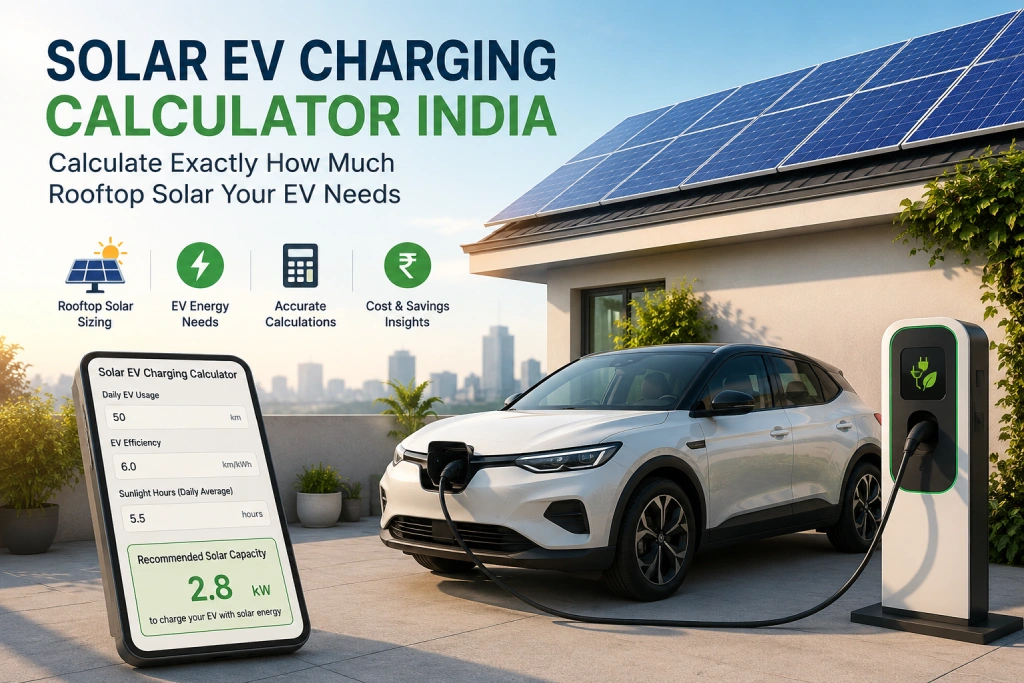
Quick answer: How much rooftop solar does an EV need?
The amount of rooftop solar required to charge an EV depends on four main inputs: how far you drive, how much electricity the EV consumes per kilometre, charging/system losses, and how much electricity your solar system is expected to generate at your location. It is therefore more accurate to calculate the energy requirement first and size the solar system from that result than to use a single national “kW per EV” figure.
The basic calculation is:
Daily EV electricity requirement = Daily driving distance × EV electricity consumption per km
If the vehicle's consumption is expressed as kWh/100 km:
Daily EV electricity requirement = Daily km × EV kWh/100 km ÷ 100
Then, after accounting for any explicitly stated charging/system-loss assumption:
Required solar capacity (kW) = EV charging electricity required per day ÷ expected solar generation per kW per day
These are calculation formulas, not claims about a universal Indian EV or solar system.
Get a rooftop solar assessment for your home
Calculate NowQuick summary
| What you want to calculate | Formula |
|---|---|
| Daily EV energy | Daily km × EV kWh/km |
| EV energy from kWh/100 km | Daily km × kWh/100 km ÷ 100 |
| Electricity supplied to charging system | Energy stored ÷ charging efficiency |
| Solar capacity required | Charging electricity/day ÷ solar generation/kW/day |
| EV electricity cost/km | Charging electricity cost ÷ km driven |
| Petrol cost/km | Petrol price/litre ÷ petrol mileage km/litre |
Important: the numbers produced by the calculator should be labelled “Calculated result based on the inputs shown.” User-selected values should be labelled “User input” or “Illustrative assumption.”
What is a solar EV charging calculator?
A solar EV charging calculator estimates the electricity required to operate an electric vehicle and then estimates the rooftop solar capacity needed to generate that electricity.
The calculation does not depend only on battery size. A driver's daily distance and the vehicle's electricity consumption determine how much energy is required for daily travel. Solar-system output then determines how much installed solar capacity is needed to produce that energy.
The calculator should therefore connect two separate calculations:
- EV energy requirement
- Solar generation requirement
The distinction is important because a vehicle's battery capacity is not the same thing as the amount of electricity a particular driver needs every day.
1. The exact EV + solar calculation
Step 1: Calculate daily EV electricity consumption
The first calculation is straightforward.
Daily EV electricity = Daily driving distance × EV electricity consumption per km
For vehicles whose efficiency is stated as kWh/100 km:
Daily EV electricity = Daily distance × EV consumption ÷ 100
Example
Suppose a user enters:
- Daily distance: 40 km
- EV consumption: 13 kWh/100 km
The calculation is:
40 × 13 ÷ 100 = 5.2 kWh/day
Calculated example based on the inputs shown: 5.2 kWh/day.
The 40 km/day and 13 kWh/100 km values are illustrative inputs, not national averages.
Step 2: Account for charging losses
Energy stored in an EV battery and electricity drawn from the electricity supply are not necessarily identical.
For a calculator that models charging efficiency, use:
Electricity drawn from supply = Energy required by vehicle ÷ charging efficiency
For example, if an illustrative calculator assumption were 90% charging efficiency:
5.2 ÷ 0.90 = 5.78 kWh
Calculated example based on the illustrative assumption: approximately 5.78 kWh would be required from the electricity supply.
The 90% figure is an illustrative assumption only. It should not be presented as a universal charging efficiency for every EV.
The calculator should allow the user or methodology to change this assumption rather than silently applying one fixed loss percentage.
2. How much solar capacity is required?
Once the electricity requirement is known, the next question is how much electricity one unit of installed solar capacity can reasonably generate at the user's location.
The calculation is:
Required solar capacity = Daily EV charging electricity requirement ÷ expected solar generation per kW/day
For example, if the calculator uses an illustrative solar-generation assumption of 4 kWh per kW per day:
5.78 ÷ 4 = 1.45 kW
Calculated example based on the assumptions shown: approximately 1.45 kW of solar capacity.
This does not mean that every Indian household needs 1.45 kW of solar for a 40-km daily commute. The result changes when the user changes EV consumption, charging efficiency or expected solar generation.
3. Why there is no universal “1 kW solar produces X units every day” answer
Solar generation varies with location, weather, irradiation, system design and other operating conditions. MNRE material illustrates this variation: one government solar-resource document reports normalized production in Leh at about 4.89 kWh per kW of installed capacity per day and notes seasonal and day-to-day variation. (Ministry of New and Renewable Energy)
MNRE's broader rooftop-solar material also treats solar generation as a site- and system-dependent issue rather than a single fixed national output figure. (Solar Rooftop)
Therefore, a good solar EV charging calculator India should ask for an expected solar-generation value rather than hard-code one number as if it applied equally across the country.
Factors that can affect the result include:
- location;
- solar resource;
- season;
- weather;
- shading;
- system design;
- system losses;
- orientation and installation conditions.
The calculator should therefore display:
Illustrative assumption — change this value in the calculator.
rather than:
“1 kW solar produces exactly X units every day in India.”
4. Battery capacity is not the same as daily solar requirement
Battery capacity tells you how much electrical energy the battery can store under the relevant specification.
It does not automatically tell you how much electricity the vehicle will consume every day.
For example, two EV owners can have vehicles with similar battery capacities but very different daily energy requirements if one drives 20 km per day and another drives 80 km per day.
The more useful calculation for rooftop-solar sizing is therefore:
Daily kilometres × vehicle electricity consumption
The Bureau of Energy Efficiency's EV material also distinguishes battery capacity from vehicle energy consumption and discusses the relationship between vehicle mass, battery capacity and energy consumption. (Bureau of Energy Efficiency)
5. Worked example: 40 km of EV driving per day
Consider an illustrative calculator example.
User inputs
| Input | Example value | Status |
|---|---|---|
| Daily driving | 40 km | Illustrative input |
| EV consumption | 13 kWh/100 km | Illustrative input |
| Charging efficiency | 90% | Illustrative assumption |
| Solar generation | 4 kWh/kW/day | Illustrative assumption |
Daily EV energy
40 × 13 ÷ 100 = 5.2 kWh/day
Electricity required from supply
5.2 ÷ 0.90 = 5.78 kWh/day
Solar capacity
5.78 ÷ 4 = 1.45 kW
Result
Calculated example based on the inputs shown: approximately 1.45 kW of solar capacity would be required to generate an equivalent daily amount of electricity under the illustrative 4 kWh/kW/day solar-generation assumption.
The result is not a recommendation for every EV owner.
If the user's actual solar yield is different, the required capacity changes.
6. What happens if you drive 30, 40 or 50 km per day?
The calculation changes linearly if all other assumptions remain unchanged.
Using the same illustrative inputs of 13 kWh/100 km, 90% charging efficiency and 4 kWh/kW/day solar generation:
| Daily driving | EV energy/day | Supply energy/day* | Solar capacity* |
|---|---|---|---|
| 30 km | 3.90 kWh | 4.33 kWh | 1.08 kW |
| 40 km | 5.20 kWh | 5.78 kWh | 1.45 kW |
| 50 km | 6.50 kWh | 7.22 kWh | 1.81 kW |
- Calculated examples based on the stated illustrative assumptions.
These values are mathematical outputs from the displayed inputs, not measured performance for a particular EV or solar installation.
7. How to calculate your EV's electricity consumption
EV efficiency can be expressed in different ways.
A common calculator format is:
kWh/100 km
For example:
13 kWh/100 km
The equivalent per-kilometre figure is:
13 ÷ 100 = 0.13 kWh/km
The calculator can then use:
Daily km × 0.13 kWh/km
Vehicle-specific consumption should preferably come from the relevant vehicle documentation or the user's own measured data rather than an assumed “average Indian EV efficiency.”
The BEE's EV material demonstrates that EV energy consumption is affected by vehicle characteristics and is not a single universal number. (Bureau of Energy Efficiency)
8. Why the calculator should use your actual EV efficiency
A generic EV efficiency number can produce a misleading solar requirement.
Your result changes when the following change:
- vehicle model;
- driving conditions;
- driving pattern;
- vehicle load;
- speed;
- climate;
- charging conditions.
For this reason, the calculator should preferably provide either:
Vehicle-specific verified efficiency
or
User input: actual/assumed EV efficiency
The page should clearly distinguish those two sources of data.
9. Charging losses: the number that should not be hidden
A calculator that simply multiplies kilometres by vehicle efficiency may be estimating energy consumed by the vehicle rather than the electricity that must be supplied to the charging system.
If the calculator includes charging efficiency, it should show the assumption.
Formula
Supply energy = Required battery/vehicle energy ÷ charging efficiency
Example
If the vehicle requires 5.2 kWh and the calculator uses an illustrative 90% efficiency:
5.2 ÷ 0.90 = 5.78 kWh
Calculated example based on the illustrative assumption: 5.78 kWh.
Do not describe 90% as the charging efficiency of all Indian EVs. The purpose of the assumption is to make the calculation transparent.
10. Can you charge an EV using rooftop solar?
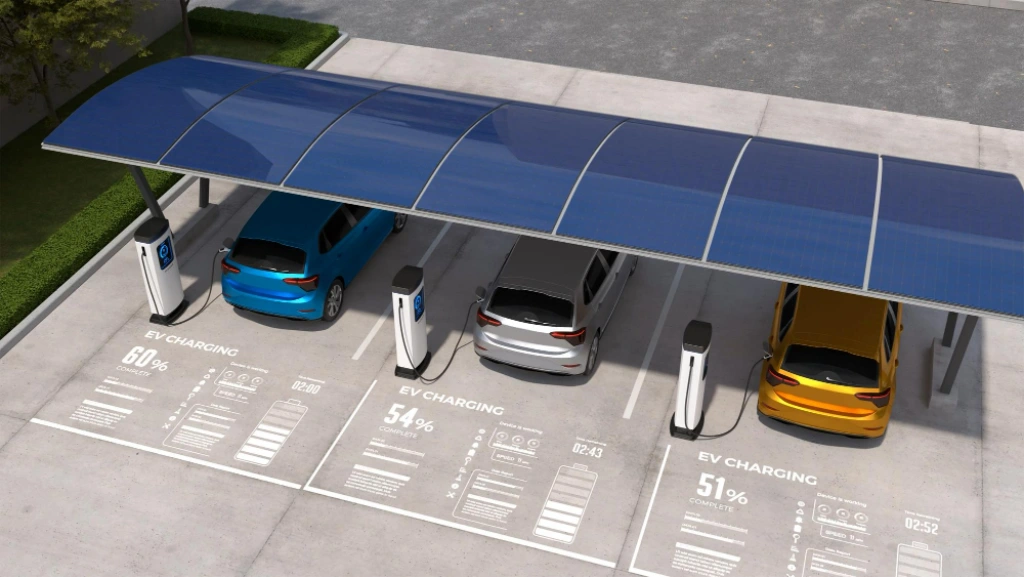
Yes. Rooftop solar electricity can be used as part of a home's electricity supply for EV charging. Solar companies in India also market integrated rooftop-solar and EV-charging solutions; for example, Tata Power has publicly described financing partnerships covering both rooftop solar installations and EV charging stations. (Tata Power)
The practical energy flow can be thought of as:
Solar PV → inverter/electrical system → household loads and/or EV charger
When solar generation is insufficient for the instantaneous load, the home's electrical system may also draw electricity from the grid, depending on the system configuration and applicable metering arrangement.
The calculator should therefore distinguish solar energy generated, solar energy used for EV charging, and grid electricity used for EV charging.
11. What happens when you charge the EV at night?
A rooftop solar system does not automatically mean that the EV can be charged only with solar electricity.
If the vehicle is charged after solar generation has fallen, the charging electricity may come from the grid unless an energy-storage system or another arrangement is available.
For a grid-connected household, the economic calculation therefore needs to distinguish between:
- solar generation;
- electricity consumed directly;
- electricity exported;
- electricity imported;
- electricity used by the EV.
The exact financial treatment of exported and imported electricity depends on the applicable state/DISCOM regulatory and metering framework. The Central Electricity Authority maintains state/DISCOM electricity-tariff information and analyses different tariff structures, illustrating why a single national residential electricity tariff should not be assumed. (Central Electricity Authority)
12. Rooftop solar + grid charging
A household can have both rooftop solar and grid electricity.
For example, the calculator could show:
Solar generation available for EV = 4 kWh
EV charging requirement = 6 kWh
Remaining requirement = 2 kWh
That 2 kWh is a calculated energy balance, not automatically a claim about the user's actual grid bill. The financial result depends on the household's electricity tariff and applicable metering arrangement.
This distinction is important.
Energy calculation ≠ electricity-bill calculation
A solar system may generate enough energy over a billing period to offset a substantial amount of consumption, while the actual bill depends on the applicable tariff and regulatory arrangement.
Calculate how much rooftop solar your EV needs
Calculate Now13. Electricity tariff: use the user's actual rate
India does not have one universal residential electricity tariff.
The Central Electricity Authority publishes state/DISCOM-level electricity tariff and duty information and analyses different tariff structures. (Central Electricity Authority)
Therefore, the calculator should ask:
What is your applicable electricity cost per kWh?
The user can enter the relevant value from their electricity bill or applicable tariff.
Grid charging cost
The basic calculation is:
Grid electricity used for EV charging × applicable electricity rate
For example, if a user enters:
- Grid electricity = 100 kWh/month
- Electricity rate = ₹8/kWh
then:
100 × ₹8 = ₹800/month
Calculated example based on user inputs.
The ₹8/kWh figure is an illustrative input, not an Indian national tariff.
14. EV charging cost per kilometre
Once the monthly or annual EV electricity cost is known:
EV cost/km = EV charging cost ÷ kilometres driven
For example, if the calculator produces:
- annual charging cost = ₹12,000;
- annual driving distance = 10,000 km;
then:
₹12,000 ÷ 10,000 = ₹1.20/km
Calculated example based on the inputs shown.
The result is not a universal EV running-cost figure.
15. Why the ₹0.50/km solar-EV claim should not be used as a universal figure
A claim such as:
“Solar EV charging costs ₹0.50/km”
is incomplete unless the calculation states the assumptions behind the result.
The result depends on:
- EV electricity consumption;
- charging losses;
- solar generation;
- electricity tariff;
- solar-system economics;
- driving distance;
- whether solar capital cost is included;
- whether the calculation represents marginal electricity cost or total system cost.
Therefore, this article should not present ₹0.50/km as India's universal solar-EV running cost.
The correct approach is:
Enter the user's inputs and calculate the result.
That makes the number reproducible.
16. Petrol vs EV running cost
A petrol comparison should also be based on user inputs.
Petrol cost per kilometre
Petrol cost/km = Petrol price per litre ÷ petrol vehicle mileage in km/litre
Example
Suppose the user enters:
- Petrol price = ₹100/litre
- Petrol vehicle mileage = 15 km/litre
Then:
₹100 ÷ 15 = ₹6.67/km
Calculated result based on the inputs shown: ₹6.67/km.
The ₹100/litre and 15 km/litre values are illustrative inputs.
The calculator should not describe ₹7–₹10/km as India's universal petrol running cost because petrol cost/km changes with fuel price and vehicle mileage.
17. Annual petrol vs EV comparison
The calculator can compare annual energy/fuel expenditure.
Petrol
Annual petrol cost = annual kilometres × petrol cost/km
EV
Annual EV electricity cost = annual EV electricity consumption × applicable electricity cost
Difference
Annual running-cost difference = annual petrol cost − annual EV electricity cost
If solar electricity offsets some or all of the EV's grid electricity consumption, the calculator should show that solar offset separately.
This prevents the page from hiding the assumptions inside one headline savings number.
18. Solar charging cost vs solar-system cost
“Solar charging costs nothing” is also too broad.
A rooftop solar installation has an upfront system cost, while solar generation can reduce the amount of electricity purchased from the grid.
Therefore, the calculator should distinguish at least three concepts:
1. Grid electricity cost
What the household pays for electricity imported from the grid.
2. Solar-offset value
The value of electricity consumption displaced or offset by solar generation under the applicable arrangement.
3. Solar-system economics
The capital cost, financing, maintenance and other relevant economics of the rooftop system.
A calculator that shows only “₹0 electricity cost” would omit the capital-cost question.
19. Can PM Surya Ghar solar also charge your EV?
PM Surya Ghar: Muft Bijli Yojana is a rooftop-solar scheme, not a generic separate EV charging subsidy. The scheme was launched on 13 February 2024 and was approved with a total outlay of ₹75,021 crore to support rooftop solar for one crore households. (Press Information Bureau)
The scheme's residential CFA structure provides:
- 60% of system cost for systems up to 2 kW;
- 40% of additional system cost for capacity between 2 and 3 kW;
- CFA capped at 3 kW for the residential structure described by the Cabinet announcement. (Press Information Bureau)
The government subsequently stated that PM Surya Ghar targets rooftop-solar installations in one crore residential households by FY 2026–27, with the same ₹75,021 crore outlay. (Press Information Bureau)
The important distinction
Solar subsidy ≠ EV subsidy.
Eligible rooftop solar receives the applicable Central Financial Assistance under the scheme. The electricity produced by the rooftop system can subsequently serve household electricity loads, which can include EV charging.
The official PM Surya Ghar documentation also specifically identifies common facilities including EV charging within the GHS/RWA component, subject to the scheme's conditions. The official notification specifies CFA of ₹18,000/kWp for that GHS/RWA common-facility component, including EV charging, up to the stated capacity limit. (Solar Rooftop)
Therefore, the safer wording is:
PM Surya Ghar provides Central Financial Assistance for eligible rooftop solar installations. The resulting solar electricity can be used for household electricity needs, including EV charging. Eligible GHS/RWA common facilities can also fall under the scheme's specified provision for EV charging.
Do not describe the programme simply as an “EV charging subsidy.”
20. What should the solar EV calculator ask you?
Required inputs
1. EV type
Car, scooter, motorcycle or other vehicle category.
2. Vehicle model
Useful when verified vehicle-specific data is available.
3. Daily driving distance
Enter kilometres driven per day.
4. EV electricity consumption
Enter kWh/100 km or kWh/km.
5. Electricity tariff
Enter the applicable electricity rate.
6. Solar-generation assumption
Enter the expected generation per kW/day.
7. Existing solar capacity
Useful for households that already have rooftop solar.
8. Monthly driving distance
Useful for monthly cost calculations.
9. Petrol price
Required only when petrol comparison is selected.
10. Petrol vehicle mileage
Required only when petrol comparison is selected.
21. Advanced calculator inputs
The calculator can also allow:
- charging efficiency;
- annual driving distance;
- existing rooftop solar capacity;
- percentage of solar generation allocated to EV charging;
- tariff escalation assumption;
- solar degradation assumption;
- charging schedule;
- net-metering/export arrangement.
These should be clearly marked as optional assumptions, because not every user will have reliable values for every variable.
22. What should the calculator display?
A useful solar EV charging calculator India should produce more than one headline number.
Output 1 — Daily EV energy
Daily km × EV kWh/100 km ÷ 100
Output 2 — Charging-system electricity
Vehicle energy ÷ charging efficiency
Output 3 — Monthly EV electricity
Daily EV electricity × driving days
Output 4 — Annual EV electricity
Annual driving distance × EV consumption
Output 5 — Required solar capacity
Charging electricity/day ÷ solar generation/kW/day
Output 6 — Grid charging cost
Grid electricity × applicable tariff
Output 7 — EV cost/km
EV electricity cost ÷ kilometres driven
Output 8 — Petrol cost/km
Petrol price ÷ petrol mileage
Output 9 — Annual petrol cost
Annual kilometres × petrol cost/km
Output 10 — Annual EV-vs-petrol difference
Annual petrol cost − annual EV electricity cost
If solar offsets part of the EV requirement, the calculator should separately show the solar offset.
23. Solar capacity for 30, 40 and 50 km/day: why the result varies
A useful calculator-led article should not publish a single “EV solar panel requirement.”
Instead, show how the result changes when the input changes.
Using the earlier illustrative assumptions:
- 13 kWh/100 km EV consumption;
- 90% charging efficiency;
- 4 kWh/kW/day solar generation;
the mathematical results are:
| Daily driving | Daily EV energy | Supply energy | Solar capacity |
|---|---|---|---|
| 30 km | 3.90 kWh | 4.33 kWh | 1.08 kW |
| 40 km | 5.20 kWh | 5.78 kWh | 1.45 kW |
| 50 km | 6.50 kWh | 7.22 kWh | 1.81 kW |
All three rows are calculated examples based on the same illustrative assumptions.
Change the EV efficiency or solar-yield assumption and every result changes.
24. What happens if you already have rooftop solar?
Suppose a household already has a rooftop solar system.
The relevant question is not simply:
“Do I have solar?”
The better question is:
“How much of my existing solar generation can realistically be allocated to the EV?”
The calculator can therefore compare:
Existing solar generation
against
Household electricity consumption + EV electricity requirement
For example, if an existing system generates enough electricity over the relevant period to offset the additional EV energy requirement, the user may not need to install additional capacity purely because of the EV.
However, actual bill savings depend on the applicable electricity tariff and metering arrangement.
25. Net metering and solar EV charging
Net-metering and related arrangements can affect how a grid-connected rooftop-solar system's exported and imported electricity is treated.
The National Portal for Rooftop Solar provides information on group and virtual net-metering as well as state-specific regulatory material, reinforcing the fact that rooftop-solar arrangements are not simply one identical rule across every location. (Solar Rooftop)
The calculator should therefore avoid promising a particular financial outcome from net metering without knowing:
- the user's state;
- DISCOM;
- applicable tariff;
- metering arrangement;
- export/import rules.
For a nationwide calculator, the safest approach is to make the user's applicable arrangement an input or clearly identify the result as an estimate.
26. Important limitations of a solar EV calculation
A calculator is useful because it makes assumptions visible. It is not a guarantee of actual electricity generation or vehicle consumption.
Solar generation is variable
Government solar-resource material documents seasonal and day-to-day variations in solar generation. (Ministry of New and Renewable Energy)
EV consumption is variable
Vehicle characteristics and operating conditions affect energy consumption; BEE's EV material discusses the relationship between vehicle characteristics and energy consumption. (Bureau of Energy Efficiency)
Charging losses vary
The calculator should disclose its charging-efficiency assumption rather than presenting one fixed loss percentage as universal.
Electricity tariffs vary
CEA maintains tariff information by state and DISCOM and analyses different tariff structures. (Central Electricity Authority)
Net-metering treatment varies
The applicable regulatory and metering arrangement should be checked for the user's location.
Solar-system economics are separate from electricity consumption
A “solar electricity cost” calculation can mean marginal electricity cost, avoided grid electricity cost or total lifecycle/system cost. The calculator should state which one it is showing.
27. Why the calculator should avoid generic ₹/km claims
A strong calculator-led page should resist the temptation to provide a single attractive number such as:
“EV costs ₹X/km.”
The number is meaningful only when the inputs are visible.
For example:
₹1.20/km — calculated from the user's electricity tariff, EV efficiency and driving distance.
is substantially more useful than:
EVs cost ₹1.20/km in India.
The first statement identifies the calculation context.
The second incorrectly implies a national average.
The same principle applies to petrol.
28. The most important calculation for an EV + solar household
The key question is not:
“How big is the EV battery?”
The more useful question is:
“How much electricity does my driving require, and how much solar electricity can my rooftop generate?”
The calculation chain is:
Daily kilometres
↓
EV electricity consumption
↓
Daily EV energy requirement
↓
Charging/system losses
↓
Electricity required from supply
↓
Solar generation available
↓
Required solar capacity
↓
Solar/grid electricity split
↓
Charging cost
↓
EV vs petrol running-cost comparison
This sequence makes the calculation transparent and reproducible.
29. Key takeaways
- Solar EV charging should be calculated from energy consumption, not battery size alone.
- Daily EV electricity = daily kilometres × EV electricity consumption per kilometre.
- Charging efficiency should be an explicit assumption rather than a hidden universal percentage.
- Required solar capacity depends on expected solar generation at the installation location.
- Solar generation varies with location and operating conditions. (Ministry of New and Renewable Energy)
- Electricity tariffs should be based on the user's applicable tariff rather than one assumed national rate. (Central Electricity Authority)
- Petrol cost/km should be calculated from actual petrol price and vehicle mileage.
- ₹0.50/km should not be presented as India's universal solar-EV cost without fully disclosed assumptions.
- ₹7–₹10/km should not be presented as a universal Indian petrol running cost.
- PM Surya Ghar is a rooftop-solar financial-assistance scheme, not a generic standalone EV charging subsidy. (Press Information Bureau)
- The best calculator is one that shows the assumptions behind every result.
Frequently Asked Questions
How much solar power is needed to charge an EV?
The required solar capacity depends on daily driving distance, EV electricity consumption, charging losses and expected solar generation. Calculate daily EV electricity first, then divide the charging electricity requirement by expected solar generation per kW per day. The result is an estimate based on the inputs used.
Can I charge my EV with rooftop solar?
Yes. Rooftop solar electricity can supply household electrical loads that include EV charging. The actual energy flow depends on the home's electrical configuration, solar generation at the time of charging, grid connection and applicable metering arrangement. Tata Power, for example, has publicly described rooftop solar and EV-charging solutions together. (Tata Power)
How many solar panels are needed to charge an electric car?
There is no single panel count that applies to every EV owner. First calculate the required solar capacity in kW. Panel count then depends on the wattage of the panels selected. The article should therefore calculate solar capacity first and panel count second.
How much does it cost to charge an EV with solar power?
The answer depends on whether you mean marginal electricity cost, avoided grid-electricity cost or the total cost of the solar system. A transparent calculator should show grid electricity cost separately from solar-system economics rather than simply calling solar charging "free."
Is solar EV charging cheaper than grid charging?
It can reduce the amount of electricity purchased from the grid when solar generation offsets EV electricity consumption. The financial benefit depends on the applicable electricity tariff, solar generation, system economics and metering arrangement. Electricity tariffs vary by state and DISCOM. (Central Electricity Authority)
Can PM Surya Ghar solar be used for EV charging?
Eligible rooftop solar installed under PM Surya Ghar can generate electricity for household electricity needs, which can include EV charging. The scheme provides Central Financial Assistance for eligible rooftop-solar installations; it should not be described simply as a separate EV charging subsidy. (Press Information Bureau)
Does PM Surya Ghar provide a separate EV charging subsidy?
The residential component is structured around Central Financial Assistance for eligible rooftop solar installations. The official scheme documentation separately specifies a GHS/RWA common-facility provision that includes EV charging, subject to the stated conditions. (Solar Rooftop)
How do I calculate EV electricity consumption per kilometre?
If an EV consumes 13 kWh/100 km, divide 13 by 100 to obtain 0.13 kWh/km. Then multiply the result by the user's daily kilometres to calculate daily vehicle energy consumption. The 13 kWh/100 km example is illustrative.
How much solar capacity do I need for 30 km per day?
There is no universal answer. For example, using illustrative assumptions of 13 kWh/100 km, 90% charging efficiency and 4 kWh/kW/day solar generation produces approximately 1.08 kW. That result is a mathematical example, not a national recommendation.
How much solar capacity do I need for 50 km per day?
Using the same illustrative assumptions—13 kWh/100 km, 90% charging efficiency and 4 kWh/kW/day solar generation—the calculation produces approximately 1.81 kW. Changing any of those assumptions changes the result.
Does EV battery capacity determine solar-panel requirements?
No, not by itself. Daily driving energy is the more relevant starting point for sizing solar around normal vehicle use. Battery capacity describes the vehicle's storage capability, while daily kilometres and energy consumption determine the electricity required for a particular driving pattern. BEE's EV material discusses battery capacity and energy-consumption relationships. (Bureau of Energy Efficiency)
What happens when the EV needs charging at night?
If the rooftop solar system is not generating electricity at the time of charging, the household may use grid electricity unless an appropriate storage or other arrangement is available. The financial impact depends on the household's electricity tariff and applicable metering arrangement.
Can net metering help with solar EV charging?
Net metering or other grid-connected arrangements can affect how solar exports and grid imports are treated, but the exact rules depend on the applicable state/DISCOM framework. The National Portal for Rooftop Solar provides state and metering-related resources. (Solar Rooftop)
How do I compare solar-EV cost with petrol cost?
Calculate EV electricity cost from the electricity required for charging and the applicable electricity tariff, then divide by kilometres driven. For petrol, divide petrol price per litre by vehicle mileage in km/litre. The two results can then be compared using the same driving distance.
What information do I need to calculate my actual EV charging cost?
At minimum, use daily or monthly driving distance, EV electricity consumption and the applicable electricity tariff. For solar analysis, also enter expected solar generation and, where relevant, charging efficiency, existing solar capacity and the applicable metering arrangement.
Calculate How Much Rooftop Solar Your EV Needs
Don't rely on a generic “EV costs ₹X/km” claim.
Enter your:
- EV efficiency;
- daily kilometres;
- electricity tariff;
- charging-efficiency assumption;
- expected solar generation;
- existing solar capacity.
Then calculate:
EV electricity → solar requirement → grid offset → charging cost → EV vs petrol comparison.
External authority references
Government / primary sources
- PM Surya Ghar — National Portal for Rooftop Solar
- MNRE PM Surya Ghar operational guidelines
- PM Surya Ghar Cabinet approval — Press Information Bureau
- MNRE rooftop-solar programme information
- Central Electricity Authority tariff information
- Bureau of Energy Efficiency EV Digest
Supporting technical/industry source
Source and methodology note
This article intentionally separates:
Official government facts → cited to government sources.
Vehicle/OEM information → should be cited to the relevant OEM documentation when a specific vehicle model is used.
User inputs → explicitly labelled as user inputs.
Illustrative assumptions → explicitly labelled as assumptions.
Calculator results → explicitly labelled as calculated results.
That distinction is essential because the calculator's value comes from showing how the number was produced, rather than presenting an unsupported national average.
The PM Surya Ghar figures in this article are based primarily on official Government of India/MNRE/PIB material. The government confirmed the scheme's ₹75,021 crore outlay, one-crore-household target, launch on 13 February 2024, and residential CFA structure; later government reporting states the FY 2026–27 target period. (Press Information Bureau)
The article deliberately does not use ₹0.50/km as a universal solar-EV running-cost claim or ₹7–₹10/km as a universal petrol-running-cost claim because neither figure is meaningful without the underlying assumptions.