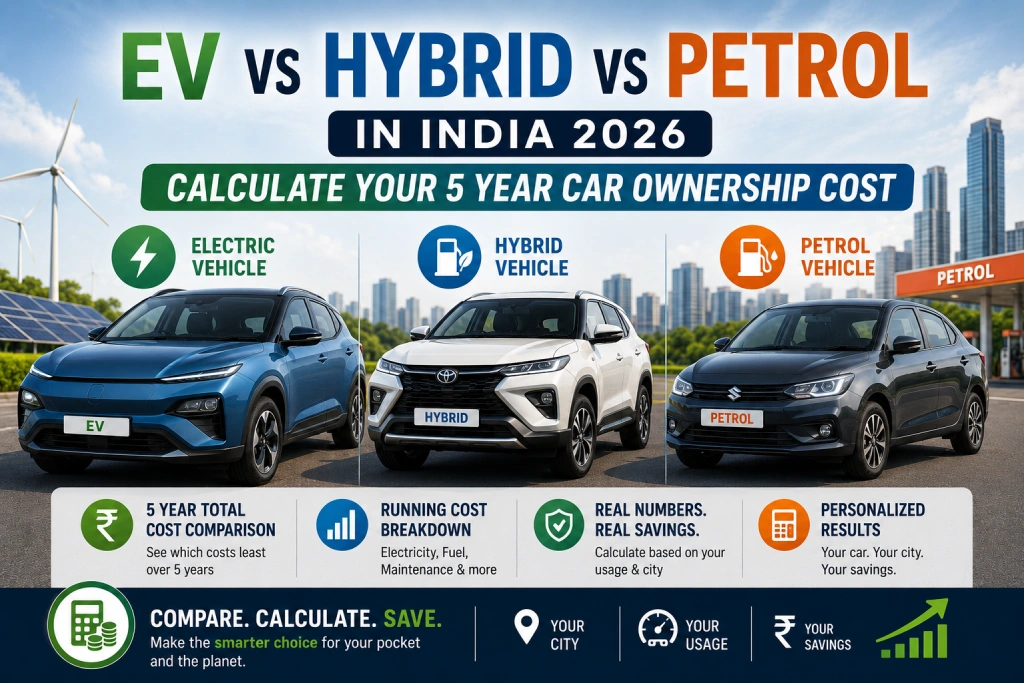
EV vs Hybrid vs Petrol in India 2026: Calculate Your 5-Year Car Ownership Cost
Updated on date: 4 september 2026
Quick answer
There is no universally cheapest choice between an electric vehicle (EV), a self-charging strong hybrid and a petrol car. The lowest-cost option depends on the vehicle's acquisition price, annual kilometres, petrol price, electricity tariff, charging mix, maintenance, insurance, financing, applicable incentives, ownership period and resale value.
That is why comparing only advertised mileage or purchase price can produce the wrong answer for an individual buyer.
The most useful comparison is a 5-year Total Cost of Ownership (TCO) calculation using your own numbers.
Calculate Your 5-Year EV vs Hybrid vs Petrol Cost
Calculate Now| Cost factor | EV | Strong hybrid | Petrol |
|---|---|---|---|
| Primary energy | Electricity | Petrol + electric drive | Petrol |
| Routine external charging | Required | Not required for normal operation | Not required |
| Main running-cost input | kWh/100 km + ₹/kWh | km/l + ₹/litre | km/l + ₹/litre |
| Home-charging access | Important | Not required | Not required |
| Petrol-price sensitivity | Lower | High | High |
| Electricity-tariff sensitivity | High | Low for normal operation | None |
| 5-year winner | Calculator determines | Calculator determines | Calculator determines |
Important: The table describes the calculation framework; it does not predict which powertrain will be cheapest for every buyer.
[Calculate Your 5-Year EV vs Hybrid vs Petrol Cost]
EV vs hybrid vs petrol: what should you compare?
EV vs hybrid vs petrol cost comparison means comparing the total financial cost of owning different powertrains over the same period, rather than comparing only their purchase prices or advertised efficiency figures.
A meaningful comparison should include the costs that actually affect your ownership experience:
- acquisition price;
- annual kilometres;
- petrol price;
- electricity tariff;
- EV charging mix;
- vehicle efficiency;
- maintenance;
- insurance;
- registration and applicable taxes;
- financing, if included;
- resale value; and
- verified incentives.
The result can change substantially when one of these assumptions changes.
For example, an EV's energy-cost calculation depends on electricity consumption and electricity price. A petrol vehicle's calculation depends on fuel efficiency and petrol price. A self-charging strong hybrid can be modelled primarily through petrol consumption because routine external charging is not required.
The correct question is therefore not “Are EVs cheaper?”
The better question is:
“Which vehicle has the lowest total cost for my driving pattern and ownership assumptions?”
That distinction is central to a defensible 2026 car-cost calculator.
How the 5-year ownership-cost calculator works
A 5-year car ownership calculator estimates the total cost of acquiring and operating a vehicle over a selected ownership period, after accounting for energy or fuel, maintenance, insurance and other selected costs and subtracting applicable resale value and verified incentives.
The calculator should allow users to control the assumptions instead of forcing every Indian buyer into the same fuel price, electricity tariff or annual mileage.
1. Enter the vehicle acquisition cost
The calculator should provide two modes:
- Ex-showroom comparison
- On-road ownership comparison
The two modes should not be silently mixed.
For example, Hyundai currently lists the CRETA Electric from ₹18,02,800 ex-showroom, while Hyundai's separate BaaS model starts at ₹10.99 lakh ex-showroom plus a battery usage charge starting at ₹3.9/km. These are different ownership structures and should be calculated separately. (Hyundai)
Toyota's current Innova HyCross page lists the model with petrol and hybrid powertrains and shows a starting ex-showroom price of ₹18.70 lakh on the current page. (Toyota Bharat)
Because manufacturers can change prices and variants, the calculator should store a source date alongside vehicle-price data.
2. Enter annual kilometres
Annual driving distance is one of the most important variables.
Suggested calculator presets:
- 5,000 km
- 10,000 km
- 15,000 km
- 20,000 km
- 25,000+ km
These should be labelled as calculator presets, not claims about average Indian driving.
The user should also be able to enter a custom annual distance.
3. Select ownership period
The default can be:
5 years
The calculator can offer:
- 3 years
- 5 years
- 7 years
- 10 years
The ownership period should affect fuel or charging expenditure, maintenance, insurance and the timing of resale.
4. Enter petrol price
The calculator should ask:
Petrol price: ₹___ / litre
A single India-wide petrol price should not be hard-coded because fuel prices vary by location and can change over time.
The calculator should preferably allow the user to select a city or manually enter the current price.
5. Enter electricity tariff
The calculator should ask:
Home electricity tariff: ₹___ / kWh
A second field should capture:
Public charging price: ₹___ / kWh
The calculator should not present one national household electricity tariff as though it applies to every Indian EV owner.
6. Enter efficiency
Use separate inputs for:
Petrol: km/litre
Hybrid: km/litre
EV: kWh/100 km
The interface should distinguish between:
- manufacturer-certified figures;
- independent test figures, where properly sourced; and
- user's observed real-world figures.
That distinction prevents certified efficiency from being presented as a guaranteed result for every driver.
How to calculate EV running cost
EV running cost per kilometre can be calculated from the vehicle's energy consumption and electricity tariff. If an EV consumes X kWh/100 km and electricity costs ₹Y/kWh, the basic energy cost is X ÷ 100 × Y per kilometre.
EV cost-per-kilometre formula
EV energy cost/km =
(kWh/100 km ÷ 100) × electricity price per kWh
Example using user-entered values
Suppose the calculator user enters:
- EV consumption = X kWh/100 km
- electricity tariff = ₹Y/kWh
The result is:
X ÷ 100 × Y = ₹Z/km
The calculator should calculate the result dynamically.
The values X and Y should come from the user's inputs or from a cited vehicle/tariff database.
Annual EV charging cost
Annual EV charging cost =
annual kilometres × EV kWh/km × electricity tariff
Where:
EV kWh/km = kWh/100 km ÷ 100
Home versus public charging
Charging source matters.
The calculator should therefore allow users to enter a charging split such as:
- 100% home;
- 75% home / 25% public;
- 50% home / 50% public;
- 25% home / 75% public;
- 100% public.
These are calculator choices rather than claims about how Indian EV owners actually charge.
The blended electricity cost can then be calculated from the user's home and public charging prices.
How to calculate hybrid running cost
A self-charging strong hybrid uses petrol as its external fuel source while its hybrid system manages electrical energy internally. Toyota identifies the Innova HyCross Hybrid as a fifth-generation self-charging strong hybrid system. (Toyotabharat)
Toyota's 2026 announcement says the Innova HyCross Hybrid uses a 2.0-litre four-cylinder gasoline engine and a fifth-generation self-charging strong-hybrid system, with stated hybrid system output of 137 kW (186 PS). (Toyotabharat)
Toyota's official specifications separately identify petrol and hybrid powertrains for the Innova HyCross. (Toyota Bharat)
Hybrid fuel-cost formula
Annual hybrid fuel cost =
annual kilometres ÷ hybrid km/litre × petrol price
For example, if a user enters:
- annual distance = X km;
- hybrid efficiency = Y km/l;
- petrol price = ₹Z/litre;
then:
X ÷ Y × Z
produces the estimated annual petrol cost.
The calculator should not automatically convert a manufacturer's certified efficiency figure into a guaranteed real-world mileage figure.
Why hybrid calculation differs from EV calculation
For the self-charging hybrid model, the primary externally purchased energy input is petrol.
For the EV model, the primary externally purchased energy input is electricity.
The two powertrains therefore require different running-cost inputs.
How to calculate petrol running cost
Petrol running cost per kilometre is calculated by dividing the petrol price per litre by the vehicle's fuel efficiency in kilometres per litre.
Petrol cost-per-kilometre formula
Petrol cost/km =
petrol price per litre ÷ km/litre
Annual petrol cost
Annual petrol cost =
annual kilometres ÷ petrol efficiency × petrol price
The calculator should use the selected vehicle's efficiency rather than assigning a generic mileage figure to all petrol cars.
For example, Hyundai currently lists the CRETA with a 1.5-litre petrol engine, 1.5-litre diesel engine and 1.5-litre turbo-petrol engine. (Hyundai)
Hyundai's current CRETA range is listed from ₹10.90 lakh to ₹20.11 lakh ex-showroom, with petrol and diesel powertrains. (Hyundai)
Those figures demonstrate why the calculator should use specific vehicle/variant inputs, rather than treating “petrol SUV” as a single standard product.
What belongs in 5-year TCO?
Five-year TCO should combine acquisition and ownership costs while allowing optional components to be switched on or off.
A practical formula is:
TCO =
acquisition cost
+ fuel/charging cost
+ maintenance
+ insurance
+ taxes/registration
+ financing cost
− resale value
− verified incentives
Acquisition cost
Use either:
- ex-showroom price for a controlled comparison; or
- on-road acquisition cost for an ownership comparison.
Do not combine ex-showroom price for one vehicle with on-road price for another.
Fuel or charging
Calculate:
- petrol fuel expenditure for petrol;
- petrol fuel expenditure for a self-charging strong hybrid;
- electricity expenditure for an EV.
Maintenance
Maintenance should be entered using a documented vehicle-specific figure or user estimate.
The calculator should not make unsupported claims such as:
“EV maintenance is always 50% cheaper.”
A numerical maintenance comparison requires a specific source and defined maintenance scope.
Insurance
Insurance can be included as:
- annual user-entered insurance;
- sourced vehicle-specific estimate; or
- a manually entered five-year total.
Insurance should not be silently assumed to be identical across different vehicles.
Taxes and registration
For an on-road comparison, applicable registration and other charges should be vehicle- and location-specific.
The calculator should therefore provide either:
Registration/tax: ₹___
or a location-specific data source.
Financing
Financing should be an optional component.
A buyer paying cash and a buyer financing the vehicle can have different total ownership costs even when the underlying vehicle price is identical.
Resale value
Resale value is particularly sensitive to:
- vehicle;
- age;
- mileage;
- condition;
- market conditions;
- variant; and
- timing.
The calculator should therefore allow a user-entered resale estimate unless a reliable current dataset is available.
Do not invent a universal depreciation percentage.
2026 vehicle examples
The purpose of these examples is to demonstrate how the calculator can use currently documented vehicles. The examples should not be interpreted as an apples-to-apples recommendation because the vehicles occupy different market positions and body styles.
Hyundai CRETA Electric: EV example
Hyundai's current CRETA Electric specification page lists two battery capacities:
- 42 kWh
- 51.4 kWh
The same page lists certified driving ranges of:
- 420 km for the 42 kWh version;
- 510 km for the 51.4 kWh version.
Hyundai identifies the range as being based on the MIDC Part 1 + Part 2 cycle. (Hyundai)
Hyundai's current price page lists the CRETA Electric from ₹18,02,800 ex-showroom, while noting that prices can vary by state, city, variant and applicable charges. (Hyundai)
CRETA Electric BaaS is a separate calculation
Hyundai announced its Battery-as-a-Service model on 2 July 2026.
The announcement states:
- starting vehicle price: ₹10.99 lakh ex-showroom;
- battery EMI starting at ₹3.9/km;
- BaaS separates the battery payment from the vehicle's upfront price. (Hyundai)
Hyundai's own BaaS explainer contrasts the conventional CRETA Electric ownership structure with BaaS and identifies the battery usage payment as a separate cost. (Hyundai)
Therefore, the calculator should have two distinct scenarios:
Scenario A — Conventional EV ownership
Vehicle acquisition
+ charging
+ maintenance
+ insurance
+ other selected costs
− resale
Scenario B — CRETA Electric BaaS
Lower vehicle acquisition cost
+ battery usage charges
+ charging
+ maintenance
+ insurance
+ other selected costs
− resale
Do not subtract the BaaS battery fee from the conventional EV purchase price.
Toyota Innova HyCross Hybrid: strong-hybrid example
Toyota's 2026 announcement states that the Innova HyCross crossed 2 lakh cumulative sales in India by April 2026. Toyota also describes the vehicle as using a fifth-generation self-charging strong-hybrid system. (Toyotabharat)
Toyota states that the hybrid version uses a 2.0-litre four-cylinder gasoline engine and delivers 137 kW (186 PS) system output. (Toyotabharat)
Toyota's official specifications list petrol and hybrid versions separately and identify the hybrid engine as a fifth-generation hybrid with a four-cylinder engine. (Toyotabharat)
Toyota's current model page lists the Innova HyCross from ₹18.70 lakh ex-showroom. (Toyota Bharat)
The model therefore provides a clearly documented current example of a self-charging strong hybrid.
Hyundai CRETA petrol: petrol example
Hyundai's current CRETA lineup includes petrol and diesel versions. The manufacturer lists a 1.5-litre petrol, 1.5-litre diesel and 1.5-litre turbo-petrol engine range. (Hyundai)
Hyundai's current CRETA price page lists the model from ₹10,90,700 ex-showroom and states that the price varies by variant, engine and transmission. (Hyundai)
Important model correction
The current Hyundai India lineup does not establish a production “CRETA HEV” or “VERNA HEV” model.
Hyundai's current lineup lists the VERNA with a 1.5-litre Turbo GDi petrol and 1.5-litre MPi petrol powertrain. (Hyundai)
The current CRETA listing likewise identifies petrol and diesel powertrains rather than a hybrid version. (Hyundai)
Therefore, a 2026 comparison should use a documented strong-hybrid vehicle such as the Toyota Innova HyCross rather than describing a “CRETA HEV” or “VERNA HEV” as a current production model.
When does an EV or hybrid break even?
Break-even kilometres estimate how far a vehicle must be driven before its lower running cost offsets its higher upfront acquisition cost.
The basic formula is:
Break-even kilometres =
additional upfront cost
÷ running-cost saving per kilometre
Example structure
Suppose the calculator determines:
Vehicle A costs ₹X more upfront
Vehicle A saves ₹Y/km in running cost
Then:
Break-even =
X ÷ Y kilometres
The actual values must come from the user's selected vehicles and assumptions.
When break-even should not be shown
If the alternative vehicle has:
- zero running-cost advantage; or
- a higher running cost;
the calculator should not manufacture a break-even distance.
Instead display:
There is no running-cost break-even under your current assumptions.
This is important because a mathematical break-even figure only exists when the denominator represents a genuine positive running-cost saving.
Break-even versus TCO
Break-even kilometres and TCO are related but not identical.
A vehicle may have lower running costs but still have a higher total ownership cost over a short ownership period because the upfront price difference has not been recovered.
Conversely, a vehicle can reach running-cost break-even and subsequently become the lower-cost option if the other ownership assumptions remain favourable.
That is why the calculator should show both:
- 5-year TCO
- Break-even kilometres
How petrol prices affect the result
Petrol price directly affects the running cost of petrol and self-charging hybrid vehicles because both calculations use petrol consumption multiplied by petrol price.
The calculator should therefore make petrol price a user-controlled input.
Higher petrol price
A higher petrol price increases:
Petrol cost/km
and:
Hybrid fuel cost/km
assuming efficiency remains unchanged.
Lower petrol price
A lower petrol price reduces both values.
The effect on the final TCO depends on:
- annual kilometres;
- vehicle efficiency;
- ownership period;
- acquisition-price difference; and
- other ownership costs.
The calculator should therefore show sensitivity rather than declare a permanent winner.
How electricity tariffs affect EV economics
EV energy cost depends directly on electricity consumption and the tariff paid for the electricity used to charge the vehicle.
The basic calculation is:
EV cost/km =
kWh/100 km ÷ 100 × ₹/kWh
However, the effective cost can depend on where the vehicle is charged.
Home charging
Use:
Home charging share × home electricity tariff
Public charging
Use:
Public charging share × public charging price
Blended charging cost
A calculator can therefore estimate a blended charging price from the user's selected charging mix.
For example:
Blended cost =
(home share × home tariff)
+
(public share × public tariff)
The shares should total 100%.
This approach is preferable to publishing a single India-wide “EV charging cost per km” figure because the user's electricity tariff and charging behaviour can materially change the result.
Maintenance, insurance and resale
Maintenance
Maintenance should be included when the data is available.
But the article should avoid unsupported universal percentages.
A claim such as:
“EV maintenance costs 50% less than petrol.”
requires a specific source, defined maintenance scope, vehicle comparison and time period.
Without those details, the calculator should allow the user to enter actual or estimated annual maintenance.
Insurance
Insurance should be treated as a vehicle-specific ownership cost.
The calculator can provide:
Annual insurance: ₹____
and multiply the value by the selected ownership period if the user chooses a flat annual assumption.
For greater accuracy, the interface can also permit year-by-year insurance inputs.
Resale
Resale should be an explicit input.
Estimated resale value after ownership period: ₹____
If reliable vehicle-specific resale data is available, the calculator can offer a sourced default.
Otherwise, user input is preferable to an invented depreciation rate.
PM E-DRIVE and EV incentives
PM E-DRIVE is a Government of India electric-mobility scheme with a total outlay of ₹10,900 crore that was extended from 31 March 2026 to 31 March 2028, but the scheme's different vehicle segments have different eligibility periods and conditions. (Press Information Bureau)
The Ministry of Heavy Industries says the original scheme was notified with an outlay of ₹10,900 crore for two years and was subsequently extended to 31 March 2028 within the same outlay. (Press Information Bureau)
The government also describes PM E-DRIVE as supporting multiple EV categories and charging infrastructure. (Heavy Industries Ministry)
Do not automatically subtract PM E-DRIVE from every private EV
This is a critical calculator rule.
Government material specifies demand incentives for particular categories, including e-2Ws, e-3Ws, e-trucks and e-ambulances, rather than establishing a universal purchase discount for every private electric passenger car. (Heavy Industries Ministry)
Therefore, the calculator should use:
Applicable verified EV incentive: ₹_____
The amount should be entered only after checking:
- vehicle eligibility;
- vehicle category;
- purchase date;
- applicable scheme period;
- registration requirements;
- state-specific incentives, if any; and
- scheme conditions.
The official government extension also states that the scheme is fund-limited and that the relevant scheme or sub-component can close if allocated funds are exhausted before the terminal date. (Press Information Bureau)
Which powertrain fits which buyer?
An EV can be financially attractive when:
- the purchase-price difference is manageable;
- the user has suitable charging access;
- annual kilometres are sufficient for running-cost differences to matter;
- electricity costs are favourable;
- the ownership period is long enough to recover the acquisition difference; and
- resale and other ownership assumptions do not reverse the result.
These are calculator conditions, not a claim that every EV buyer will save money.
A strong hybrid can be attractive when:
- the buyer wants lower petrol consumption without routine external charging;
- petrol prices make efficiency valuable;
- the buyer wants conventional refuelling;
- the vehicle's acquisition premium can be justified by expected fuel savings; and
- the ownership period and annual kilometres support the economics.
Toyota describes the Innova HyCross Hybrid as a self-charging strong hybrid. (Toyotabharat)
A petrol vehicle can be attractive when:
- acquisition cost is lower;
- annual kilometres are relatively low;
- the buyer values conventional refuelling;
- the selected petrol vehicle has an appropriate efficiency level; and
- the full ownership calculation remains favourable.
The calculator should not label petrol, hybrid or EV as the default winner.
How to use the calculator
Step 1: Select the vehicles
Choose:
- EV;
- strong hybrid;
- petrol.
Use specific model and variant data whenever possible.
Step 2: Choose the price basis
Select:
- ex-showroom; or
- on-road.
Do not mix the two.
Step 3: Enter annual kilometres
Enter your expected yearly driving distance.
Step 4: Select ownership period
Choose:
- 3;
- 5;
- 7; or
- 10 years.
Step 5: Enter petrol price
Enter the current price you actually expect to pay.
Step 6: Enter electricity prices
Enter:
- home electricity tariff;
- public charging price.
Step 7: Enter charging mix
Specify the percentage of EV charging performed at home and in public.
Step 8: Enter efficiency
Enter:
- petrol km/l;
- hybrid km/l;
- EV kWh/100 km.
Where available, label each value as certified or user-observed.
Step 9: Enter maintenance and insurance
Add annual or ownership-period estimates.
Step 10: Add financing
Turn financing on if you want the calculator to include borrowing costs.
Step 11: Add resale
Enter the expected resale value.
Step 12: Add verified incentives
Enter only incentives for which eligibility has been confirmed.
Step 13: Calculate TCO
The calculator should return:
| Cost component | EV | Hybrid | Petrol |
|---|---|---|---|
| Acquisition | Calculated | Calculated | Calculated |
| Fuel/charging | Calculated | Calculated | Calculated |
| Maintenance | User input | User input | User input |
| Insurance/other | User input | User input | User input |
| Resale | User input/calculated | User input/calculated | User input/calculated |
| Incentive | Verified input | Verified input | Verified input |
| 5-year TCO | Calculated | Calculated | Calculated |
Step 14: Show the mathematical winner
The result should say:
Lowest estimated 5-year cost: [calculated vehicle]
The result should be based entirely on the user's inputs.
There should be no predetermined EV, hybrid or petrol winner.
❓ Frequently Asked Questions
Is an EV cheaper than a hybrid over five years?
Not necessarily. An EV can have lower energy costs under favourable charging assumptions, but the final five-year TCO also depends on acquisition price, annual kilometres, maintenance, insurance, incentives, financing and resale. The calculator should determine the result from the buyer's actual inputs rather than assuming that EVs are always cheaper.
Is a hybrid cheaper than a petrol car?
A strong hybrid can have lower fuel expenditure than a comparable petrol vehicle, but lower fuel expenditure does not automatically mean lower five-year TCO. The acquisition-price difference, annual kilometres, petrol price, maintenance, insurance and resale assumptions all affect the final result.
What is EV running cost per kilometre?
EV running cost per kilometre can be calculated as electricity consumption in kWh/100 km divided by 100 and multiplied by the electricity tariff. For example, the formula is kWh/100 km ÷ 100 × ₹/kWh. The actual result depends on the user's consumption and electricity price.
What is hybrid running cost per kilometre?
For a self-charging strong hybrid, a basic fuel-cost calculation is petrol price per litre divided by the hybrid's kilometres per litre. The calculation should use a vehicle-specific efficiency figure rather than treating all hybrids as having the same mileage.
What is petrol running cost per kilometre?
Petrol running cost per kilometre equals petrol price per litre divided by kilometres travelled per litre. The formula is ₹/litre ÷ km/litre. Actual ownership cost also depends on annual distance and other vehicle costs.
Does home charging make an EV cheaper?
Home charging can change EV running-cost economics because the electricity tariff used for charging affects the cost per kilometre. The calculator should therefore allow the user to enter a home tariff and a separate public-charging price instead of assuming one universal charging cost.
Should public charging be included in EV TCO?
Yes, when the buyer uses public charging. The calculator should allow the user to specify the percentage of charging performed publicly and the applicable public-charging price.
Should maintenance be included in a 5-year car comparison?
Yes, if reliable maintenance data is available. Otherwise, the calculator should allow the user to enter an annual or ownership-period estimate. Unsupported universal claims about EV, hybrid or petrol maintenance should not be used.
Should resale value be included in TCO?
Yes. Resale value can materially affect total ownership cost because the owner does not necessarily bear the vehicle's entire acquisition cost when the vehicle is sold. If reliable current resale data is unavailable, user-entered resale value is preferable to an invented depreciation percentage.
Should loan interest be included?
It depends on the calculator's purpose. A financing-aware ownership comparison should include financing cost because two buyers can pay different amounts for the same vehicle depending on their borrowing arrangements. A cash-purchase comparison can switch financing off.
Does PM E-DRIVE apply to every private electric car?
No universal passenger-car purchase discount should be assumed. Government material identifies specific vehicle categories receiving demand incentives under PM E-DRIVE, so the calculator should verify eligibility before subtracting an incentive. (Heavy Industries Ministry)
Is PM E-DRIVE still active in 2026?
The PM E-DRIVE scheme's overall tenure was extended from 31 March 2026 to 31 March 2028 within its ₹10,900 crore outlay. However, different sub-components have different timelines and conditions, so the calculator should verify the applicable category and date rather than treating 31 March 2028 as universal eligibility for every EV. (Press Information Bureau)
Is the Toyota Innova HyCross a self-charging hybrid?
Yes. Toyota describes the Innova HyCross Hybrid as using a fifth-generation self-charging strong-hybrid electric system. Toyota's 2026 announcement also identifies a 2.0-litre four-cylinder gasoline engine and 137 kW (186 PS) hybrid system output. (Toyotabharat)
What battery options does the Hyundai CRETA Electric have?
Hyundai currently lists 42 kWh and 51.4 kWh battery options for the CRETA Electric. Hyundai lists certified driving ranges of 420 km and 510 km respectively under its stated MIDC certification conditions. (Hyundai)
Does Hyundai offer a BaaS version of the CRETA Electric?
Yes. Hyundai announced its Battery-as-a-Service model in July 2026. Hyundai states that the BaaS version starts at ₹10.99 lakh ex-showroom, with battery EMI starting at ₹3.9/km. The BaaS model should be calculated separately from conventional battery-included EV ownership. (Hyundai)
Are Hyundai CRETA HEV and VERNA HEV current production models?
The current Hyundai India sources do not establish those models as current production hybrid vehicles. Hyundai's current CRETA lineup lists petrol and diesel powertrains, while the current VERNA listing identifies 1.5-litre Turbo GDi petrol and 1.5-litre MPi petrol engines. (Hyundai)
Compare Another Car
Calculate NowKey takeaways
- There is no universal winner between EV, strong hybrid and petrol.
- Purchase price alone does not determine five-year ownership cost.
- Annual kilometres strongly affect the economics of lower running-cost vehicles.
- Petrol price affects both petrol and self-charging hybrid fuel costs.
- Electricity tariff affects EV charging cost.
- Home/public charging mix should be an explicit EV-calculator input.
- Certified vehicle figures should not automatically be presented as real-world results.
- Maintenance should be sourced or entered rather than based on unsupported percentages.
- Resale value should be sourced where possible or entered by the user.
- Financing should be optional.
- EV incentives should only be deducted after eligibility is verified.
- PM E-DRIVE's ₹10,900 crore scheme was extended to 31 March 2028, but that does not create a universal passenger-EV subsidy. (Press Information Bureau)
- The Hyundai CRETA Electric currently has 42 kWh and 51.4 kWh battery options with Hyundai-listed certified ranges of 420 km and 510 km. (Hyundai)
- The Toyota Innova HyCross provides a current documented example of a fifth-generation self-charging strong hybrid. (Toyotabharat)
- The calculator—not a blanket editorial claim—should determine the lowest-cost option.
Conclusion
EV, strong hybrid and petrol cars cannot be ranked as universally cheapest without knowing the buyer's actual assumptions.
An EV's economics depend heavily on acquisition cost, annual kilometres, electricity tariff and charging mix. A strong hybrid's running-cost model depends primarily on petrol consumption and petrol price. A petrol car can remain financially competitive when its acquisition cost and operating assumptions produce the lower total.
The most defensible approach is therefore to calculate the complete ownership picture:
Acquisition
+ fuel/charging
+ maintenance
+ insurance
+ taxes/registration
+ financing
− resale
− verified incentives
= Total Cost of Ownership
The EV vs hybrid vs petrol cost calculator should let the buyer change the assumptions and immediately see how the result changes.
That makes the calculator more useful than a static claim that one powertrain is always cheaper.
Authority references
- Hyundai CRETA Electric specifications
- Hyundai CRETA Electric price
- Hyundai CRETA Electric BaaS announcement
- Hyundai India current model lineup
- Toyota Innova HyCross official specifications
- Toyota Innova HyCross 2-lakh sales and hybrid-system announcement
- PIB — PM E-DRIVE extension to 31 March 2028
- Ministry of Heavy Industries — PM E-DRIVE scheme details
Editorial data policy
For every dynamic value displayed by the calculator—vehicle price, certified efficiency/range, fuel price, electricity tariff, incentive, maintenance estimate or resale estimate—the production implementation should retain:
Value → source → source date → applicability/variant → calculation timestamp
That approach keeps the calculator transparent and makes future updates auditable.