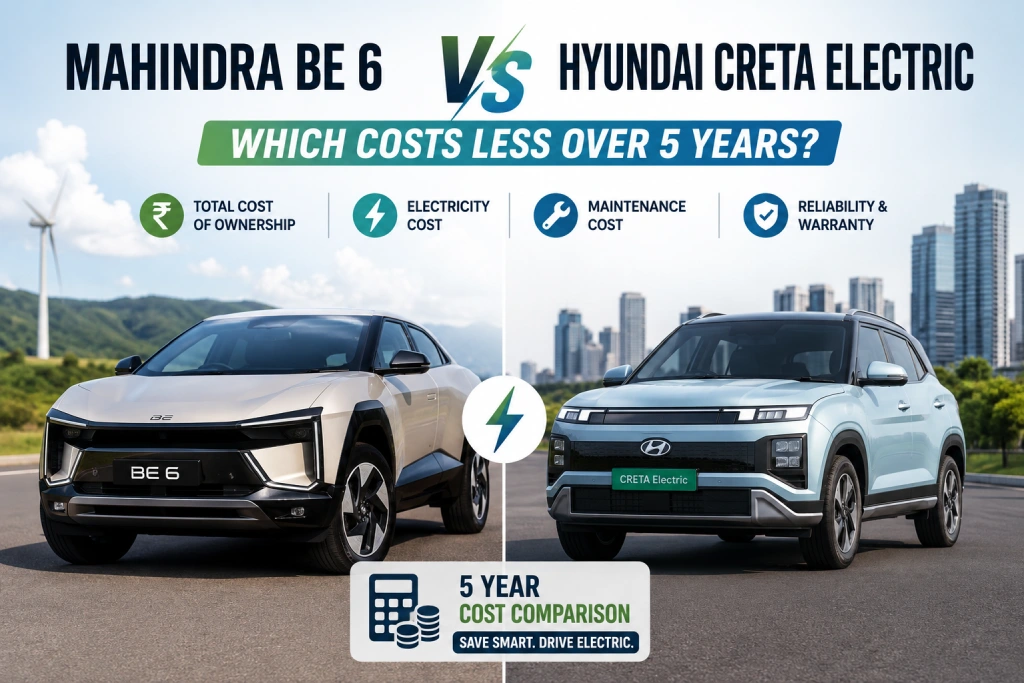
Mahindra BE 6 vs Hyundai CRETA Electric: Which Costs Less Over 5 Years?
Updated on date: 3 september 2026
Introduction
The question “Mahindra BE 6 vs Hyundai CRETA Electric: which costs less over five years?” cannot be answered reliably by comparing only ex-showroom prices.
A five-year EV ownership calculation depends on several variables: the exact vehicle variant, purchase price, charger and installation cost, annual kilometres, electricity tariff, home-versus-public charging mix, charging losses, maintenance, insurance and—if you choose to include it—resale value.
The comparison is particularly important because the two vehicles have different battery configurations. The BE 6 Pack Two uses a 59 kWh battery, while Hyundai offers the CRETA Electric with 42 kWh and 51.4 kWh battery options. (Mahindra Booking)
For this comparison, the defined vehicles are:
- Mahindra BE 6 Pack Two — 59 kWh
- Hyundai CRETA Electric Long Range — 51.4 kWh
Mahindra currently lists the BE 6 Pack Two 59 kWh at ₹21.90 lakh ex-showroom, excluding charger and installation. (Mahindra Booking) Hyundai currently lists the CRETA Electric from ₹18,02,800 ex-showroom, but that is the model's starting price rather than a verified price for the specific 51.4 kWh Long Range variant. (Hyundai)
That distinction matters. A meaningful five-year TCO comparison should use the actual selected variant's purchase price rather than comparing one model's starting price against another model's higher-specification version.
Quick Answer: Which Is Cheaper Over Five Years?
There is no universal five-year cost winner between the Mahindra BE 6 and Hyundai CRETA Electric. The result depends mainly on the exact purchase price, annual kilometres, electricity tariff, charging mix, charging losses, insurance, maintenance and resale assumptions.
The BE 6 Pack Two has a 59 kWh battery and a 557 km ARAI/MIDC P1+P2 certified range. Mahindra separately quotes approximately 400 km of city range from its internal testing with the air conditioner switched on. (Mahindra Booking)
The CRETA Electric Long Range has a 51.4 kWh battery and a 510 km ARAI-certified range under the manufacturer's stated test methodology. (Hyundai)
The important point
A higher certified range does not automatically mean lower five-year ownership cost.
Likewise, a lower purchase price does not automatically make one EV cheaper to own.
The calculator should determine the result using the buyer's own:
- Annual kilometres
- Electricity tariff
- Home-charging percentage
- Public-charging percentage
- Charging-loss assumption
- Maintenance budget
- Insurance quote
- Optional resale assumption
5-Year EV TCO Calculator
What is EV total cost of ownership?
EV total cost of ownership (TCO) is the total cost of acquiring and operating an electric vehicle over a defined ownership period, minus any resale value included in the calculation.
For this comparison:
Gross 5-year TCO = Purchase price + charger/installation + electricity + maintenance + insurance + other selected costs
If resale is enabled:
Net 5-year TCO = Gross 5-year TCO − estimated resale value
These are calculator formulas, not manufacturer claims.
Calculator inputs
The calculator should allow you to change:
| Input | BE 6 | CRETA Electric |
|---|---|---|
| Vehicle | BE 6 Pack Two | CRETA Electric 51.4 kWh |
| Ownership period | User input | User input |
| Annual kilometres | User input | User input |
| Electricity tariff | User input | User input |
| Home charging share | User input | User input |
| Public charging share | User input | User input |
| Charging losses | User input/model assumption | User input/model assumption |
| Maintenance | User input/verified data | User input/verified data |
| Insurance | Actual quote/input | Actual quote/input |
| Resale | Optional assumption | Optional assumption |
This approach avoids presenting a nationwide electricity price, insurance premium or five-year maintenance figure as if every Indian buyer faces the same cost.
BE 6 vs CRETA Electric: What Are We Comparing?
Mahindra BE 6 Pack Two — 59 kWh
The Mahindra BE 6 Pack Two uses a 59 kWh battery. Mahindra lists its ARAI MIDC P1+P2 certified range at 557 km and separately states approximately 400 km real-world city range based on internal testing in city conditions with AC on. (Mahindra Booking)
Mahindra currently lists the Pack Two 59 kWh at ₹21.90 lakh ex-showroom, excluding charger and installation. The company's terms state that 7.2 kW and 11.2 kW charger options are available at additional cost. (Mahindra Booking)
The BE 6 uses CCS2 charging. Mahindra's official brochure specifies 7.2 kW and 11.2 kW AC wall-charger options and quotes 20–80% DC charging in approximately 20 minutes under specified charger conditions. (Mahindra Booking)
Mahindra's terms also state a lifetime battery warranty for the first registered owner under private-registration conditions. If ownership changes, the HV battery warranty becomes 10 years or 2,00,000 km, whichever occurs earlier, subject to the stated terms. (Mahindra Booking)
BE 6 data classification
Known manufacturer data
- Battery: 59 kWh
- Certified range: 557 km
- Manufacturer internal city-test figure: approximately 400 km
- Pack Two price: ₹21.90 lakh ex-showroom
- CCS2 charging
- 7.2 kW / 11.2 kW AC wall-charger options
- Stated 20–80% DC charging time: approximately 20 minutes under specified conditions
- Battery warranty terms described above
Calculator inputs
- Electricity tariff
- Annual kilometres
- Charging mix
- Insurance
- Maintenance
- Optional resale value
Model assumptions
- Charging-loss percentage, if the user does not enter one
- Any efficiency figure not independently established for the precise use case
Calculated outputs
- Annual electricity cost
- Five-year electricity cost
- Gross TCO
- Net TCO
- Cost/km
- Monthly equivalent
- Break-even mileage
Hyundai CRETA Electric Long Range — 51.4 kWh
Hyundai currently offers the CRETA Electric with 42 kWh and 51.4 kWh liquid-cooled lithium-ion battery packs. The 51.4 kWh Long Range configuration is listed with a 510 km MIDC Part 1 + Part 2 certified range. (Hyundai)
The 51.4 kWh Long Range version has a 126 kW / 171 PS traction motor. (Hyundai)
Hyundai specifies CCS2 charging. Its specifications page lists an estimated 7 hours 15 minutes for 10–100% AC charging from a 7.4 kW charger for the 51.4 kWh version and approximately 39 minutes for 10–80% DC charging using a suitable DC fast charger. (Hyundai)
Hyundai explicitly cautions that actual charging time can vary according to factors including battery charge level, charger output, vehicle and battery settings, battery temperature, ambient temperature and uninterrupted power supply. (Hyundai)
CRETA Electric data classification
Known manufacturer data
- Battery: 51.4 kWh
- Certified range: 510 km
- Motor output: 126 kW / 171 PS
- Charging standard: CCS2
- AC charger: 7.4 kW
- Stated 10–80% DC charging time: approximately 39 minutes under specified conditions
(Hyundai)
Calculator inputs
- Exact purchase price of selected variant
- Electricity tariff
- Annual kilometres
- Charging mix
- Insurance
- Maintenance
- Optional resale
Purchase Price: The First Major TCO Difference
Mahindra's official terms currently list the BE 6 Pack Two 59 kWh at ₹21.90 lakh ex-showroom, without charger and installation. (Mahindra Booking)
Hyundai currently lists the CRETA Electric at a starting ex-showroom price of ₹18,02,800. Hyundai also states that prices can vary according to state, city, variant and applicable charges. (Hyundai)
The critical issue is that ₹18,02,800 is a starting price, not the verified purchase price of the 51.4 kWh Long Range configuration.
Therefore, the calculator should not automatically perform:
₹21.90 lakh − ₹18.028 lakh
and label the difference as the purchase-price advantage of the two selected vehicles.
That would mix two different configurations.
Correct calculator treatment
For the BE 6:
Purchase price = ₹21.90 lakh, subject to the applicable current terms
For the CRETA Electric:
Purchase price = user-selected/current verified price for the exact 51.4 kWh variant
The calculator should display a warning if a starting price rather than a variant-specific price is being used.
What About Hyundai CRETA Electric BaaS?
The 2026 comparison also has another complication: Battery-as-a-Service (BaaS).
Hyundai announced CRETA Electric BaaS on 2 July 2026. Under the announced model, the CRETA Electric starts at ₹10.99 lakh ex-showroom, while the battery payment starts at ₹3.9 per kilometre. (Hyundai)
That means a BaaS CRETA Electric should not be compared with an outright-purchase BE 6 using only the initial ex-showroom price.
The BaaS calculation needs to treat the battery payment as an ongoing ownership cost.
Hyundai itself describes the BaaS model as separating the battery payment from the vehicle invoice, with the battery fee starting at ₹3.9/km. (Hyundai)
Therefore, the calculator should eventually offer separate scenarios:
Scenario A — Conventional EV ownership
Vehicle + battery purchased together.
Scenario B — CRETA Electric BaaS
Lower vehicle acquisition price + applicable battery usage payments.
These two ownership structures should never be mixed into one simplistic purchase-price comparison.
Energy Cost: How Much Does Each EV Cost to Drive?
What is EV energy cost?
EV energy cost is the cost of the electricity required to replenish the energy consumed during driving, including charging losses when the calculation is based on electricity purchased from the grid.
A transparent calculation is:
Annual electricity cost = annual kilometres × energy consumed per kilometre × effective electricity price
If charging losses are modelled:
Grid electricity required = vehicle energy requirement ÷ charging efficiency
The calculator should therefore expose the charging-loss assumption instead of hiding it.
Why certified range should not be converted directly into a universal ₹/km figure
The BE 6's 557 km figure is an ARAI MIDC-certified figure, while Mahindra separately publishes an approximately 400 km internal city-condition result for the 59 kWh vehicle with AC on. (Mahindra Booking)
Hyundai's 510 km CRETA Electric figure is also a certified figure under the manufacturer's stated test conditions. (Hyundai)
Those figures should not be presented as guaranteed everyday driving range.
The difference between certified and actual consumption is exactly why the calculator should either:
- use a verified efficiency dataset appropriate to the calculation, or
- allow the user to enter an efficiency assumption.
The article should never silently convert certified range into a claimed real-world ₹/km cost.
Five-Year Running-Cost Scenarios
A useful calculator should show at least three annual-mileage scenarios.
Low-use scenario: 5,000 km/year
This scenario represents a relatively low annual driving distance.
The calculator should calculate:
- 5,000 km × selected energy-consumption assumption
- Charging losses
- Home/public charging split
- Electricity tariff
- Resulting annual energy cost
- Resulting five-year energy cost
No universal rupee result should be published unless the electricity price and efficiency assumptions are explicitly stated.
Typical-use scenario: 10,000 km/year
At 10,000 km/year, the calculator should repeat the same methodology.
The important comparison is not simply:
“Car A costs ₹X/km.”
Instead, the calculator should tell the user:
“Using your electricity tariff, annual mileage and charging mix, Car A's five-year electricity cost is ₹X compared with ₹Y for Car B.”
That makes the result reproducible.
High-use scenario: 20,000 km/year
At 20,000 km/year, energy costs become more significant because the driver purchases substantially more electricity over five years.
This is where a break-even calculation becomes particularly useful.
However, the calculator should still use the same transparent variables rather than assuming that higher mileage automatically makes one vehicle cheaper.
Maintenance Cost Over Five Years
Maintenance is one area where a TCO calculator should resist the temptation to publish an attractive but unsupported number.
Hyundai's warranty policy states that the CRETA Electric has a 3-year/unlimited-kilometre vehicle warranty. (Hyundai)
Hyundai's official maintenance information can establish service requirements, but a service interval does not automatically establish the total rupee amount that an individual owner will pay over five years.
For that reason, the calculator should distinguish between:
Verified maintenance price
A current authorised-service quotation or manufacturer/dealer service package.
Maintenance interval
The manufacturer's specified service schedule.
User estimate
The amount the owner expects to spend.
Model assumption
A value used solely to make a scenario operational where verified pricing is unavailable.
The same discipline should be applied to the BE 6.
Do not publish “five-year maintenance = ₹X” unless the underlying service-price data can be independently verified.
Insurance Cost
Insurance is another variable that should remain editable.
A single nationwide insurance number would be misleading because the actual premium can depend on factors such as:
- Vehicle variant
- Registration location
- Insurer
- Insured declared value
- Policy terms
- Add-ons
- Driver/customer-specific factors
The calculator should therefore ask:
What is your actual annual insurance quote?
The user can enter the first-year premium and either enter projected future premiums separately or apply a clearly labelled modelling assumption.
This produces a more defensible TCO calculation than presenting a generic insurance figure as fact.
Battery and Vehicle Warranty
BE 6 warranty
Mahindra states that the BE 6 battery carries a lifetime warranty for the first registered owner, applicable to private registration. In the event of ownership change, Mahindra states that the HV battery warranty becomes 10 years or 2,00,000 km, whichever occurs earlier, subject to its stated terms. (Mahindra Booking)
The BE 6 brochure likewise specifies lifetime HV-battery warranty terms and the ownership-transfer provision. (Mahindra Booking)
CRETA Electric warranty
Hyundai's current warranty policy lists the CRETA Electric vehicle warranty as 3 years/unlimited kilometres. (Hyundai)
Hyundai's CRETA Electric brochure specifies an 8-year/160,000-km battery warranty, whichever occurs earlier. (Hyundai)
Why warranty should not decide TCO by itself
Warranty affects risk exposure, but warranty duration is not the same as ownership cost.
A buyer should therefore treat warranty as a separate decision factor while allowing the TCO calculator to focus on actual financial inputs.
Charging: BE 6 vs CRETA Electric
BE 6
Mahindra specifies CCS2 charging, 7.2 kW and 11.2 kW AC wall-charger options, and approximately 20-minute 20–80% DC charging under specified charger conditions for the relevant configurations. (Mahindra Booking)
CRETA Electric
Hyundai specifies CCS2 charging and a 7.4 kW AC wallbox. The official specification page lists approximately 39 minutes for 10–80% DC charging with a suitable DC fast charger. (Hyundai)
Hyundai explicitly notes that charging time varies with battery state, charger output, battery temperature, ambient conditions and other factors. (Hyundai)
What matters for TCO?
The biggest financial question is not simply which car charges faster.
It is:
How much of your charging will happen at home, and how much will happen at paid public chargers?
A buyer who charges predominantly at home may have a very different five-year electricity bill from a buyer who relies heavily on public DC charging.
That is why the calculator must expose both:
- Home charging %
- Public charging %
Five-Year TCO Table
The publication version should use the following structure.
| Cost component | BE 6 Pack Two | CRETA Electric 51.4 kWh |
|---|---|---|
| Purchase price | ₹21.90 lakh* | Exact variant input |
| Charger/installation | Input | Input |
| 5-year electricity | Calculated | Calculated |
| 5-year maintenance | Input/verified | Input/verified |
| 5-year insurance | User input | User input |
| Other ownership costs | Input | Input |
| Gross 5-year cost | Calculated | Calculated |
| Resale value | Optional | Optional |
| Net 5-year TCO | Calculated | Calculated |
| Cost/km | Calculated | Calculated |
| Monthly equivalent | Calculated | Calculated |
*Mahindra's current official terms list ₹21.90 lakh for the BE 6 Pack Two 59 kWh excluding charger and installation. (Mahindra Booking)
Important: The CRETA Electric purchase-price cell should remain an exact-variant input until the current price of the selected 51.4 kWh variant is independently verified.
Break-Even Analysis
What is TCO break-even mileage?
Break-even mileage is the annual or cumulative driving distance at which the ownership-cost advantage from lower operating costs offsets a higher initial cost, given a defined set of assumptions.
The calculation should not be performed using purchase price and electricity cost alone.
The model should include all relevant variables being compared.
For example:
Upfront-cost difference
versus
Five-year operating-cost difference
The break-even point changes when the following inputs change:
- Electricity tariff
- Charging losses
- Home/public charging mix
- Annual kilometres
- Maintenance
- Insurance
- Resale
- BaaS payments, if applicable
Therefore, the article should not publish a universal statement such as:
“The BE 6 breaks even after X kilometres.”
unless all assumptions behind X are shown.
Who Should Buy the BE 6?
The BE 6 may make more financial sense for a buyer whose calculator inputs justify its higher purchase price and who values its larger 59 kWh battery configuration.
Mahindra lists the 59 kWh BE 6 at 557 km ARAI MIDC range, compared with 683 km for its 79 kWh version. (Mahindra Booking)
For the defined 59 kWh comparison, the relevant decision factors are:
- Exact purchase price
- Annual kilometres
- Electricity tariff
- Home/public charging split
- Charging-loss assumption
- Maintenance
- Insurance
- Optional resale
- Battery warranty conditions
The BE 6 should therefore be described as the better financial choice only when the user's calculator result demonstrates that outcome.
Who Should Buy the CRETA Electric?
The CRETA Electric may make more financial sense for a buyer whose selected configuration provides the required range and features at an acceptable acquisition and ownership cost.
The 51.4 kWh Long Range configuration has a 510 km certified range and 126 kW/171 PS motor output. (Hyundai)
Hyundai also offers a 42 kWh configuration with a 420 km certified range. (Hyundai)
For a five-year TCO comparison, the relevant questions are:
- Which exact variant is being purchased?
- What is the current variant-specific price?
- Is the vehicle being purchased conventionally or through BaaS?
- What is the annual mileage?
- How much home charging is available?
- What electricity tariff applies?
- What is the actual insurance quote?
- What maintenance cost can be verified?
Final Verdict: Which One Wins?
BE 6 wins if:
- Its higher upfront cost is sufficiently offset by the buyer's operating assumptions.
- The buyer drives enough kilometres for energy-cost differences to matter.
- The buyer's charging pattern produces a favourable five-year result.
- The selected BE 6 configuration matches the buyer's requirements.
- The calculated five-year TCO is lower after all selected costs are included.
CRETA Electric wins if:
- The selected CRETA Electric variant has a sufficiently lower acquisition cost.
- The buyer's annual mileage and charging pattern produce a lower five-year energy cost.
- Insurance and maintenance assumptions remain favourable.
- A BaaS configuration is being compared and its battery-payment structure produces a lower total cost.
- The calculator's five-year TCO is lower after all selected costs are included.
The calculator decides
There is no defensible reason to declare a universal five-year winner without specifying the assumptions.
The strongest conclusion is:
The BE 6 vs CRETA Electric five-year winner depends on the buyer's exact variant, annual kilometres, electricity tariff, charging mix, maintenance, insurance and resale assumptions.
That conclusion follows directly from the TCO methodology rather than from a subjective vehicle preference.
❓ Frequently Asked Questions
1. Is the Mahindra BE 6 cheaper than the Hyundai CRETA Electric?
Not necessarily. The answer depends on the exact variants and ownership assumptions. Mahindra currently lists the BE 6 Pack Two 59 kWh at ₹21.90 lakh ex-showroom excluding charger and installation, while Hyundai lists the CRETA Electric from ₹18,02,800; the Hyundai starting price should not automatically be treated as the price of the 51.4 kWh Long Range variant. (Mahindra Booking)
2. Which has the lower running cost: BE 6 or CRETA Electric?
Neither can be declared universally cheaper without defining the calculation. Running cost depends on annual kilometres, electricity tariff, energy-consumption assumption, charging losses and home/public charging mix.
3. Which has the bigger battery?
The BE 6 Pack Two comparison vehicle has the larger battery. The BE 6 Pack Two uses a 59 kWh battery, while the selected CRETA Electric Long Range uses a 51.4 kWh battery. (Mahindra Booking)
4. Which has the higher certified range?
The BE 6 Pack Two has the higher certified range in this specific comparison. Mahindra lists 557 km ARAI MIDC P1+P2 range for the 59 kWh BE 6, while Hyundai lists 510 km for the 51.4 kWh CRETA Electric. (Mahindra Booking)
These are certified test figures and should not be presented as guaranteed real-world range.
5. How much does it cost to charge the BE 6?
There is no single national charging cost. The cost depends on the amount of electricity purchased, electricity tariff, charging losses and whether the vehicle is charged at home or through paid public charging.
The calculator should therefore ask for the user's electricity price rather than publishing one universal ₹ figure.
6. How much does it cost to charge the CRETA Electric?
The same principle applies to the CRETA Electric. Battery capacity alone does not determine the owner's charging bill.
The calculation requires:
Energy required × effective electricity price + applicable charging losses.
The CRETA Electric is offered with 42 kWh and 51.4 kWh battery packs. (Hyundai)
7. Which is cheaper over five years?
The calculator should answer this for each user. A five-year TCO comparison should include purchase price, charger/installation, electricity, maintenance, insurance and optional resale value.
8. Does battery warranty affect five-year TCO?
Warranty affects ownership risk but should not automatically be converted into a TCO saving. Mahindra states lifetime battery warranty for the first registered private owner under its stated terms, while Hyundai's current CRETA Electric material specifies an 8-year/160,000-km battery warranty. (Mahindra Booking)
9. Should I compare the 59 kWh BE 6 with the 51.4 kWh CRETA Electric?
Yes, if the buyer deliberately chooses those configurations for comparison, but the article must identify them explicitly. The BE 6 configuration has a 59 kWh battery and 557 km certified range; the CRETA Electric Long Range has a 51.4 kWh battery and 510 km certified range. (Mahindra Booking)
10. Does home charging make a difference to EV TCO?
Yes, potentially, because the effective electricity price used by the calculator can differ between home and public charging. The correct size of that difference depends on the user's actual electricity tariff and public-charging prices.
The calculator should therefore expose the home/public charging split rather than assuming that every kilometre is charged in the same way.
11. Does public charging change five-year TCO?
It can. A buyer who relies heavily on paid public charging should model that cost separately from home electricity.
The calculator should allow the user to enter both the public-charging share and public-charging price.
12. How should resale value be included?
Resale should be treated as an optional scenario rather than an established fact unless a reliable current dataset supports the estimate.
The calculator should show:
Gross ownership cost
and, separately:
Net ownership cost after assumed resale value.
That prevents an unsupported future resale percentage from being presented as a guaranteed financial outcome.
Key Takeaways
- BE 6 Pack Two: 59 kWh battery and 557 km ARAI MIDC P1+P2 certified range. (Mahindra Booking)
- CRETA Electric Long Range: 51.4 kWh battery and 510 km certified range. (Hyundai)
- BE 6 Pack Two current official price: ₹21.90 lakh ex-showroom excluding charger and installation. (Mahindra Booking)
- CRETA Electric current starting price: ₹18,02,800 ex-showroom, but that is not automatically the price of the 51.4 kWh variant. (Hyundai)
- BE 6 charging: CCS2, with 7.2 kW and 11.2 kW AC wall-charger options; Mahindra quotes approximately 20 minutes for 20–80% DC charging under specified conditions. (Mahindra Booking)
- CRETA Electric charging: CCS2, 7.4 kW AC charging and approximately 39 minutes for 10–80% DC charging under specified conditions. (Hyundai)
- BE 6 battery warranty: lifetime for the first registered private owner under specified conditions; ownership transfer changes the warranty to 10 years/2,00,000 km, whichever occurs earlier. (Mahindra Booking)
- CRETA Electric vehicle warranty: 3 years/unlimited kilometres. (Hyundai)
- CRETA Electric battery warranty: 8 years/160,000 km, whichever occurs earlier. (Hyundai)
- CRETA Electric BaaS: announced at ₹10.99 lakh starting ex-showroom with battery payment starting at ₹3.9/km. (Hyundai)
- Certified range should not be presented as guaranteed real-world range. (Mahindra Booking)
- Insurance should be user-specific.
- Maintenance should not be invented.
- Resale should be treated as a scenario unless supported by reliable data.
- The five-year winner should be determined from the user's actual inputs.
Calculate Your 5-Year EV Ownership Cost
The most useful next step is not another generic comparison.
Enter:
- Your annual kilometres
- Home electricity tariff
- Public charging price
- Home/public charging split
- Insurance quote
- Maintenance estimate
- Optional resale assumption
Then calculate the BE 6 vs CRETA Electric five-year TCO using the same assumptions for both vehicles.
The calculator should make every material assumption visible so that the result can be audited and reproduced.
External Authority References
- Mahindra BE 6 official terms, pricing and warranty
- Mahindra BE 6 official brochure/specifications
- Hyundai CRETA Electric official specifications
- Hyundai CRETA Electric official price/highlights
- Hyundai CRETA Electric official warranty policy
- Hyundai CRETA Electric official BaaS announcement
- Hyundai CRETA Electric official brochure
Data-integrity note
I have deliberately not supplied a fabricated five-year TCO winner, universal ₹/km figure, five-year maintenance amount, insurance amount, resale percentage or variant-specific CRETA Electric 51.4 kWh purchase price where the available authoritative sources do not establish those values sufficiently. Those values belong in the calculator as verified inputs or explicitly labelled assumptions.
This follows the supplied brief's requirement that unsupported numerical claims be omitted or converted into clearly labelled inputs rather than silently estimated.