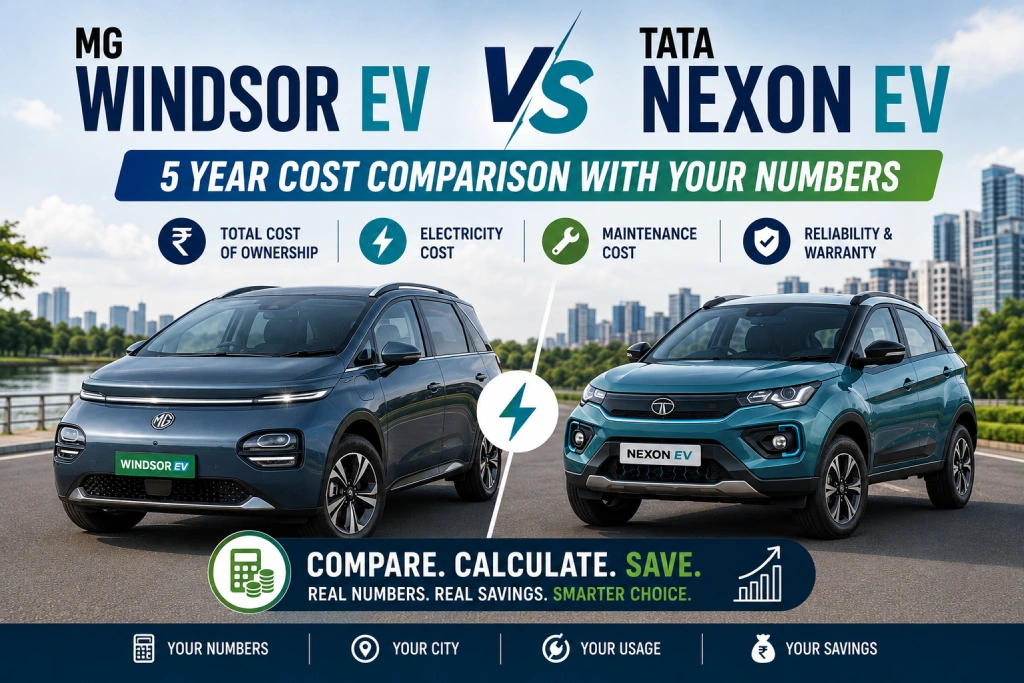
MG Windsor EV vs Tata Nexon EV: 5-Year Cost Comparison With Your Numbers
Updated on date: 4 september 2026
Compare MG Windsor EV vs Tata Nexon EV over 5 years using your driving, charging, insurance, maintenance and resale assumptions.
Quick Answer
The MG Windsor EV vs Tata Nexon EV five-year cost comparison depends on the buyer's actual driving and ownership assumptions. Annual kilometres, electricity tariff, home/public charging mix, purchase price, insurance, maintenance, financing, resale value and the Windsor's battery-rental structure can all affect the calculated five-year result.
The MG Windsor Pro has a 52.9-kWh battery and a 449-km certified MIDC P1+P2 range. Tata's current information lists the Nexon.ev 45 with a 45-kWh battery, 489-km MIDC P1+P2 range and 350–375 km C75 range. These figures come from the manufacturers and should remain labelled according to their respective test/certification definitions. [Manufacturer data: JSW MG Motor India; Tata.ev]
The Windsor also requires separate treatment because MG currently offers a BaaS structure in which the displayed starting price is ₹9.99 lakh plus battery rental at ₹3.99/km. MG's official page separately lists the Windsor's battery-inclusive price range. [Manufacturer data: JSW MG Motor India]
Factor | MG Windsor Pro | Tata Nexon.ev 45 |
Battery | 52.9 kWh | 45 kWh |
Certified range | 449 km MIDC P1+P2 | 489 km MIDC P1+P2 |
Published C75 | No equivalent figure used here | 350–375 km |
BaaS | Available | Not treated as an equivalent ownership structure |
Five-year energy cost | Depends on user inputs | Depends on user inputs |
Five-year ownership cost | Calculated result | Calculated result |
The correct question is therefore not simply "Which EV is cheaper?" It is "Which EV produces the lower five-year calculated ownership cost for my numbers?"
1. MG Windsor EV vs Tata Nexon EV: What Determines Five-Year Cost?
Five-year EV ownership cost is a calculated estimate combining the costs and assumptions relevant to owning and operating an EV for five years, less the value recovered when the vehicle is sold.
The calculation should distinguish four categories:
Manufacturer data
Independent published test data
User-entered assumptions
Calculated results
This distinction is particularly important for EV comparisons because a manufacturer-certified range, a buyer's assumed energy consumption and a calculator-derived cost per kilometre are not the same type of information.
The main five-year inputs
The calculator should allow the buyer to enter:
Annual kilometres
Electricity tariff
Home-charging percentage
Public-charging percentage
Public-charging price
Vehicle purchase price
Insurance
Annual maintenance/service cost
Financing cost
Expected resale value
Optional tyre/replacement costs
Applicable registration or road-tax costs
Applicable Windsor BaaS battery rental
The first eleven items are either user inputs or calculated values unless supported by a specific external source.
2. MG Windsor Pro: Battery, Range and Current Ownership Structure
The MG Windsor Pro uses a 52.9-kWh battery and has a manufacturer-certified 449-km MIDC P1+P2 range. JSW MG Motor India announced the Windsor Pro with the larger 52.9-kWh battery and 449-km certified range in May 2025. [Manufacturer data: JSW MG Motor India]
MG's official announcement identifies the Windsor Pro's 52.9-kWh battery, 449-km MIDC P1+P2 certified range, 136 PS power and 200 Nm torque. Only the battery and range are needed for the five-year cost model. [Manufacturer data: JSW MG Motor India]
The official source should therefore be used instead of third-party specification aggregators when establishing the Windsor Pro's core technical figures.
Current Windsor BaaS pricing
MG's current Windsor Pro page displays:
₹9.99 lakh + battery rental @ ₹3.99/km
as its BaaS starting structure. [Manufacturer data: JSW MG Motor India]
MG's separate Windsor EV page also currently states that the Windsor is available with 38-kWh and 52.9-kWh battery options, and lists the battery-inclusive Windsor price range at ₹14.69 lakh to ₹16.99 lakh ex-showroom. [Manufacturer data: JSW MG Motor India]
Because MG has published different BaaS and vehicle prices at different dates, a five-year calculator must record the price date and selected variant rather than treating a historical promotional price as permanently valid.
3. Tata Nexon.ev 45: Battery, Range and Current Pricing
The Tata Nexon.ev 45 has a 45-kWh battery and an ARAI-certified 489-km MIDC P1+P2 range. Tata also publishes a 350–375 km C75 range for the Nexon.ev 45. [Manufacturer data: Tata.ev]
Tata's official specification page identifies the Nexon.ev 45 as having a 45-kWh high-density lithium-ion battery and a 489-km ARAI-certified range based on MIDC Part 1 + Part 2. [Manufacturer data: Tata.ev]
Tata's official support information separately lists the Nexon.ev 45's:
Battery capacity: 45 kWh
MIDC P1+P2: 489 km
C75: 350–375 km
[Manufacturer data: Tata.ev]
Current Nexon.ev pricing
Tata's official pricing page currently states that the Nexon.ev range starts at ₹12.49 lakh ex-showroom and extends to ₹17.49 lakh ex-showroom for the listed variants. [Manufacturer data: Tata.ev]
The starting price should not automatically be used as the purchase price in a Windsor Pro versus Nexon.ev 45 calculation because the Nexon.ev range includes both 30-kWh and 45-kWh configurations.
The calculator should instead require the buyer to select the actual Nexon.ev variant being compared.
4. MIDC Range vs C75 Range: Do Not Mix the Numbers
MIDC-certified range and C75 range should be presented as separate manufacturer-published measurements rather than treating them as interchangeable real-world figures.
For the Windsor Pro, MG publishes:
449 km — MIDC P1+P2 certified range.
For the Nexon.ev 45, Tata publishes:
489 km — MIDC P1+P2
and:
350–375 km — C75.
[Manufacturer data: JSW MG Motor India; Tata.ev]
Therefore, this article should not state:
"The Nexon EV has a real-world range of 489 km."
That would incorrectly convert Tata's certified MIDC figure into a generic real-world claim.
Likewise, the Windsor's 449-km figure should be described as its manufacturer-certified MIDC P1+P2 range, not presented as guaranteed everyday driving range.
Why the distinction matters for the calculator
The five-year calculator should ideally use an explicit energy-consumption assumption rather than silently deriving everyday consumption from a certified range figure.
For example:
User-entered assumption: 18 kWh/100 km
Then:
Annual energy consumption = annual kilometres × 18 ÷ 100
The resulting energy consumption is a Calculated result.
It is not manufacturer data.

5. Windsor BaaS vs Battery-Inclusive Ownership
MG Windsor BaaS must be calculated separately from battery-inclusive Windsor ownership because the BaaS structure adds a battery-rental component based on kilometres.
MG currently displays the Windsor BaaS structure as:
₹9.99 lakh + ₹3.99/km battery rental
on its official Windsor Pro page. [Manufacturer data: JSW MG Motor India]
The same official page should therefore be used when building a current BaaS scenario.
Scenario A — Windsor battery-inclusive
The calculation uses the applicable battery-inclusive purchase price.
The battery-rental component is:
₹0
if the selected purchase structure genuinely includes the battery and has no separate per-kilometre battery rental.
Scenario B — Windsor BaaS
The calculation should include:
Vehicle purchase price + applicable BaaS battery rental + charging + insurance + maintenance + financing − resale value
The BaaS component can be calculated as:
Applicable BaaS rate × kilometres subject to the programme
Important pricing-date issue
MG's official May 2025 announcement for the Windsor Exclusive Pro stated a BaaS price of ₹12.24 lakh + ₹4.5/km. [Manufacturer data: JSW MG Motor India]
MG's current official Windsor Pro page now displays a different BaaS starting structure of ₹9.99 lakh + ₹3.99/km. [Manufacturer data: JSW MG Motor India]
These numbers should not be combined.
The older ₹4.5/km figure is historical information. The current ₹3.99/km figure is the current displayed starting information found on MG's website.
A published calculator should show the date on which the applicable price was checked.
6. How to Calculate Five-Year EV Ownership Cost
A five-year ownership calculation should separate vehicle cost, energy cost, ownership expenses, financing, applicable BaaS charges and resale value.
A simplified calculation is:
Five-year ownership cost = purchase-related cost + energy cost + insurance + maintenance + financing + applicable BaaS cost + optional ownership costs − resale value
The formula itself is a calculation methodology, not manufacturer data.
Step 1 — Annual kilometres
User-entered assumption
Example:
15,000 km/year
Five-year distance:
15,000 × 5 = 75,000 km
Calculated result: 75,000 km.
Step 2 — Electricity tariff
User-entered assumption
Example:
₹8/kWh
The calculator should not assume ₹8/kWh applies to every Indian EV owner.
The applicable electricity tariff depends on the user's electricity arrangement and tariff.
Step 3 — Charging mix
User-entered assumption
Example:
Home charging: 80%
Public charging: 20%
The calculator should allow the buyer to modify the split.
Step 4 — Public charging price
User-entered assumption
Example:
₹15/kWh
This should be entered by the user or populated from a clearly identified charging-provider tariff source.
The calculator should not present ₹15/kWh as a universal Indian public-charging price.
Step 5 — Vehicle price
Vehicle price should be entered with:
Manufacturer
Model
Variant
Battery
Ownership structure
Ex-showroom/on-road status
City where relevant
Source date
This prevents an old promotional price from being presented as a current price.
Step 6 — Insurance
User-entered or quotation-backed input
Insurance should not be presented as a universal fixed number unless a specific insurer quotation and vehicle/driver profile support the figure.
Step 7 — Maintenance
User-entered or source-backed input
The calculator should allow the buyer to enter the annual maintenance/service figure.
If the site publishes a service-cost figure, the source and date should be displayed.
Step 8 — Financing
Optional user-entered input
A cash purchase and a financed purchase should not be treated as identical financial scenarios.
If financing is included, the calculator should show the financing assumptions used.
Step 9 — Resale value
User-entered assumption
Unless a manufacturer or dealer provides a documented guaranteed resale/buyback amount, future resale value should not be presented as a known fact.
The calculator can instead ask:
Expected resale value after five years: ₹_____
7. Charging Cost Calculation
Charging cost is a calculated result based on the user's energy-consumption assumption, charging mix and electricity prices.
For a simple calculator:
Annual energy consumption = annual kilometres × energy consumption ÷ 100
For example:
User-entered assumption: 15,000 km/year
User-entered assumption: 18 kWh/100 km
Then:
15,000 × 18 ÷ 100
= 2,700 kWh/year
Calculated result: 2,700 kWh/year.
Five-year energy consumption:
2,700 × 5
= 13,500 kWh
Calculated result: 13,500 kWh.
Mixed charging example
Assume:
User-entered assumption: 80% home charging
User-entered assumption: 20% public charging
Then:
13,500 × 80%
= 10,800 kWh home charging
and:
13,500 × 20%
= 2,700 kWh public charging
Both are Calculated results.
If the buyer enters:
₹8/kWh home electricity
and:
₹15/kWh public charging
then:
Home:
10,800 × ₹8 = ₹86,400
Public:
2,700 × ₹15 = ₹40,500
Total:
₹1,26,900 over five years
This ₹1,26,900 figure is a Calculated result based entirely on the stated user-entered assumptions.
It is not an MG or Tata published ownership-cost figure.
8. Windsor BaaS: Five-Year Example
Suppose the buyer enters:
User-entered assumption: 15,000 km/year
Five-year distance:
75,000 km
Calculated result: 75,000 km.
Using the current MG website's displayed starting BaaS rate of:
₹3.99/km
the illustrative battery-rental calculation becomes:
75,000 × ₹3.99
= ₹2,99,250
Calculated result based on the displayed ₹3.99/km rate and the 75,000-km assumption.
The ₹2,99,250 figure is not a five-year BaaS price published by MG.
It is a mathematical calculation.
The actual calculator should also apply any programme-specific conditions or limitations contained in the applicable BaaS terms before producing a final ownership figure.
9. Why Annual Mileage Can Change the BaaS Result
A per-kilometre battery-rental component increases when the number of kilometres subject to that charge increases.
Using the current displayed rate of ₹3.99/km purely as an illustration:
Five-year kilometres | Calculation | Illustrative BaaS amount |
25,000 km | 25,000 × ₹3.99 | ₹99,750 |
50,000 km | 50,000 × ₹3.99 | ₹1,99,500 |
75,000 km | 75,000 × ₹3.99 | ₹2,99,250 |
100,000 km | 100,000 × ₹3.99 | ₹3,99,000 |
All figures in this table are Calculated results, not manufacturer-published five-year costs.
This illustrates why a BaaS vehicle should not be evaluated using purchase price alone.
10. Five-Year Cost Per Kilometre
Five-year cost per kilometre is calculated by dividing total five-year ownership cost by the total kilometres driven during the five-year period.
Formula:
Five-year cost per km = five-year ownership cost ÷ five-year kilometres
For example, if a hypothetical calculation produced:
₹8,00,000 total five-year ownership cost
and:
75,000 km
then:
₹8,00,000 ÷ 75,000
= ₹10.67/km
The ₹10.67/km number is a Calculated result.
It should never be described as an MG or Tata published cost-per-kilometre figure unless the manufacturer itself publishes that exact figure.
11. Current Price Snapshot
Prices must be tied to the date checked because vehicle prices and promotional structures can change.
MG Windsor
MG's current official Windsor information lists the battery-inclusive Windsor price range at ₹14.69 lakh–₹16.99 lakh ex-showroom, while the BaaS structure starts at ₹9.99 lakh + ₹3.99/km. [Manufacturer data: JSW MG Motor India]
Tata Nexon.ev
Tata's current official Nexon.ev pricing page lists the model range from ₹12.49 lakh to ₹17.49 lakh ex-showroom. [Manufacturer data: Tata.ev]
Why these numbers cannot be directly compared
The Tata starting price covers the broader Nexon.ev range, including 30-kWh and 45-kWh configurations.
The MG BaaS starting price excludes the battery ownership component and therefore cannot be compared directly with a battery-inclusive vehicle price.
The correct comparison requires:
same vehicle category + comparable variant + same pricing date + same ownership structure.
12. Manufacturer Data vs Calculator Data
A transparent EV ownership calculator should make the distinction obvious.
Item | Classification |
Windsor Pro battery | Manufacturer data |
Windsor Pro 449-km MIDC range | Manufacturer data |
Nexon.ev 45 battery | Manufacturer data |
Nexon.ev 489-km MIDC range | Manufacturer data |
Nexon.ev 350–375 km C75 | Manufacturer data |
Current displayed MG BaaS rate | Manufacturer data |
Current listed vehicle price | Manufacturer data |
Annual kilometres | User-entered assumption |
Home electricity tariff | User-entered assumption |
Public charging tariff | User-entered assumption |
Charging mix | User-entered assumption |
Expected resale value | User-entered assumption |
Five-year distance | Calculated result |
Energy consumption | Calculated result |
Charging cost | Calculated result |
BaaS five-year amount | Calculated result |
Five-year ownership cost | Calculated result |
Cost per kilometre | Calculated result |
This separation is central to a trustworthy TCO page.
13. What About Battery Warranty?
Battery warranty can affect the ownership-risk discussion, but warranty coverage should not automatically be converted into a monetary five-year saving unless the warranty terms and an actual avoided-cost scenario are established.
Tata.ev states that it introduced a Lifetime HV Battery Warranty for the Nexon.ev 45 kWh for private individual customers in June 2025. [Manufacturer data: Tata.ev]
That is a meaningful ownership consideration.
However, the calculator should not arbitrarily assign a rupee value to the warranty.
A warranty is not the same thing as a guaranteed cash saving.
14. Which EV Costs Less for Different Drivers?
The financially preferable vehicle can change when the buyer changes the assumptions used in the five-year calculation.
Buyer with low annual mileage
A low-mileage buyer should pay particular attention to:
Upfront purchase structure
BaaS terms
Insurance
Maintenance
Financing
Resale value
The buyer should not assume that a lower per-kilometre operating cost automatically makes one vehicle cheaper overall.
Buyer with high annual mileage
A high-mileage buyer should pay particular attention to:
Energy consumption
Electricity tariff
Public charging dependence
BaaS per-kilometre cost
Tyre costs
Maintenance
Resale
A per-kilometre BaaS charge can become a larger absolute amount as kilometres increase.
Buyer with mostly home charging
A buyer who performs most charging at home should enter the actual applicable home electricity tariff.
The calculator should then model the resulting energy cost.
Buyer dependent on public charging
A buyer who uses public charging frequently should enter the applicable public charging price.
The calculator should not assume that public charging costs the same as residential electricity.
15. What the Comparison Should Not Claim
A data-driven article should avoid unsupported statements such as:
"Windsor is definitely cheaper over five years."
"Nexon EV is definitely cheaper over five years."
"Windsor costs exactly ₹X/km in real-world driving."
"Nexon EV really gives 489 km."
"Windsor really gives 449 km."
"Every owner will pay ₹3.99/km."
"Every owner will spend ₹X on maintenance."
"Every owner will get ₹X resale value."
Those statements require assumptions or additional evidence.
A safer formulation is:
"Under the assumptions entered into the calculator, the calculated five-year ownership cost is ₹X."
16. Five-Year Comparison Framework
The final calculator should present the result in a format such as:
Cost component | Windsor battery-inclusive | Windsor BaaS | Nexon.ev 45 |
Vehicle purchase | Calculated | Calculated | Calculated |
Battery rental | — | Calculated | — |
Charging | Calculated | Calculated | Calculated |
Insurance | User input | User input | User input |
Maintenance | User input | User input | User input |
Financing | Optional | Optional | Optional |
Tyres | Optional | Optional | Optional |
Registration/tax | Location-specific | Location-specific | Location-specific |
Expected resale | User input | User input | User input |
Net five-year cost | Calculated | Calculated | Calculated |
Total kilometres | Calculated | Calculated | Calculated |
Cost/km | Calculated | Calculated | Calculated |
This table should be populated dynamically rather than using a fabricated universal example.
❓ Frequently Asked Questions
Is the MG Windsor EV cheaper than the Tata Nexon.ev over five years?
There is no single defensible answer without specifying the vehicle variants and ownership assumptions. The calculation should include purchase price, charging, insurance, maintenance, financing, resale value and, where applicable, Windsor BaaS battery rental.
What is the MG Windsor Pro battery capacity?
The MG Windsor Pro has a 52.9-kWh battery. MG states a 449-km certified MIDC P1+P2 range for the Pro. [Manufacturer data: JSW MG Motor India]
What is the Tata Nexon.ev 45 battery capacity?
The Tata Nexon.ev 45 has a 45-kWh battery and a 489-km ARAI-certified MIDC P1+P2 range. [Manufacturer data: Tata.ev]
What is the Tata Nexon.ev 45 C75 range?
Tata's official support information lists 350–375 km C75 for the Nexon.ev 45. [Manufacturer data: Tata.ev]
Is 489 km the Nexon.ev's real-world range?
No. The 489-km figure is Tata's ARAI-certified MIDC P1+P2 figure. Tata separately publishes a 350–375 km C75 figure for the Nexon.ev 45. [Manufacturer data: Tata.ev]
Is 449 km the Windsor's real-world range?
The 449-km figure should be described as the Windsor Pro's manufacturer-certified MIDC P1+P2 range, rather than as a guaranteed real-world range. [Manufacturer data: JSW MG Motor India]
What is MG Windsor BaaS?
MG Windsor BaaS is a battery-as-a-service ownership structure in which MG's displayed vehicle price is accompanied by a separate battery-rental charge per kilometre. MG's current Windsor Pro page displays a starting structure of ₹9.99 lakh + ₹3.99/km. [Manufacturer data: JSW MG Motor India]
How much will Windsor BaaS cost over five years?
The amount depends on kilometres subject to the applicable battery-rental charge. For example, 75,000 km multiplied by the currently displayed ₹3.99/km rate produces a ₹2,99,250 calculated result. The figure is not a manufacturer-published five-year cost.
Should the ₹12.49 lakh Tata Nexon.ev price be used in the comparison?
Not automatically. Tata's ₹12.49 lakh starting price applies to the Nexon.ev range, while the comparison should use the selected 45-kWh variant's applicable price. [Manufacturer data: Tata.ev]
Should insurance be included?
Yes, if the objective is a broader five-year ownership-cost estimate. The actual insurance amount should be entered from a quotation or clearly labelled assumption rather than presented as a universal fixed number.
Should resale value be included?
Yes. If the objective is net five-year ownership cost, expected resale value should be included as a user-entered assumption unless a documented guaranteed value exists.
Should financing be included?
Financing can be included as an optional input because a financed purchase has a different cash-cost structure from a cash purchase.
How is EV cost per kilometre calculated?
Divide the calculated five-year ownership cost by the calculated total kilometres driven during the five-year period.
Which EV is better for a high-mileage buyer?
The answer depends on the buyer's complete calculation. A high-mileage buyer should specifically examine energy cost and, if applicable, the Windsor's per-kilometre BaaS charge.
18. Key Takeaways
The MG Windsor Pro has a 52.9-kWh battery and 449-km MIDC P1+P2 certified range. [Manufacturer data: JSW MG Motor India]
The Tata Nexon.ev 45 has a 45-kWh battery and 489-km MIDC P1+P2 certified range. [Manufacturer data: Tata.ev]
Tata separately publishes 350–375 km C75 for the Nexon.ev 45. [Manufacturer data: Tata.ev]
MIDC and C75 should not be presented as identical range measurements.
The current MG website displays ₹9.99 lakh + ₹3.99/km as a Windsor BaaS starting structure. [Manufacturer data: JSW MG Motor India]
MG's current Windsor information lists the battery-inclusive Windsor price range at ₹14.69 lakh–₹16.99 lakh ex-showroom. [Manufacturer data: JSW MG Motor India]
Tata's current Nexon.ev pricing page lists the range from ₹12.49 lakh to ₹17.49 lakh ex-showroom. [Manufacturer data: Tata.ev]
BaaS and battery-inclusive ownership should be calculated separately.
Electricity tariff should be a user input.
Annual kilometres should be a user input.
Resale value should be a user assumption unless supported by a guaranteed value.
Cost per kilometre should be a calculated result.
A five-year winner should only be declared after the assumptions are specified.
19. Conclusion
The most defensible way to compare the MG Windsor EV vs Tata Nexon EV over five years is to move beyond headline price and use a transparent ownership-cost calculation.
The manufacturer data establishes the starting facts: the Windsor Pro has a 52.9-kWh battery and 449-km certified MIDC P1+P2 range, while the Nexon.ev 45 has a 45-kWh battery, 489-km MIDC P1+P2 range and a published 350–375 km C75 range. [Manufacturer data: JSW MG Motor India; Tata.ev]
The ownership calculation then adds the buyer's own variables: annual kilometres, electricity tariff, charging mix, public charging price, insurance, maintenance, financing and expected resale value.
The Windsor requires additional care because its BaaS structure introduces a separate per-kilometre battery-rental component. MG's current official page displays a starting BaaS structure of ₹9.99 lakh plus ₹3.99/km, while earlier official MG announcements used different pricing. [Manufacturer data: JSW MG Motor India]
That means a five-year comparison should always show the variant, price date, ownership structure and assumptions.
There is no responsible basis for declaring one vehicle universally cheaper without those inputs.
Calculate Your 5-Year EV Ownership Cost
Enter your own annual kilometres, electricity tariff, charging mix, vehicle price, insurance, maintenance and resale assumptions to calculate your estimated five-year result.
Compare MG Windsor EV and Tata Nexon EV Using Your Numbers
Your calculated result—not a generic headline—is the relevant ownership comparison.
External Authority Sources
Primary sources used for the factual claims in this article:
JSW MG Motor India — MG Windsor EV Pro official product page
JSW MG Motor India — MG Windsor EV official product page
JSW MG Motor India — Windsor Pro launch announcement
JSW MG Motor India — Windsor Exclusive Pro announcement
Tata.ev — Nexon.ev official specifications
Tata.ev — Nexon.ev official support/range information
Tata.ev — Nexon.ev official pricing
Tata.ev — Nexon.ev official warranty information
No EVTech.News claim has been used to establish the core vehicle specifications or ownership-cost calculations.
Source verification
MG Windsor Pro — 52.9 kWh / 449 km: JSW MG's official May 2025 announcement states the larger 52.9-kWh battery and 449-km MIDC P1+P2 certified range. (MG Motor India)
Current MG BaaS: JSW MG's current Windsor Pro page displays a starting BaaS structure of ₹9.99 lakh + ₹3.99/km. (MG Motor India)
Current Windsor battery-inclusive pricing: JSW MG's current Windsor page states ₹14.69 lakh–₹16.99 lakh ex-showroom and separately describes the BaaS structure. (MG Motor India)
Historical Windsor BaaS pricing: JSW MG's May 2025 Exclusive Pro announcement states ₹12.24 lakh + ₹4.5/km, demonstrating why historical and current pricing must not be mixed. (MG Motor India)
Nexon.ev 45 — battery/range: Tata's official specification page states 45 kWh and 489 km ARAI-certified MIDC P1+P2. (Tata Motors Electric)
Nexon.ev 45 — C75: Tata's official support information lists 489 km MIDC P1+P2 and 350–375 km C75 for the Nexon.ev 45. (Tata Motors Electric)
Current Nexon.ev pricing: Tata's official pricing page currently lists the Nexon.ev range from ₹12.49 lakh to ₹17.49 lakh ex-showroom. (Tata Motors Electric)
Nexon.ev 45 battery warranty: Tata.ev states that its Lifetime HV Battery Warranty was introduced for the Nexon.ev 45 kWh for private individual customers in June 2025. (Tata Motors Electric)