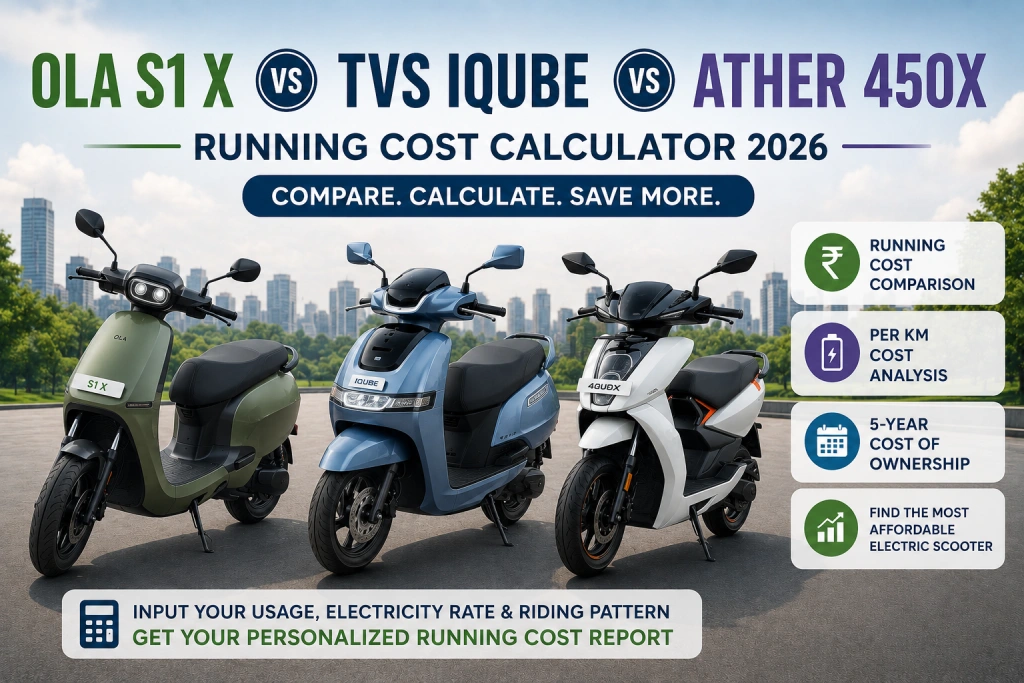
Ola S1 X vs TVS iQube vs Ather 450X: Running Cost Calculator 2026
Updated on date: 4 september 2026
Quick Answer
Electric scooter running cost is primarily a function of energy consumption, kilometres ridden and the electricity tariff. For the Ola S1 X, TVS iQube and Ather 450X, this calculator estimates energy use from the selected variant's published battery capacity and IDC/certified range, then applies the user's monthly kilometres and electricity price. The result is an estimate, not a laboratory measurement of wall-to-wheel consumption.
The three model families have multiple battery/range configurations. Ola currently lists the S1 X Gen 3 with 2 kWh, 3 kWh and 4 kWh batteries and 108 km, 176 km and 242 km IDC ranges respectively. TVS currently lists five iQube configurations from 2.3 kWh/114 km to 5.3 kWh/212 km IDC range. Ather's 450X specification material lists 2.9 kWh and 3.7 kWh versions with 126 km and 161 km certified range respectively.
Quick comparison
| Model | Battery configuration | Published range | Derived battery energy per published km* |
|---|---|---|---|
| Ola S1 X | 2 kWh | 108 km IDC | 18.52 Wh/km |
| Ola S1 X | 3 kWh | 176 km IDC | 17.05 Wh/km |
| Ola S1 X | 4 kWh | 242 km IDC | 16.53 Wh/km |
| TVS iQube | 2.3 kWh | 114 km IDC | 20.18 Wh/km |
| TVS iQube | 3.1 kWh | 123 km IDC | 25.20 Wh/km |
| TVS iQube | 3.5 kWh | 145 km IDC | 24.14 Wh/km |
| TVS iQube S | 4.7 kWh | 175 km IDC | 26.86 Wh/km |
| TVS iQube ST | 5.3 kWh | 212 km IDC | 25.00 Wh/km |
| Ather 450X | 2.9 kWh | 126 km certified | 23.02 Wh/km |
| Ather 450X | 3.7 kWh | 161 km certified | 22.98 Wh/km |
*These figures are derived calculations: installed battery capacity ÷ published range. They should not be interpreted as independently measured real-world or wall-to-wheel consumption. Source specifications: Ola, TVS and Ather.
The important point: the scooter with the smallest battery is not automatically the cheapest to operate per kilometre. The relevant calculation is energy required per kilometre, combined with the user's electricity tariff and distance.
Introduction
Searching for an electric scooter running cost calculator in India in 2026 is more useful than simply asking which scooter has the largest battery or longest claimed range.
The reason is simple: battery capacity tells you how much energy the battery stores, while running cost depends on how much energy is required to cover the distance you actually ride. Your monthly electricity bill also depends on your electricity tariff.
The Ola S1 X, TVS iQube and Ather 450X are three major electric-scooter choices that can be compared using this approach. However, each product family has multiple configurations, so treating “S1 X”, “iQube” or “450X” as one fixed specification can produce misleading comparisons. Ola lists three S1 X Gen 3 battery configurations, TVS lists five iQube configurations, and Ather lists two 450X battery/range configurations in its current specification material.
This article therefore focuses specifically on charging-energy cost. It does not claim that one scooter is universally the cheapest to own, because purchase price, insurance, maintenance, tyres, financing and depreciation are separate ownership variables.
How Much Does It Cost to Run an Electric Scooter in 2026?
Electric scooter charging cost can be estimated by multiplying the energy required for the distance travelled by the electricity tariff. In its simplest form, the calculation is:
Energy cost = energy consumed × electricity price
For a monthly estimate:
Monthly charging cost = monthly electricity consumption × electricity tariff
The difficult part is estimating electricity consumption. One way to build a model from published specifications is to divide battery capacity by the published range:
Derived energy per published kilometre = battery capacity (kWh) ÷ published range (km)
Then:
Monthly energy requirement = monthly kilometres × derived energy per kilometre
And:
Monthly charging cost = monthly energy requirement × electricity tariff
These are mathematical calculations based on published specifications, not manufacturer-certified real-world electricity consumption.
Ather provides a separate real-world-style calculation example for its 450X with 161 km IDC range. Ather says the scooter consumes about 30 Wh/km in that example; at 1,000 km per month, the calculation produces 30 kWh of monthly electricity use, and at ₹7/kWh the illustrated cost is ₹210.
That Ather example is useful for understanding how an electricity-cost calculation works. It should not be substituted automatically for the specification-derived calculations used throughout this comparison.
Ola S1 X Running Cost
The Ola S1 X should be calculated by variant because Ola currently lists 2 kWh, 3 kWh and 4 kWh S1 X Gen 3 configurations. Their published IDC ranges are 108 km, 176 km and 242 km respectively.
Ola S1 X 2 kWh
Ola's current S1 X Gen 3 page lists the 2 kWh configuration with a 108 km IDC range.
Derived calculation:
2 kWh ÷ 108 km = 0.01852 kWh/km
That is approximately:
18.52 Wh per published IDC kilometre
This is a derived figure, not a claim that the scooter will consume exactly 18.52 Wh from the wall for every real-world kilometre.
Ola S1 X 3 kWh
Ola lists the 3 kWh S1 X Gen 3 with a 176 km IDC range.
Derived calculation:
3 kWh ÷ 176 km = 0.01705 kWh/km
That equals approximately:
17.05 Wh per published IDC kilometre
Ola S1 X 4 kWh
Ola lists the 4 kWh S1 X Gen 3 with a 242 km IDC range.
Derived calculation:
4 kWh ÷ 242 km = 0.01653 kWh/km
That equals approximately:
16.53 Wh per published IDC kilometre
What does that tell us?
The derived energy-per-published-kilometre figure decreases across these three S1 X configurations. That illustrates why battery size alone is not a valid running-cost ranking metric.
A larger battery can provide more stored energy while the corresponding published range also increases. The running-cost calculation therefore needs both variables.
TVS iQube Running Cost
TVS currently lists five iQube configurations, ranging from a 2.3 kWh battery with 114 km IDC range to a 5.3 kWh battery with 212 km IDC range.
TVS iQube 2.3 kWh
TVS lists the 2.3 kWh iQube with a 114 km IDC range.
Derived calculation:
2.3 ÷ 114 = 0.02018 kWh/km
That is approximately:
20.18 Wh per published IDC kilometre
TVS iQube 3.1 kWh
TVS lists the 3.1 kWh version with a 123 km IDC range.
Derived calculation:
3.1 ÷ 123 = 0.02520 kWh/km
That is approximately:
25.20 Wh per published IDC kilometre
TVS iQube 3.5 kWh
TVS lists the 3.5 kWh version with a 145 km IDC range.
Derived calculation:
3.5 ÷ 145 = 0.02414 kWh/km
That is approximately:
24.14 Wh per published IDC kilometre
TVS iQube S 4.7 kWh
TVS lists the iQube S with a 4.7 kWh battery and 175 km IDC range.
Derived calculation:
4.7 ÷ 175 = 0.02686 kWh/km
That is approximately:
26.86 Wh per published IDC kilometre
TVS iQube ST 5.3 kWh
TVS lists the iQube ST with a 5.3 kWh battery and 212 km IDC range.
Derived calculation:
5.3 ÷ 212 = 0.02500 kWh/km
That is:
25.00 Wh per published IDC kilometre
Why iQube variant selection matters
The five published iQube configurations do not produce identical battery-capacity-to-range ratios.
Consequently, a calculator that simply labels the vehicle “TVS iQube” without asking which configuration the buyer owns or intends to purchase can hide a significant input difference.
For a useful running-cost estimate, select the exact configuration first.
Ather 450X Running Cost
Ather's 450X specification material lists two battery configurations: 2.9 kWh and 3.7 kWh. The corresponding certified ranges are 126 km and 161 km.
Ather 450X 2.9 kWh
Ather lists the 2.9 kWh 450X with a 126 km certified range.
Derived calculation:
2.9 ÷ 126 = 0.02302 kWh/km
That equals approximately:
23.02 Wh per published kilometre
Ather 450X 3.7 kWh
Ather lists the 3.7 kWh 450X with a 161 km certified range.
Derived calculation:
3.7 ÷ 161 = 0.02298 kWh/km
That equals approximately:
22.98 Wh per published kilometre
Ather's separate electricity-consumption example
Ather's charging-cost article gives a practical example using the 161 km Ather 450X. Ather states approximately 30 Wh/km for that example, then calculates 30 kWh for 1,000 km and ₹210 at an assumed ₹7/kWh electricity price.
The difference between approximately 30 Wh/km in Ather's example and the approximately 22.98 Wh/km derived from installed capacity divided by certified range demonstrates why these two numbers should not be presented as interchangeable measurements.
The calculator in this article therefore labels the specification-derived number as a calculation rather than claiming it is measured wall-to-wheel consumption.
Electric Scooter Running Cost Calculator
The calculator should use the following inputs.
Step 1: Select your scooter
Choose:
- Ola S1 X
- TVS iQube
- Ather 450X
Step 2: Select the exact battery/range variant
For example:
- Ola S1 X: 2 kWh, 3 kWh or 4 kWh.
- TVS iQube: 2.3 kWh, 3.1 kWh, 3.5 kWh, 4.7 kWh or 5.3 kWh.
- Ather 450X: 2.9 kWh or 3.7 kWh.
Step 3: Enter monthly kilometres
Enter your expected monthly distance.
Useful example inputs are:
- 500 km/month
- 1,000 km/month
- 1,500 km/month
- 2,000 km/month
These are calculator examples, not claims about typical Indian scooter usage.
Step 4: Enter electricity tariff
Enter your actual electricity price in:
₹/kWh
This is important because electricity tariffs vary by location, tariff category, consumption slab and other billing conditions. The calculator should therefore avoid assuming one universal Indian electricity rate.
Step 5: Optional charging-loss input
The calculator can optionally allow the user to add a charging-loss percentage.
If the user enters a loss percentage, the model can calculate:
Wall electricity = calculated battery energy × (1 + charging-loss percentage)
The percentage should remain a user input unless a verified model-specific charging-loss figure is available.
Example: 1,000 km Per Month
To demonstrate the calculation, the following example uses:
Monthly distance: 1,000 km
Electricity tariff: ₹7/kWh
The ₹7/kWh figure is an illustrative calculation input, not a claim that ₹7/kWh is India's universal household electricity tariff. Ather uses ₹7/kWh in its own illustrative charging example.
Derived monthly charging-energy estimates
Using battery capacity ÷ published range:
| Variant | Derived energy | Estimated energy for 1,000 km | Estimated cost at ₹7/kWh |
|---|---|---|---|
| Ola S1 X 2 kWh | 18.52 Wh/km | 18.52 kWh | ₹129.63 |
| Ola S1 X 3 kWh | 17.05 Wh/km | 17.05 kWh | ₹119.32 |
| Ola S1 X 4 kWh | 16.53 Wh/km | 16.53 kWh | ₹115.70 |
| iQube 2.3 kWh | 20.18 Wh/km | 20.18 kWh | ₹141.23 |
| iQube 3.1 kWh | 25.20 Wh/km | 25.20 kWh | ₹176.42 |
| iQube 3.5 kWh | 24.14 Wh/km | 24.14 kWh | ₹168.97 |
| iQube S 4.7 kWh | 26.86 Wh/km | 26.86 kWh | ₹188.00 |
| iQube ST 5.3 kWh | 25.00 Wh/km | 25.00 kWh | ₹175.00 |
| Ather 450X 2.9 kWh | 23.02 Wh/km | 23.02 kWh | ₹161.11 |
| Ather 450X 3.7 kWh | 22.98 Wh/km | 22.98 kWh | ₹160.87 |
All figures in this table are calculations from manufacturer-published battery capacity and range, multiplied by the illustrative 1,000 km/month and ₹7/kWh inputs. The source specifications are from Ola, TVS and Ather.
The numbers should not be interpreted as predictions of the actual electricity appearing on a household meter. Real charging can involve losses and actual energy consumption can differ from certified-range-based calculations.
For comparison, Ather's own separate example estimates 30 kWh for 1,000 km using its approximately 30 Wh/km assumption and therefore calculates ₹210 at ₹7/kWh.
That difference is exactly why the calculator should distinguish derived specification-based estimates from measured or manufacturer-published consumption figures.
What Changes Your Actual EV Charging Bill?
Monthly distance
Monthly kilometres have a direct mathematical effect on electricity expenditure. If the energy requirement per kilometre remains constant, doubling the kilometres approximately doubles the calculated energy requirement.
For example, a calculator using 1,000 km as its baseline will produce approximately half the calculated energy requirement at 500 km and approximately 1.5 times the requirement at 1,500 km, assuming the same energy-per-kilometre input.
These are mathematical consequences of the calculator formula, not claims about actual rider behaviour.
Electricity tariff
The same scooter can produce different charging costs for different users because the electricity price per kWh can differ.
If two users have the same calculated electricity requirement but different ₹/kWh rates, their calculated charging bills will differ proportionally.
That is why the calculator should ask for the user's actual electricity tariff instead of presenting one national “EV electricity rate.”
Energy consumption
Battery capacity is not the same thing as energy consumption per kilometre.
A battery's capacity describes the amount of stored energy, while consumption describes how much energy is required to travel a distance. The published range is therefore an important variable in a specification-derived calculation.
Charging losses
The electricity drawn from the wall can differ from the energy ultimately stored in the battery.
Because the exact loss depends on the charging system and operating conditions, this article does not invent a universal percentage. Instead, the calculator can expose charging losses as an optional user input.
Speed, traffic and riding mode
Actual energy consumption can vary with operating conditions.
Ather's current riding-mode guidance explicitly says riding modes affect speed, acceleration and energy consumption, and gives different range figures for different modes on the 450X.
For example, Ather's May 2026 article lists 100 km for Eco mode on the 2.9 kWh 450X, 85 km in Ride mode, 80 km in Sport mode and 75 km in Warp mode; for the 3.7 kWh 450X, it lists 125 km, 105 km, 95 km and 85 km respectively.
Those figures demonstrate why a certified range number should not automatically be presented as a guaranteed everyday range.
Payload, tyre pressure and temperature
These factors can also influence real-world energy use, but this comparison does not attach unsupported numerical penalties to them.
The correct editorial approach is to acknowledge their influence without inventing a percentage such as “10% more electricity” unless a suitable authoritative source supports that exact figure.
Which One Is Cheapest to Run?
There is no defensible universal winner without defining the exact variant, electricity tariff, distance and methodology.
Using the specification-derived calculation in this article, the 1,000 km example produces different estimated costs for different configurations. Those figures change when the user changes the electricity tariff or monthly kilometres.
For example, under the illustrative ₹7/kWh input, the derived calculation produces approximately ₹115.70 for 1,000 km for the 4 kWh Ola S1 X, while the 4.7 kWh iQube S produces approximately ₹188 under the same methodology. Those are calculations from published battery/range specifications, not measured electricity bills.
The correct buyer question is therefore:
“Which selected variant has the lowest estimated energy cost for my distance and electricity tariff?”
That question is more precise than asking:
“Which scooter is cheapest?”

Why the Smallest Battery Is Not Automatically the Cheapest
A larger battery does not automatically mean higher running cost per kilometre.
The battery-capacity-to-range calculation demonstrates why.
The Ola S1 X 4 kWh configuration has a larger battery than the 2 kWh configuration, but the published ranges are 242 km and 108 km respectively.
Using those published figures:
4 ÷ 242 = 0.01653 kWh/km
while:
2 ÷ 108 = 0.01852 kWh/km
The derived ratio is therefore lower for the 4 kWh configuration.
Again, that does not prove that the 4 kWh scooter will consume less electricity in every real-world situation. It only demonstrates that battery capacity by itself cannot determine running cost.
Is the Cheapest-to-Charge Scooter the Cheapest to Own?
No. Charging cost is only one component of vehicle ownership cost.
A complete total-cost-of-ownership calculation can involve:
- Purchase price
- Registration and taxes
- Insurance
- Financing
- Maintenance
- Tyres
- Battery-related costs
- Depreciation
- Electricity or fuel
This article intentionally does not assign values to those categories unless they are supported by current, appropriate sources.
The calculator's scope is narrower:
How much electricity is required, and what will that electricity cost for the distance you enter?
That narrower scope makes the calculation easier to audit and avoids mixing verified specifications with unsupported assumptions.
IDC Range vs Real-World Range: What Buyers Need to Know
IDC or certified range should not be treated as a guaranteed real-world riding range.
Ola's current S1 X page labels its published figures as IDC range, while TVS labels its iQube figures as IDC range. Ather's specification material uses the term “Certified Range.”
The distinction matters because the calculator in this article derives an energy-per-kilometre figure from battery capacity and published range.
That calculation is useful for consistent model-to-model comparison, but it should not be presented as a laboratory measurement of actual electricity drawn from a wall socket.
Ather's own published charging example illustrates the issue. Ather uses approximately 30 Wh/km for its 161 km 450X example, while the simple 3.7 kWh ÷ 161 km calculation gives approximately 22.98 Wh/km.
The two numbers have different methodological origins and should not be merged into one supposedly exact consumption figure.
Important calculator note
Your actual electricity cost can differ from this estimate because speed, traffic, riding mode, payload, tyre pressure, temperature, charging losses and other operating conditions affect energy consumption. The calculator uses manufacturer-published battery/range data unless the user supplies a measured consumption figure.
July 2026 Electric Two-Wheeler Sales Context
The sales context needs careful wording.
Government Vahan data reported by Moneycontrol showed 173,294 electric two-wheeler registrations in July 2026, based on data available as of July 29. TVS Motor recorded 47,242 registrations, Bajaj Auto recorded 38,974, and Ather Energy recorded 25,907.
Moneycontrol reported TVS with a 27.3% market share, Bajaj with 22.5%, and Ather with 14.9% for the reported July registrations.
Ola Electric recorded 11,880 registrations in the same reporting, according to the Vahan-based July figures reported by Moneycontrol.
These are manufacturer-level registration figures, not evidence that the Ola S1 X, TVS iQube and Ather 450X were the three best-selling electric-scooter models.
A separate model-level sales report lists the TVS iQube at 59,386 units in July 2026, compared with 23,029 units in July 2025.
That model-level number should not be casually merged with the Vahan manufacturer-registration figures because the datasets and reporting methodologies are different.
Why this article compares these three scooters
The editorial purpose is to compare three prominent electric-scooter choices using a common running-energy methodology.
It is not to claim:
“Ola S1 X, TVS iQube and Ather 450X were India's top three electric scooters by July 2026 Vahan sales.”
The available evidence does not support that statement.
❓ Frequently Asked Questions
How much does it cost to charge an Ola S1 X?
The answer depends on the selected S1 X configuration, monthly distance and electricity tariff. Ola currently lists 2 kWh, 3 kWh and 4 kWh S1 X Gen 3 configurations with 108 km, 176 km and 242 km IDC ranges respectively. Use the calculator to enter your exact variant, monthly kilometres and ₹/kWh tariff.
How much does it cost to charge a TVS iQube?
The cost depends on the iQube variant, distance and electricity tariff. TVS currently lists 2.3 kWh, 3.1 kWh, 3.5 kWh, 4.7 kWh and 5.3 kWh configurations with published IDC ranges from 114 km to 212 km. A single "iQube charging cost" therefore does not represent every configuration.
How much does an Ather 450X cost per kilometre?
A specification-derived estimate can be calculated by dividing the battery capacity by the published certified range. Ather lists 2.9 kWh/126 km and 3.7 kWh/161 km configurations for the 450X, producing derived ratios of approximately 23.02 Wh/km and 22.98 Wh/km respectively. These are calculations, not measured real-world consumption figures.
Which electric scooter has the lowest running cost?
There is no universal answer without defining the exact variant, monthly kilometres, electricity tariff and calculation methodology. A model with a smaller battery is not automatically cheaper per kilometre. The calculator compares energy required per published kilometre and then applies the user's electricity tariff.
Does a bigger EV battery mean a higher running cost?
Not necessarily. A larger battery stores more energy, but the scooter may also have a longer published range. For example, the Ola S1 X 4 kWh configuration has a published 242 km IDC range, while the 2 kWh version has a 108 km IDC range. Running-cost comparison therefore requires both battery capacity and range.
Is IDC range the same as real-world range?
No. IDC or certified range is a published test/certification figure and should not be treated as a guaranteed real-world distance. Ola and TVS publish IDC range figures, while Ather uses certified-range terminology in its specification material.
How does electricity tariff affect EV scooter running cost?
Electricity tariff directly affects the calculated charging bill. If calculated electricity consumption remains unchanged, a higher ₹/kWh tariff produces a proportionally higher charging cost. This is why the calculator allows the user to enter their own electricity price rather than assuming a single nationwide rate.
Can I calculate the cost for 500 km per month?
Yes. Enter 500 km as the monthly distance, select the exact scooter variant and enter your electricity tariff. The calculator will multiply the selected energy-per-kilometre estimate by 500 and then apply the electricity tariff.
Can I calculate the cost for 1,000 km per month?
Yes. Ather itself uses 1,000 km as an illustrative monthly distance in its charging-cost example. Ather's example assumes approximately 30 Wh/km and ₹7/kWh, producing 30 kWh and ₹210 respectively. The calculator in this article can instead use the selected manufacturer's battery/range data.
Can I calculate the cost for 1,500 km per month?
Yes. Enter 1,500 km as the monthly distance. The calculation will scale the selected energy-per-kilometre estimate to the new distance and apply the electricity tariff.
Does charging loss affect EV running cost?
Yes, charging losses can mean the electricity drawn from the wall is greater than the energy ultimately stored in the battery. Because a universal model-specific loss percentage has not been established for this comparison, the calculator should treat charging loss as an optional input rather than inventing a fixed percentage.
Can I compare an EV scooter with a petrol scooter?
Yes, but the comparison requires separate verified inputs for petrol price, petrol-scooter fuel efficiency and the relevant EV electricity cost. Ather provides a specific illustrative petrol comparison using assumptions of 40 km/L and ₹100/L alongside its 30 Wh/km and ₹7/kWh EV example. Those assumptions should not be presented as universal current Indian petrol prices or universal petrol-scooter mileage.
Key Takeaways
- Electric scooter running cost depends on energy use, distance and electricity price.
- Battery capacity alone cannot determine running cost.
- The Ola S1 X has 2 kWh, 3 kWh and 4 kWh configurations with 108 km, 176 km and 242 km IDC ranges on Ola's current page.
- The TVS iQube currently has five listed battery configurations from 2.3 kWh to 5.3 kWh, with IDC ranges from 114 km to 212 km.
- The Ather 450X is listed with 2.9 kWh and 3.7 kWh configurations and 126 km/161 km certified ranges.
- Derived battery-capacity/range figures are calculations, not measured wall-to-wheel consumption.
- Ather separately publishes an approximately 30 Wh/km example for its 161 km 450X and calculates 30 kWh for 1,000 km.
- Actual charging cost can vary with riding conditions, riding mode and charging losses.
- July 2026 Vahan-based reporting placed TVS Motor first among electric two-wheeler manufacturers, followed by Bajaj and Ather.
- The available evidence does not justify calling the Ola S1 X, TVS iQube and Ather 450X the three best-selling electric-scooter models in July 2026.
- Charging cost is only one part of total ownership cost.
Conclusion
The best way to compare the Ola S1 X, TVS iQube and Ather 450X on running cost is not to ask which scooter has the smallest battery or longest published range.
Instead, select the exact variant, calculate the energy requirement from the published battery/range data, enter your monthly kilometres, and apply your actual electricity tariff.
That approach produces a transparent estimate that can be personalized to 500 km, 1,000 km, 1,500 km or any other monthly distance.
The calculation should always be treated as an estimate. Published IDC or certified range is not a guarantee of real-world consumption, and charging losses and riding conditions can change the electricity drawn from the wall.
Calculate your Ola S1 X, TVS iQube or Ather 450X running cost using your own kilometres and electricity tariff.
External Authority References
- Ola Electric — S1 X Gen 3 official specifications
- TVS Motor — iQube official specifications
- Ather Energy — 450 series specification sheet
- Ather Energy — electricity consumption and charging-cost example
- Moneycontrol — July 2026 Vahan-based electric two-wheeler registrations
- July 2026 scooter sales reporting