Tata Sierra EV vs Nexon EV: Price, Running Cost & 5-Year TCO
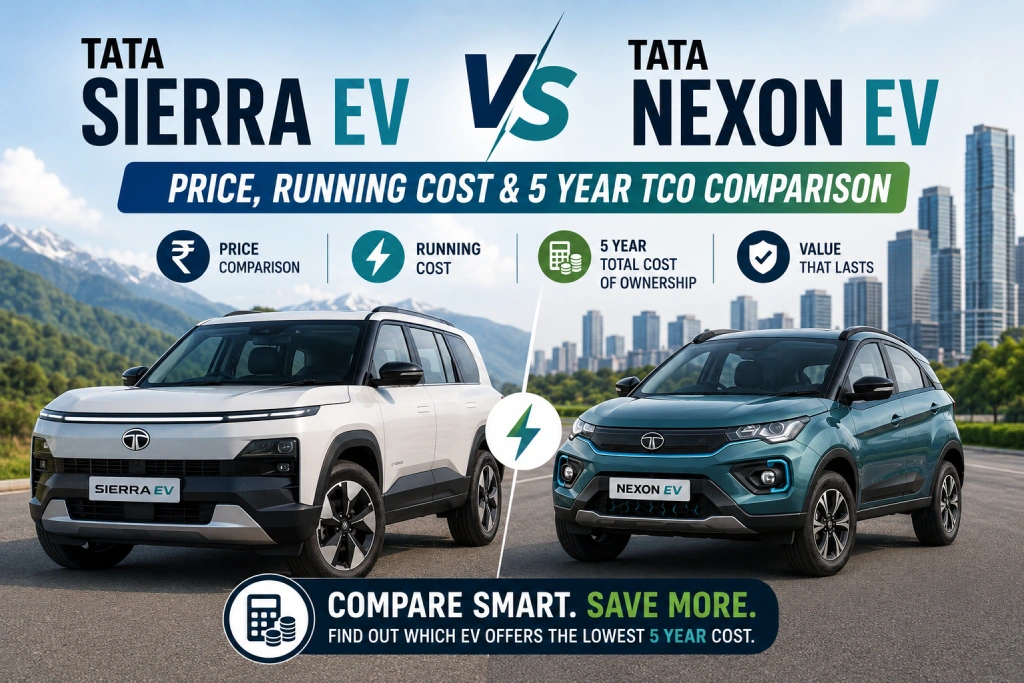
Quick Answer: Tata Sierra EV vs Nexon EV
The Tata Sierra EV is not automatically the better financial choice simply because it is larger or offers a bigger battery. Tata launched the Sierra.ev at an introductory ₹18.79 lakh ex-showroom, while Tata currently lists the Nexon.ev from ₹12.49 lakh. The Sierra's financial justification therefore depends on whether its additional space, range capability, equipment and available QWD configuration are worth the higher acquisition cost to a particular buyer.
Calculate your Tata Sierra EV vs Nexon EV 5-year running cost
Sierra EV or Nexon EV? Put your own numbers into the calculator and see which vehicle costs less over 3, 5 or 7 years.
Calculate NowWhat is the key difference?
The Sierra.ev is positioned as the larger, more premium proposition, with 63-kWh and 75-kWh battery options. Tata's current support information lists MIDC ranges of 535 km for the 63-kWh version, 665 km for the 75-kWh RWD version and 624 km for the 75-kWh QWD version.
The Nexon.ev 45 uses a 46.08-kWh battery and has a Tata-listed 489-km MIDC range and 350–375-km C75 range.
Quick comparison
| Factor | Tata Sierra.ev | Tata Nexon.ev 45 |
|---|---|---|
| Starting ex-showroom price | ₹18.79 lakh at launch | ₹12.49 lakh currently listed by Tata |
| Battery | 63 kWh / 75 kWh | 46.08 kWh |
| Maximum MIDC range | 665 km for 75-kWh RWD | 489 km |
| Sierra C75 range | 440–460 km / 510–530 km / 480–500 km depending on version | 350–375 km |
| Sierra drivetrain | RWD and QWD versions are offered | FWD configuration |
| Main financial argument | Additional capability, space, range and equipment for a higher price | Lower acquisition cost |
Bottom line: the Nexon.ev has the stronger argument if your priority is keeping the initial vehicle expenditure low. The Sierra.ev becomes more compelling when the buyer specifically values its larger SUV format, additional battery choices, longer certified range and higher equipment levels.
What Does ₹18.79 Lakh Actually Get You?
The Tata Sierra.ev's ₹18.79-lakh introductory price applies to the entry version rather than automatically representing the specification of every Sierra.ev variant. Tata's launch information identified the ₹18.79-lakh version as the 63-kWh Pure variant, while higher variants and the 75-kWh versions cost more.
The Sierra.ev is offered with two battery capacities: 63 kWh and 75 kWh. Tata's current support page lists the 63-kWh Sierra.ev at 535 km MIDC and 440–460 km C75, while the 75-kWh RWD version is listed at 665 km MIDC and 510–530 km C75. The 75-kWh QWD version is listed at 624 km MIDC and 480–500 km C75.
That distinction matters because a buyer comparing the ₹18.79-lakh Sierra with a highly equipped Nexon.ev is not necessarily comparing equivalent equipment.
Tata's Sierra product page also lists a 238 PS RWD output, 306 PS cumulative QWD output, 504 Nm cumulative torque for QWD and a claimed 0–100 km/h time of 5.8 seconds. These specifications relate to the applicable Sierra variants and should not be presented as characteristics of the ₹18.79-lakh entry version unless Tata confirms the equipment for that version.
Tata's Sierra page highlights features including an independent multi-link rear suspension, six terrain modes for the QWD setup, a 622-litre boot and an express-charging claim of up to 263 km of range in 15 minutes. Tata also states that features and specifications can vary by variant.
Definition: Sierra EV starting price
The Sierra EV starting price is the advertised ex-showroom price of the entry variant. It should not be treated as the price of a fully equipped Sierra.ev or as an on-road price.
Tata's price page specifically states that its indicated prices are ex-showroom and subject to change, and that the final payable price is determined at invoicing/delivery with applicable taxes, duties and statutory charges.
What Does the Nexon EV Cost?
The Tata Nexon.ev currently starts at ₹12.49 lakh according to Tata's official model page. The Nexon.ev 45 is a separate battery version using a 46.08-kWh battery, with a Tata-listed 489-km MIDC range and 350–375-km C75 range.
The Nexon.ev 45's technical brochure specifies a 110-kW motor and 215 Nm of torque. Tata also lists a 350-litre boot, 8.9-second 0–100 km/h claim and charging options including 3.3-kW and 7.2-kW AC charging and DC fast charging.
The technical brochure states that a 60-kW DC fast charger can charge the Nexon.ev 45 from 10% to 80% in about 40 minutes under the stated test conditions.
Definition: Nexon EV 45
The Nexon.ev 45 is Tata's 45-kWh-class Nexon electric version; its technical brochure specifies a 46.08-kWh battery pack, while Tata's current support information lists a 489-km MIDC range and 350–375-km C75 range.
Sierra EV vs Nexon EV: The Upfront Price Difference
At the currently published starting prices:
₹18.79 lakh − ₹12.49 lakh = ₹6.30 lakh.
That ₹6.30-lakh figure is useful for understanding the price gap, but it is not a like-for-like variant comparison.
The ₹18.79-lakh Sierra price refers to the entry 63-kWh Pure variant at launch, while ₹12.49 lakh is Tata's current Nexon.ev starting price. Equipment, battery capacity, range and variant positioning differ.
The more important question is therefore not:
“Is the Sierra ₹6.30 lakh more expensive?”
The more useful question is:
“What additional value am I getting for the additional money?”
That question changes the article from a price comparison into a purchase decision.
Price comparison rule
Always distinguish:
- Ex-showroom price from on-road price.
- Starting price from equivalent variant price.
- Battery/range differences from equipment differences.
- Manufacturer price from financing, insurance and registration costs.
Tata itself states that its displayed vehicle prices can change and that the final price payable is the applicable price at invoicing/delivery plus applicable charges.
Sierra EV vs Nexon EV: Running Cost
Running cost depends primarily on how much energy the vehicle consumes per kilometre and what the driver pays for electricity. Battery capacity alone does not determine charging cost per kilometre.
Tata's published C75 data allows a useful derived calculation. For the Sierra 63, Tata gives a 63-kWh battery and a C75 range of 440–460 km. For the Sierra 75 RWD, Tata gives 75 kWh and 510–530 km. For the Nexon.ev 45, Tata gives 46.08 kWh and 350–375 km C75.
The calculation is:
Implied energy consumption = battery capacity ÷ C75 range × 100
This is a calculation from Tata's published battery and range figures. It is not an independently measured efficiency test.
Sierra EV 63 kWh
At the lower published C75 range:
63 ÷ 440 × 100 = 14.32 kWh/100 km.
At the upper published C75 range:
63 ÷ 460 × 100 = 13.70 kWh/100 km.
Therefore, the implied consumption range is approximately:
13.7–14.3 kWh/100 km.
Sierra EV 75 kWh RWD
At 510 km:
75 ÷ 510 × 100 = 14.71 kWh/100 km.
At 530 km:
75 ÷ 530 × 100 = 14.15 kWh/100 km.
Therefore:
14.2–14.7 kWh/100 km, based on Tata's published battery capacity and C75 range.
Nexon EV 45
Using the 46.08-kWh battery and 350–375-km C75 range:
46.08 ÷ 350 × 100 = 13.17 kWh/100 km.
At 375 km:
46.08 ÷ 375 × 100 = 12.29 kWh/100 km.
Therefore:
12.3–13.2 kWh/100 km, based on Tata's published figures.
What does this tell us?
The derived numbers indicate that the Nexon.ev 45 has a lower implied energy requirement per 100 km than the Sierra versions considered above, based on Tata's C75 range and battery-capacity figures.
That does not mean the Nexon will always consume less energy in every real-world situation.
Driving speed, traffic, temperature, terrain, tyre pressure, air-conditioning use, payload, driving style and charging losses can affect actual energy consumption.
The important editorial point is narrower:
A larger Sierra battery should not be interpreted as proof of lower cost per kilometre.
What Does the Running Cost Mean in Rupees?
EV charging cost per kilometre can be estimated by multiplying energy consumption in kWh per 100 km by the electricity tariff and dividing by 100.
Formula
EV energy cost/km = kWh/100 km × electricity price per kWh ÷ 100
Suppose a reader enters ₹8/kWh into the calculator. ₹8/kWh is an illustrative input, not a universal Indian electricity price.
Sierra 63
Using the derived 13.7–14.3 kWh/100 km range:
13.7 × ₹8 ÷ 100 = ₹1.10/km
14.3 × ₹8 ÷ 100 = ₹1.14/km
Therefore, the illustrative energy cost is approximately:
₹1.10–₹1.14/km.
These figures are calculated from Tata's published Sierra battery and C75 data and the illustrative ₹8/kWh input.
Sierra 75 RWD
Using the derived 14.2–14.7 kWh/100 km range:
14.2 × ₹8 ÷ 100 = ₹1.14/km
14.7 × ₹8 ÷ 100 = ₹1.18/km
Illustrative result:
₹1.14–₹1.18/km.
Nexon EV 45
Using the derived 12.3–13.2 kWh/100 km range:
12.3 × ₹8 ÷ 100 = ₹0.98/km
13.2 × ₹8 ÷ 100 = ₹1.06/km
Illustrative result:
₹0.98–₹1.06/km.
Important limitation
The calculation above uses battery capacity divided by published C75 range. It does not represent the electricity drawn from the wall.
Actual electricity consumption from the meter can be higher because charging involves losses.
Therefore, a production calculator should include a separate charging-loss percentage input rather than presenting battery-derived consumption as the exact electricity drawn from the household supply.
Why You Should Not Assume One Electricity Tariff
An EV calculator should allow the user to enter an effective electricity cost rather than imposing one universal ₹/kWh assumption on every household.
Electricity bills can depend on tariff structure, consumption and applicable charges. A Chennai or Tamil Nadu household should therefore ideally use an effective rate derived from its own bill or an applicable current tariff schedule rather than treating ₹5, ₹6 or ₹8 per unit as universally applicable.
This is particularly important for a TCO calculator because the electricity price directly changes the calculated charging cost.
Recommended calculator input
What is your effective electricity cost per kWh?
This is better than:
“Electricity costs ₹8/unit.”
The first approach makes the calculator adaptable to different households, tariffs and charging arrangements.
10,000-km Running Cost Example
A transparent example is more useful than publishing a generic annual EV saving. The example below uses 10,000 km of annual driving and ₹8/kWh purely as an illustrative calculator scenario.
Assumptions
- Annual driving: 10,000 km
- Electricity input: ₹8/kWh
- Sierra 63 derived consumption: 13.7–14.3 kWh/100 km
- Nexon EV 45 derived consumption: 12.3–13.2 kWh/100 km
The battery and C75 figures used to derive the consumption ranges come from Tata's current support information and Nexon technical documentation.
Sierra 63
At 13.7 kWh/100 km:
10,000 × 13.7 ÷ 100 = 1,370 kWh/year.
At 14.3 kWh/100 km:
10,000 × 14.3 ÷ 100 = 1,430 kWh/year.
At ₹8/kWh:
1,370 × ₹8 = ₹10,960/year.
1,430 × ₹8 = ₹11,440/year.
These are derived calculations using the stated assumptions and Tata's published Sierra data.
Nexon EV 45
At 12.3 kWh/100 km:
10,000 × 12.3 ÷ 100 = approximately 1,230 kWh/year.
Using the unrounded 12.288 kWh/100 km derived from 46.08 ÷ 375 × 100 gives approximately 1,228.8 kWh/year.
At the other end, the 13.17 kWh/100 km calculation produces approximately 1,316.6 kWh/year.
At ₹8/kWh, that produces approximately:
₹9,830–₹10,533 per year.
Difference
Under this specific illustrative scenario, the Nexon EV 45's calculated electricity expenditure is approximately ₹400–₹1,610 lower per 10,000 km, depending on where the respective published C75 ranges fall within their stated bands.
The exact result should not be treated as a permanent annual saving because:
- ₹8/kWh is an illustrative input.
- C75 is a manufacturer-published estimate.
- Actual driving conditions vary.
- Charging losses are not included in the simplified battery-energy calculation.
- Electricity tariffs can change.
The important conclusion
The Sierra's larger battery does not automatically create lower charging expenditure per kilometre.
The Sierra's financial case therefore cannot depend solely on an assumption that charging will recover its higher purchase price.
Where the Sierra EV Can Justify Its Higher Price
The Sierra EV's strongest financial justification is not necessarily lower running cost. It is the additional vehicle proposition a buyer receives for the higher acquisition cost.
Tata offers the Sierra with 63-kWh and 75-kWh batteries and RWD/QWD configurations. Tata's product information also highlights features such as a 622-litre boot, multi-link rear suspension, terrain modes and advanced technology packages, although equipment varies by variant.
1. Larger SUV proposition
A buyer choosing the Sierra is not simply buying a larger battery.
The Sierra is a larger SUV proposition with substantially different space, equipment and capability positioning.
Tata lists a 622-litre boot for the Sierra.
The Nexon.ev 45 technical brochure lists a 350-litre boot.
The difference in boot capacity is therefore a practical consideration for buyers carrying luggage or using the vehicle primarily as a family SUV.
2. Longer-range capability
The Sierra 75 RWD has a Tata-listed 665-km MIDC range, compared with 489 km MIDC for the Nexon.ev 45.
The difference is 176 km on the published MIDC figures.
However, MIDC should not be interpreted as a guaranteed real-world driving distance.
For a more practical comparison, Tata's C75 figures are 510–530 km for the Sierra 75 RWD and 350–375 km for the Nexon.ev 45.
3. QWD option
Tata offers a 75-kWh QWD Sierra configuration, and Tata's product page lists 306 PS cumulative QWD power and 504 Nm cumulative torque.
The Nexon.ev 45 technical specification identifies its drivetrain as a front-wheel-drive configuration.
For buyers who specifically want dual-motor all-wheel-drive capability, the Nexon is therefore not an equivalent substitute.
4. Equipment
The Sierra product information highlights features including multi-screen displays, connected technology, powered and ventilated seats, JBL audio and advanced parking functions on applicable variants.
The correct purchasing question is not:
“Does the Sierra have more features?”
It is:
“Are the features I personally value worth the additional money?”
That is precisely where a TCO calculator needs to be supplemented by a buyer-preference decision.
Where the Nexon EV Makes More Financial Sense
The Nexon.ev's clearest financial advantage is its lower acquisition price. Tata currently lists the Nexon.ev from ₹12.49 lakh, compared with the Sierra.ev's ₹18.79-lakh introductory launch price.
The Nexon EV deserves serious consideration when:
- Initial purchase expenditure is the primary constraint.
- Most driving is urban.
- The buyer does not need the Sierra's additional space.
- The buyer does not require QWD.
- The buyer is comfortable with the Nexon.ev 45's published 350–375-km C75 range.
These are decision-framework conclusions, not manufacturer claims.
A buyer travelling relatively few kilometres each year should be especially careful about assuming that EV running-cost savings will compensate for a large purchase-price difference.
If annual mileage is low, there are fewer kilometres over which operating-cost differences can accumulate.
5-Year TCO Calculator
Total cost of ownership is the combined cost of acquiring and operating a vehicle over a defined period.
A useful Sierra-versus-Nexon calculator should therefore avoid reducing the comparison to “charging cost per kilometre.”
Vehicle inputs
Sierra EV
- Purchase price
- Battery capacity
- C75 range
- Insurance
- Maintenance
Nexon EV
- Purchase price
- Battery capacity
- C75 range
- Insurance
- Maintenance
The calculator should use the actual selected variant rather than assuming that the Sierra's ₹18.79-lakh starting price represents every Sierra version. Tata's price page states that prices can change and that features vary by variant.
Usage inputs
The calculator should ask for:
- Annual kilometres
- Electricity price/kWh
- Charging-loss percentage
- Ownership period
- Optional petrol-car comparison
- Optional resale-value assumption
Outputs
The calculator should produce:
- Energy cost per km
- Annual charging cost
- Five-year charging cost
- Purchase-price difference
- Total acquisition + energy cost
- Insurance and maintenance cost
- Total TCO
- TCO per kilometre
- Difference between vehicles
- Break-even period where applicable
Compare EV charging cost per kilometre
Sierra EV or Nexon EV? Put your own numbers into the calculator and see which vehicle costs less over 3, 5 or 7 years.
Calculate NowRecommended formula
EV TCO = acquisition cost + electricity cost + charging-related cost + insurance + maintenance − applicable incentives − resale value
Resale value should only be included if the calculator uses a clearly identified and defensible assumption.
Why this matters
A vehicle can have a lower running cost but still have a higher total ownership cost if its acquisition-price premium is sufficiently large.
Conversely, a more expensive vehicle can become financially competitive if operating-cost differences, incentives and resale value materially narrow the acquisition gap.
The calculator should determine the result instead of assuming the result in advance.
Break-Even Analysis
Break-even analysis asks how long it would take for lower operating costs to compensate for a vehicle's higher acquisition cost.
The simplified formula is:
Break-even period = additional acquisition cost ÷ annual operating-cost advantage
For example, if Vehicle A costs ₹5 lakh more than Vehicle B but saves ₹25,000 per year in operating costs, the simple operating-cost break-even period would be:
₹5,00,000 ÷ ₹25,000 = 20 years.
That is a mathematical illustration, not a Sierra/Nexon forecast.
The Sierra-versus-Nexon calculation should use the user's actual purchase prices and actual annual kilometres.
When there is no operating-cost break-even
If the Sierra's energy cost per kilometre is higher than the Nexon's under the chosen assumptions, charging savings cannot recover the Sierra's higher purchase price.
That is an important finding.
A calculator should be allowed to return:
“No charging-cost break-even under these assumptions.”
That is more useful than forcing a positive savings result.
Which One Should You Buy?
Buy the Sierra EV if:
You want the Sierra for what the Sierra actually adds to the ownership experience, rather than expecting the additional purchase price to be recovered through charging savings.
The Sierra makes more sense for a buyer who:
- Wants the larger SUV proposition.
- Values greater published range capability.
- Wants the 63-kWh or 75-kWh battery choices.
- Wants the available QWD configuration.
- Values additional equipment.
- Needs the Sierra's larger boot.
- Regularly undertakes longer journeys.
- Can comfortably absorb the higher acquisition cost.
Buy the Nexon EV if:
Your primary goal is to reduce the initial purchase expenditure while retaining an electric SUV with a substantial published range.
The Nexon is particularly logical when:
- Purchase price is a major consideration.
- Most driving is urban.
- The Sierra's additional space is unnecessary.
- QWD is not required.
- The Nexon.ev 45's 350–375-km C75 range is adequate for your usage.
Frequently Asked Questions
Is the Tata Sierra EV available in India in 2026?
Yes. Tata Motors launched the Sierra.ev on June 30, 2026, with bookings opening at launch and deliveries scheduled from July 15, 2026.
What is the starting price of the Tata Sierra EV?
The Sierra.ev was launched at an introductory starting price of ₹18.79 lakh ex-showroom. The launch price applied to the entry 63-kWh Pure variant.
What is the Tata Sierra EV range?
Tata currently lists 535 km MIDC for the 63-kWh Sierra, 665 km for the 75-kWh RWD version and 624 km for the 75-kWh QWD version.
What is the Sierra EV C75 range?
Tata currently lists 440–460 km C75 for the 63-kWh Sierra, 510–530 km for the 75-kWh RWD version and 480–500 km for the 75-kWh QWD version.
What is the Nexon EV 45 range?
Tata lists a 489-km MIDC P1+P2 range for the Nexon.ev 45 and a 350–375-km C75 range.
Is the Sierra EV cheaper to run than the Nexon EV?
Not necessarily. Using Tata's published battery capacities and C75 ranges, the derived energy requirement is approximately 13.7–14.3 kWh/100 km for the Sierra 63, 14.2–14.7 kWh/100 km for the Sierra 75 RWD and 12.3–13.2 kWh/100 km for the Nexon.ev 45. These are calculations from manufacturer data, not independent efficiency tests.
Does a bigger EV battery mean lower running cost?
No. Battery capacity determines how much energy the battery stores; cost per kilometre depends on energy consumption and the price paid for electricity. The derived Sierra and Nexon figures above demonstrate why battery capacity alone should not be used as a running-cost indicator.
How much does it cost to charge the Sierra EV?
The answer depends on the electricity price, battery energy required, charging losses and amount of energy added. For example, using an illustrative ₹8/kWh input and the derived Sierra 63 consumption range produces approximately ₹1.10–₹1.14 per km before accounting for charging losses. The ₹8/kWh figure is only an example input.
Is the Sierra EV worth ₹18.79 lakh?
It depends on what the buyer values. The Sierra's justification is stronger for buyers who want its larger SUV format, battery options, published range capability, available QWD configuration and equipment. The Nexon.ev has the stronger argument when lower initial expenditure is the priority.
Can the Sierra EV recover its higher purchase price through charging savings?
Not automatically. A higher purchase price can only be recovered through operating savings if the vehicle generates sufficient annual savings over the ownership period. If the Sierra's electricity cost per kilometre is higher under the selected assumptions, there is no charging-cost break-even.
Is the ₹6.30-lakh Sierra-versus-Nexon price difference a like-for-like comparison?
No. ₹6.30 lakh is simply the arithmetic difference between the Sierra's ₹18.79-lakh introductory starting price and Tata's current ₹12.49-lakh Nexon.ev starting price. The two starting prices represent different vehicle variants and equipment levels.
Key Takeaways
- The Tata Sierra.ev launched at ₹18.79 lakh ex-showroom.
- Tata currently lists the Nexon.ev from ₹12.49 lakh.
- The arithmetic difference between those starting prices is ₹6.30 lakh, but it is not a like-for-like variant comparison.
- The Sierra is available with 63-kWh and 75-kWh batteries.
- Tata lists up to 665 km MIDC for the Sierra 75 RWD.
- The Sierra's published C75 figures vary by battery and drivetrain.
- The Nexon.ev 45 has a 46.08-kWh battery, 489-km MIDC range and 350–375-km C75 range.
- A larger battery does not automatically mean lower running cost.
- The derived energy-consumption calculations should not be presented as independent road-test results.
- The Sierra's stronger financial justification comes from its additional vehicle capability rather than an assumption of lower charging cost.
- The Nexon's strongest financial argument is its lower acquisition price.
- The buyer's own annual kilometres, electricity tariff and ownership period should determine the TCO result.
Final Verdict
The Tata Sierra EV should not be sold as an automatically cheaper-to-own alternative to the Nexon EV.
At its ₹18.79-lakh introductory ex-showroom starting price, the Sierra asks the buyer to commit substantially more capital than the ₹12.49-lakh Nexon.ev starting price currently listed by Tata.
The Sierra's value proposition is instead based on what the additional expenditure buys: a larger SUV format, larger battery options, greater published range capability, available QWD and a broader equipment proposition on applicable variants.
The Nexon.ev is the more cost-focused choice when the buyer prioritises lower acquisition expenditure and does not need the Sierra's additional space or capability.
The Sierra becomes easier to justify when the buyer specifically values the larger vehicle, longer-range capability, additional equipment or QWD and has the budget to pay for those attributes.
The most important point is that charging cost alone should not determine the decision.
A buyer should enter:
annual kilometres + electricity cost + charging losses + purchase price + ownership period
into a TCO calculator and compare the actual result.
External Authority Reference Suggestions
Tata Sierra.ev official page
Tata.ev Sierra.ev official page
Use for Sierra product positioning, drivetrain, performance and features.
Tata Sierra.ev price page
Use for current variant pricing and Tata's pricing disclaimers.
Tata EV Support
Tata.ev Support and Battery/Range Information
Use as the primary source for Sierra and Nexon battery, MIDC and C75 figures.
Tata Nexon.ev official page
Tata.ev Nexon.ev official page
Use for current starting price and model information.
Tata Nexon.ev 45 technical brochure
Tata Nexon.ev 45 technical brochure
Use for the 46.08-kWh battery, 110-kW motor, 215-Nm torque, charging specifications and technical data.
Editorial Fact-Check Notes Before Publication
- Recheck Tata pricing immediately before publication. Tata explicitly states that vehicle prices can change and that the final price is determined at invoicing/delivery.
- Use Tata's current support page as the authoritative source for battery/range figures.
- Do not describe C75 as an independent road test.
- Keep derived kWh/100-km calculations labelled as calculations from Tata's published battery and C75 figures.
- Do not represent ₹8/kWh as a universal electricity tariff.
- Do not publish a fixed five-year saving without user-specific assumptions.
- Do not claim the Sierra will recover its higher acquisition price through charging savings unless the calculator actually demonstrates that result under disclosed assumptions.
- Keep ex-showroom and on-road pricing separate.
- Do not describe ₹6.30 lakh as a like-for-like variant difference.
- Verify all live prices and variant availability again on Tata.ev immediately before publication.
Core editorial conclusion: the Sierra EV is best positioned as a larger, more capable and more premium EV purchase; the Nexon EV is the more acquisition-cost-focused alternative. The TCO calculator should decide whether the Sierra's additional upfront cost makes financial sense for each individual buyer.