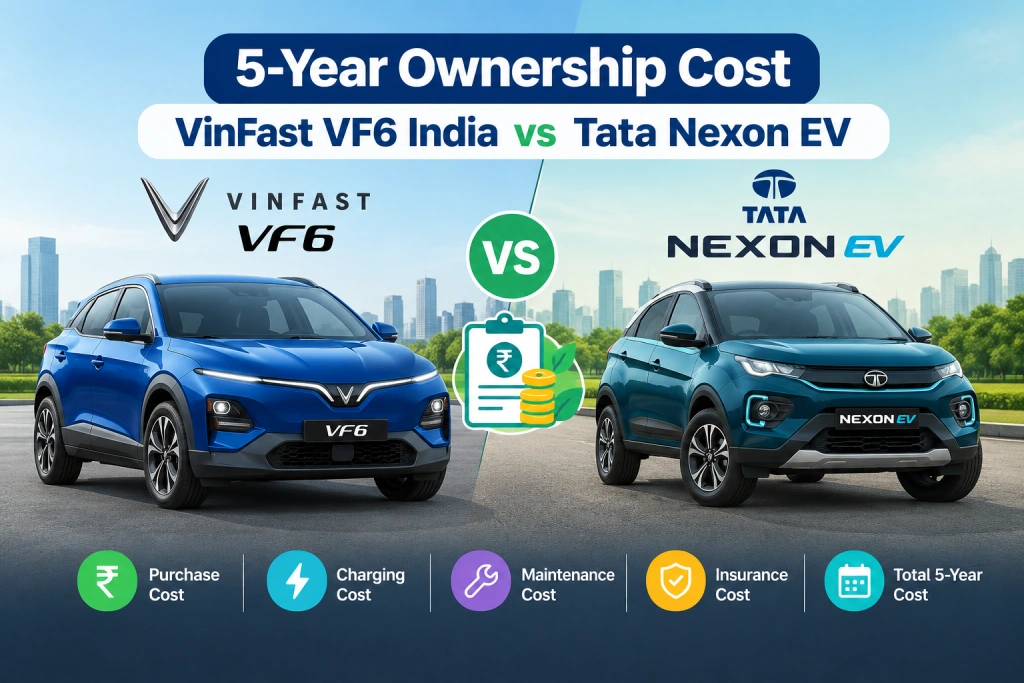
VinFast VF6 India: 5-Year Ownership Cost vs Tata Nexon EV
Updated: 3 spt 2026
Quick Answer: VF6 vs Tata Nexon EV 45
The VinFast VF6 and Tata Nexon EV 45 should not be compared only on ex-showroom price. A five-year ownership calculation needs purchase cost, electricity, insurance, maintenance and resale value. The VF6 currently starts at ₹18.19 lakh and uses a 59.6 kWh battery, while Tata's Nexon EV 45 uses a 45 kWh-class battery and has a 489 km MIDC-certified range.
The important point is that there is no defensible single five-year TCO winner without assumptions for real-world efficiency, insurance, maintenance and resale value. VinFast itself provides a five-year TCO calculator and says its own residual-value programme can reduce depreciation risk, while resale estimates for other vehicles are illustrative.
At a glance
| Factor | VinFast VF6 | Tata Nexon EV 45 |
|---|---|---|
| Current starting/variant price | ₹18.19 lakh starting price | ₹14.14 lakh for Creative 45 in current market listings |
| Battery | 59.6 kWh | 45 kWh marketed battery; Tata's specification page lists 46.08 kWh |
| Certified range | Up to 468 km | 489 km MIDC |
| DC charging | Up to 100 kW | 60 kW |
| Certified charging claim | 10–70% in 25 minutes | 10–80% in 40 minutes |
| Vehicle warranty | 7 years/160,000 km | 3 years/125,000 km |
| HV battery warranty | See warranty terms | Lifetime for eligible first registration, subject to terms |
| Bharat NCAP | 5 stars | Tata's current specification page identifies BNCAP 5-star safety |
VF6 figures are from VinFast's current India specification page; Nexon EV specifications and warranty information are from Tata.ev. The ₹14.14 lakh Creative 45 figure is a current third-party market listing because Tata's dynamic price page does not expose every variant price in its static page output.
Bottom line: the VF6 has a higher entry price, a larger battery and faster DC charging capability. The Nexon EV 45 has a lower starting price within the 45-kWh range and a higher certified range. The eventual five-year winner depends heavily on depreciation, insurance, maintenance, actual electricity consumption and charging behaviour.
What Is Five-Year EV Total Cost of Ownership?
Five-year EV total cost of ownership, or TCO, is the total cost of buying and operating an electric vehicle for five years after accounting for charging, insurance, maintenance and other ownership expenses and subtracting the vehicle's resale value.
A practical formula is:
5-year TCO = Purchase Cost + Charging Cost + Insurance + Maintenance + Other Ownership Costs − Resale Value
The formula is simple. The difficult part is obtaining reliable inputs for every variable.
VinFast's own TCO calculator allows users to select an ownership period including five years and enter monthly travel distance. VinFast also states that its RVG programme provides a fixed percentage resale mechanism, while resale values for other vehicles are estimated from market trends for illustrative purposes.
That distinction matters because a five-year TCO figure can look precise while actually depending on assumptions that may differ substantially between buyers.
VinFast VF6 India: Price, Battery, Range and Charging
The VinFast VF6 is a compact electric SUV with a 59.6 kWh battery and a current India starting price of ₹18.19 lakh on VinFast's official website. The India specification page lists Earth, Wind and Wind Infinity variants, with the Earth version rated at 130 kW and 250 Nm and up to 468 km certified range.
VF6 battery and range
VinFast's current India specification page lists a 59.6 kWh usable battery capacity for the VF6. The Earth version is listed with 130 kW maximum power, 250 Nm maximum torque and 468 km range; the Wind version is listed with 150 kW, 310 Nm and 463 km range.
The VF6 uses a CCS2 charging port, supports AC charging up to 7.2 kW and DC charging up to 100 kW. VinFast quotes approximately 25 minutes for a 10–70% DC charging session.
The official specification page also lists a 2,730 mm wheelbase, 190 mm ground clearance and 423-litre boot space.
VF6 safety
The VF6 received a 5-star Bharat NCAP rating in January 2026. Bharat NCAP test results reported by VinFast give the VF6 27.13/32 points for Adult Occupant Protection and 44.41/49 for Child Occupant Protection.
Those figures are test results, not a prediction of accident outcomes for every real-world crash.
Tata Nexon EV 45: Price, Battery, Range and Charging
The Tata Nexon EV 45 is the long-range version of the Nexon.ev and has a 489 km MIDC-certified range. Tata's current specification page lists a 45 kWh high-energy-density battery, 106 kW motor and 215 Nm torque.
Tata's current price page lists the Nexon.ev range beginning at ₹12.49 lakh for the Creative Plus MR, while current market listings show the Creative 45 at ₹14.14 lakh and higher 45-kWh variants extending to ₹17.49 lakh or more depending on trim and edition.
For this article, the Nexon EV 45 should be treated as the comparison vehicle rather than the cheaper 30 kWh model, because the 45 version is the more relevant long-range comparison with the VF6.
Nexon EV 45 battery and charging
Tata's current specification information identifies the battery as 45 kWh, while another current Tata page specifies the physical battery capacity as 46.08 kWh. Tata markets the vehicle as the Nexon.ev 45.
The Nexon EV 45 is listed with:
- 106 kW motor power
- 215 Nm torque
- 489 km MIDC-certified range
- 60 kW DC fast charging
- 10–80% DC charging in 40 minutes
- 7.2 kW AC home charging
- 350-litre boot space.
The difference in charging hardware is significant: the VF6 is rated for up to 100 kW DC, while the Nexon EV 45 is rated for 60 kW DC.
VF6 vs Nexon EV 45: Specification Comparison
| Specification | VinFast VF6 Earth | Tata Nexon EV 45 |
|---|---|---|
| Battery | 59.6 kWh | 45 kWh marketed battery |
| Published physical battery figure | 59.6 kWh usable | 46.08 kWh on Tata's specification page |
| Maximum power | 130 kW | 106 kW |
| Torque | 250 Nm | 215 Nm |
| Certified range | 468 km | 489 km |
| DC charging | Up to 100 kW | 60 kW |
| DC charging claim | 10–70% in 25 min | 10–80% in 40 min |
| Wheelbase | 2,730 mm | 2,498 mm |
| Boot space | 423 litres | 350 litres |
Source: VinFast India and Tata.ev specifications.
The comparison produces an interesting result: the VF6 has the larger battery and faster maximum DC charging capability, but the Nexon EV 45 has the higher certified range figure. Certified range figures should not be converted directly into real-world electricity consumption because actual energy use depends on driving conditions, speed, temperature, traffic, climate control and charging losses.
Five-Year Charging Cost: The Calculation That Matters
EV charging cost depends on actual electricity consumed rather than simply the battery's advertised capacity. The most reliable calculator therefore uses the owner's real-world km/kWh figure and separates home charging from public charging.
For the base illustration in this article, use:
- Monthly driving: 1,000 km
- Ownership period: 5 years
- Total distance: 60,000 km
- Illustrative electricity tariff: ₹8/kWh
- Charging efficiency: user input
- Public charging share: user input
The ₹8/kWh figure is only a calculator assumption. It is not being presented as India's universal EV electricity tariff.
Why certified range cannot be treated as real-world efficiency
A simple mathematical proxy can be produced from battery capacity and certified range.
For the VF6 Earth:
59.6 kWh ÷ 468 km × 100 = 12.74 kWh/100 km
The battery and certified-range inputs come from VinFast's India specification page.
Using Tata's 46.08 kWh physical battery figure and 489 km certified range:
46.08 kWh ÷ 489 km × 100 = 9.43 kWh/100 km
The battery and range inputs come from Tata's current specification information.
These are battery-energy-per-certified-kilometre proxies, not measured real-world charging consumption.
What happens over 60,000 km?
Using those mathematical proxies:
| Calculation | VF6 Earth | Nexon EV 45 |
|---|---|---|
| Proxy consumption | 12.74 kWh/100 km | 9.43 kWh/100 km |
| Distance | 60,000 km | 60,000 km |
| Calculated energy equivalent | ~7,644 kWh | ~5,658 kWh |
| At illustrative ₹8/kWh | ~₹61,152 | ~₹45,264 |
The calculations above are derived from the manufacturers' published battery and certified-range figures; the ₹8/kWh tariff is an explicit illustration rather than a market-average claim.
Do not publish ₹61,152 and ₹45,264 as predicted real-world five-year charging costs. They are mathematical illustrations based on certified figures.
A proper calculator should instead ask the owner for real-world km/kWh.
A Better Five-Year Charging Formula
For a more defensible calculation:
Step 1: Calculate annual kilometres
Monthly kilometres × 12
For 1,000 km/month:
1,000 × 12 = 12,000 km/year
Step 2: Calculate five-year kilometres
Monthly kilometres × 12 × 5
For 1,000 km/month:
1,000 × 12 × 5 = 60,000 km
Step 3: Calculate energy required
Five-year kilometres ÷ real-world km/kWh
Step 4: Calculate home-charging cost
Home energy consumption × home electricity tariff
Step 5: Calculate public-charging cost
Public energy consumption × public charging tariff
Step 6: Add the two
Five-year charging cost = home charging + public charging
This method is superior to using battery capacity divided by ARAI/MIDC range because the reader can substitute actual efficiency from their own driving.
An Important VF6 Ownership-Cost Factor: Free V-Green Charging
The current VinFast India programme says customers in India receive free charging on the V-Green-developed and operated network through 31 March 2029. VinFast announced the extension in March 2026.
VinFast's August 2026 dealership announcement also says complimentary charging through the V-Green network continues until 31 March 2029.
That can materially affect a VF6 owner's public-charging cost.
However, a five-year ownership calculator should not assume that all five years of public charging are free. A buyer taking delivery in 2026 could own the vehicle beyond March 2029, so the calculator should split the period:
Free-program period → paid-charging period
The calculator should also apply the programme's current terms rather than treating free charging as a permanent ownership benefit.
Three Years of Complimentary Maintenance
VinFast's August 2026 announcement says its VF6 and VF7 ownership package includes three years of complimentary maintenance, along with roadside assistance and warranty coverage depending on model.
That matters for the first three years of a five-year ownership calculation.
However, the calculator should not invent a rupee value for “three years of free maintenance.” Instead, the page should display:
Years 1–3: complimentary maintenance under the applicable VinFast programme
and allow the user to enter maintenance expenses for:
Years 4–5: user input / verified service-plan pricing
This keeps the calculation transparent.
Five-Year Maintenance Cost
Maintenance should be included in TCO, but unsupported maintenance averages should not be presented as facts.
For the VF6, VinFast currently states three years of complimentary maintenance as part of its ownership package.
For the Nexon EV 45, the article should use current Tata service-plan or scheduled-maintenance information if a rupee figure is available and verifiable. If a verified five-year total is unavailable, the calculator should use a user-entered value.
Do not write:
“The average EV maintenance cost is ₹X per year.”
unless the ₹X figure is supported by a current, authoritative source.
A better calculator has these fields:
- Year 1 maintenance
- Year 2 maintenance
- Year 3 maintenance
- Year 4 maintenance
- Year 5 maintenance
- Tyres
- Other consumables
Five-Year Insurance Cost
Insurance is one of the variables that should remain user-entered unless a current, vehicle-specific quotation is available.
Insurance premiums vary according to factors including vehicle value, location, insurer, policy structure and optional coverage.
For that reason, this article should not publish a fabricated “average VF6 insurance cost” or “average Nexon EV insurance cost.”
Instead, the calculator should ask:
Annual insurance premium: ₹_____
For a more advanced version:
| Year | VF6 | Nexon EV |
|---|---|---|
| Year 1 | User input | User input |
| Year 2 | User input | User input |
| Year 3 | User input | User input |
| Year 4 | User input | User input |
| Year 5 | User input | User input |
Depreciation: The Biggest Unknown in Five-Year TCO
Depreciation is the difference between what you pay for a vehicle and what you recover when you sell it. For a five-year ownership comparison, depreciation can materially change which vehicle has the lower TCO.
The formula is:
Depreciation = Purchase Cost − Resale Value
The problem is that a five-year resale value for a newly established model cannot responsibly be presented as an exact fact without a reliable market dataset.
VinFast's own TCO calculator explicitly addresses this problem. The company says its RVG/Residual Value Guarantee programme lets customers sell the EV back at a fixed price percentage, while resale values for other vehicles are estimated from market trends and are illustrative.
VinFast has also described its Value Assured programme as offering predefined buyback values, and a 2026 company announcement states that the programme can offer buyback support of up to 75%, subject to the programme's applicable conditions.
How the calculator should handle depreciation
Instead of declaring:
“VF6 will be worth ₹X lakh after five years.”
use three inputs:
Conservative
Expected resale value: user input
Base
Expected resale value: user input
Optimistic
Expected resale value: user input
If a buyer qualifies for a specific VinFast Value Assured offer, the calculator can use that documented buyback value as a separate scenario.
This is much safer than presenting a made-up depreciation percentage.
VF6 vs Nexon EV Warranty: A Major Five-Year Difference
Warranty is particularly important in a five-year ownership comparison because the two vehicles use materially different warranty structures.
For the VF6, VinFast warranty information identifies a 7-year/160,000-km vehicle warranty. VinFast's warranty information also identifies an 8-year battery warranty for VF6, with the applicable battery terms governing coverage.
Tata's current lifetime HV battery warranty policy lists the Nexon.ev 45 kWh with lifetime HV battery coverage and unlimited kilometres for the first registration, subject to fair-use conditions. Tata defines “Lifetime” as 15 years from the first registration date.
Tata's current Nexon EV information also identifies the standard vehicle warranty as 3 years/125,000 km.
Warranty comparison
| Warranty factor | VinFast VF6 | Tata Nexon EV 45 |
|---|---|---|
| Vehicle warranty | 7 years / 160,000 km | 3 years / 125,000 km |
| HV battery | 8-year VF6 battery coverage under applicable terms | Lifetime for eligible first registration |
| Lifetime definition | Not applicable to vehicle warranty | 15 years from first registration |
| Five-year ownership | Vehicle remains within stated warranty period if mileage limit is not exceeded | Standard vehicle warranty expires after year 3; lifetime HV battery coverage can continue subject to policy |
Sources: VinFast warranty information and Tata's current warranty policy.
The warranty comparison should not be reduced to “which warranty is better?” The relevant question is:
Which warranty protects the specific ownership risk you care about?
A buyer prioritising long vehicle-warranty coverage may value the VF6's stated seven-year vehicle warranty. A buyer prioritising long-term HV battery coverage may place greater value on Tata's lifetime battery policy for eligible first private registration.
Does Thoothukudi Manufacturing Change VF6 Ownership Economics?
VinFast's Tamil Nadu manufacturing facility is a genuine differentiator, but local assembly by itself does not prove that the VF6 will have a lower five-year ownership cost.
VinFast officially inaugurated its EV assembly plant at SIPCOT Industrial Park in Thoothukudi, Tamil Nadu, on 4 August 2025. The company says the facility covers 400 acres and initially focuses on assembling the VF6 and VF7.
VinFast says the facility's initial production capacity is 50,000 vehicles per year, scalable to 150,000 vehicles annually.
The company subsequently announced an expansion plan involving approximately 500 additional acres and a proposed US$500 million second-phase investment for electric buses and electric two-wheelers.
These facts establish local manufacturing and planned expansion.
They do not establish that:
- VF6 spare parts will always be cheaper;
- VF6 insurance will be cheaper;
- VF6 depreciation will be lower;
- VF6 maintenance will cost less;
- local assembly automatically produces a lower five-year TCO.
Those would require separate evidence.
VinFast's Growing Indian Retail Network
A new-brand ownership comparison should use measurable network information rather than unsupported claims about service quality.
VinFast announced in August 2026 that its new Bihar outlet marked its 60th dealership in India. The company said it remains on track for 75 dealerships across more than 60 cities by the end of 2026.
VinFast had previously announced its 50th retail outlet in March 2026, illustrating the pace of network expansion during 2026.
The network is therefore an important factor to monitor for a long-term buyer.
But dealership count is not the same as service quality.
The article should avoid unsupported statements such as:
“VinFast service is better than Tata.”
or:
“Tata service is more reliable.”
Instead, readers should be encouraged to check:
- nearest authorised service location;
- service availability in their city;
- parts availability;
- roadside assistance terms;
- actual service quotation;
- warranty conditions.
Five-Year EV Ownership Calculator
The calculator should separate verified vehicle data from buyer-specific assumptions.
Input 1: Purchase price
VF6 purchase price: user selects the exact variant and current price.
VinFast currently lists the VF6 starting at ₹18.19 lakh on its India website.
Nexon EV 45 purchase price: user selects the exact variant and current price.
Current listings show 45-kWh variants from approximately ₹14.14 lakh ex-showroom, with higher variants reaching ₹17.49 lakh or more depending on specification and edition.
The calculator should use the exact selected variant rather than comparing the VF6 starting price with the most expensive Nexon EV.
Input 2: Monthly kilometres
Example:
1,000 km/month
This is an assumption for the calculator, not a national driving average.
Input 3: Ownership period
Default:
5 years
The period is selected because the article's purpose is a five-year ownership comparison.
Input 4: Real-world efficiency
Example:
User enters km/kWh
Do not automatically substitute ARAI or MIDC range.
Input 5: Home charging tariff
Example:
₹8/kWh
This is an editable illustration.
Input 6: Public charging
Enter:
- Public charging percentage
- Public charging tariff
- Free charging eligibility
- Free charging programme expiry
For VF6 owners, the current VinFast V-Green programme extends free charging through 31 March 2029, subject to applicable programme conditions.
Input 7: Insurance
Enter annual premium or individual yearly premiums.
Input 8: Maintenance
Enter:
- scheduled service;
- tyres;
- consumables;
- unexpected maintenance.
For VF6, the current VinFast India ownership package includes three years of complimentary maintenance.
Input 9: Resale value
Enter expected resale value.
If the buyer has a documented Value Assured offer, the buyer can use that programme value as a separate scenario. VinFast says its Value Assured programme provides predefined buyback values, and its April 2026 announcement described the programme as offering buyback support of up to 75%, subject to the programme terms.
Calculator Formula
Annual kilometres
Monthly km × 12
Five-year kilometres
Monthly km × 12 × 5
Energy required
Five-year km ÷ real-world km/kWh
Charging cost
Home charging cost + public charging cost
Five-year ownership cost before resale
Purchase price + charging + insurance + maintenance + other costs
Five-year TCO
Purchase price + charging + insurance + maintenance + other costs − resale value
Cost per kilometre
Five-year TCO ÷ five-year kilometres
Worked Example: 1,000 km Per Month
The following example is intentionally illustrative rather than a forecast.
Assumptions:
- 1,000 km/month
- 60,000 km over five years
- ₹8/kWh electricity
- No insurance assumption
- No maintenance assumption
- No depreciation assumption
Using the manufacturers' battery/range figures only as a mathematical proxy gives approximately 7,644 kWh for the VF6 Earth and 5,658 kWh for the Nexon EV 45 over 60,000 km. At the illustrative ₹8/kWh rate, the resulting mathematical energy-cost equivalents are approximately ₹61,152 and ₹45,264 respectively.
But these numbers must not be presented as predicted real-world charging bills.
They exclude charging losses and rely on certified-range figures rather than measured real-world efficiency.
A reader who enters actual efficiency can obtain a much more meaningful result.
Scenario Analysis: When Could the VF6 Make More Sense?
Scenario 1: Buyer prioritises lower upfront cost
The Nexon EV 45 has lower-priced variants than the VF6's ₹18.19 lakh starting point. Current market listings put the Creative 45 at approximately ₹14.14 lakh ex-showroom.
For a buyer whose primary objective is minimising purchase expenditure, the Nexon EV 45 therefore deserves serious consideration.
Scenario 2: Buyer prioritises charging speed
The VF6 supports up to 100 kW DC charging, while the Nexon EV 45 supports 60 kW DC charging. VinFast quotes 10–70% in about 25 minutes; Tata quotes 10–80% in about 40 minutes.
For frequent long-distance use where compatible DC charging infrastructure is available, charging capability may therefore become an important differentiator.
Scenario 3: Buyer prioritises battery warranty
Tata's lifetime HV battery warranty for the Nexon EV 45 applies to eligible first registration and defines lifetime as 15 years from first registration, with unlimited kilometres subject to fair-use conditions.
That is a significant ownership consideration for buyers planning to keep the vehicle for many years.
Scenario 4: Buyer prioritises vehicle-warranty duration
The VF6 has a stated 7-year/160,000-km vehicle warranty, subject to the applicable warranty terms.
The Nexon EV's standard vehicle warranty is 3 years/125,000 km, while its HV battery has the separate lifetime policy for eligible first registration.
For a five-year owner, the distinction is straightforward: the standard Nexon vehicle warranty ends earlier, while the VF6's stated vehicle warranty extends beyond the five-year ownership horizon if the mileage limit is not exceeded.
Who Should Consider the VinFast VF6?
The VF6 is particularly worth evaluating for buyers who value its larger battery, faster maximum DC charging capability, longer stated vehicle warranty and premium feature positioning, and who are comfortable with a newer brand and its developing Indian network. The first three factors are directly measurable; brand-risk tolerance is a buyer preference rather than an objective cost metric.
The VF6 is worth shortlisting if you prioritise:
- 59.6 kWh battery;
- up to 100 kW DC charging;
- 7-year/160,000-km vehicle warranty;
- 423-litre boot;
- 5-star Bharat NCAP rating;
- VinFast's current ownership programmes;
- access to the expanding VinFast network.
Who Should Consider the Tata Nexon EV 45?
The Nexon EV 45 is worth considering for buyers who prioritise a lower entry price, 489 km MIDC-certified range and Tata's lifetime HV battery warranty for eligible first registrations. Tata's current specification information also lists 60 kW DC charging and 7.2 kW AC home charging for the 45 version.
The Nexon EV 45 is particularly relevant when the buyer prioritises:
- lower initial purchase price;
- 489 km certified range;
- lifetime HV battery warranty eligibility;
- established Tata.ev product ecosystem;
- multiple 45-kWh trim choices.
Which Is Cheaper After Five Years?
There is no responsible one-line answer without the reader's actual mileage, electricity tariff, insurance premium, maintenance cost and expected resale value.
The VF6 starts at a higher price than the lower-priced Nexon EV 45 variants, so the VF6 begins with a purchase-cost disadvantage when compared with a cheaper Nexon EV 45 trim.
However, the five-year calculation also needs to account for the VF6's current ownership programmes, including three years of complimentary maintenance, free V-Green charging through 31 March 2029 and its Value Assured buyback programme, all subject to their applicable conditions.
The Nexon EV 45 counters with a lower entry price and lifetime HV battery warranty for eligible first registration.
Therefore, the correct comparison is:
VF6 TCO = higher purchase price + actual ownership costs − applicable benefits − resale
versus
Nexon EV 45 TCO = purchase price + actual ownership costs − resale
The calculator should determine the final result from the buyer's inputs.
Frequently Asked Questions
Is the VinFast VF6 more expensive than the Tata Nexon EV 45?
The VF6 currently starts at ₹18.19 lakh on VinFast's India website, while current listings show the Nexon EV 45 starting at approximately ₹14.14 lakh for the Creative 45. Exact comparisons should use the same pricing basis and exact variants.
What is the VF6 battery capacity?
VinFast's current India specification page lists the VF6 with a 59.6 kWh usable battery capacity.
What is the VF6's certified range?
The VF6 Earth is listed with a 468 km certified range, while the Wind is listed at 463 km on VinFast's current India specification page.
What is the Tata Nexon EV 45 range?
Tata lists the Nexon EV 45 with a 489 km MIDC Part 1 + Part 2 certified range.
Which charges faster, VF6 or Nexon EV 45?
The VF6 has a higher maximum DC charging rating of 100 kW, compared with 60 kW for the Nexon EV 45. VinFast quotes approximately 25 minutes for 10–70% charging, while Tata quotes approximately 40 minutes for 10–80%.
Does the VF6 have a longer vehicle warranty?
Yes. VinFast states a 7-year/160,000-km vehicle warranty for the VF6, subject to applicable terms. Tata's standard Nexon EV vehicle warranty is 3 years/125,000 km.
Does the Nexon EV 45 have a lifetime battery warranty?
Yes. Tata's current policy provides a lifetime HV battery warranty for the Nexon.ev 45 kWh for eligible first registration, with unlimited kilometres subject to fair-use conditions. Tata defines lifetime as 15 years from first registration.
Does VinFast offer free charging in India?
VinFast says its V-Green charging programme in India provides free charging through 31 March 2029, subject to the programme's applicable terms.
Does VinFast offer free maintenance?
VinFast's August 2026 announcement says the VF6 and VF7 ownership package includes three years of complimentary maintenance, along with other ownership benefits.
Does Thoothukudi manufacturing make the VF6 cheaper to own?
There is no sufficient evidence to make that claim. VinFast does assemble the VF6 at its Thoothukudi facility, but local manufacturing alone does not establish lower insurance, maintenance, depreciation or resale costs.
What is the correct five-year EV TCO formula?
Five-year TCO = purchase price + charging + insurance + maintenance + other ownership costs − resale value.
Should ARAI or MIDC range be used to calculate actual charging cost?
No. Certified range is useful for comparing officially tested vehicle figures, but a five-year ownership calculator should ideally use the owner's real-world km/kWh figure. The mathematical battery/range proxy used in this article is an illustration, not measured real-world consumption. The manufacturer specifications provide the underlying certified figures.
Which EV should I buy for five years?
The answer depends on the buyer's priorities. The VF6 offers a larger battery, faster maximum DC charging and longer stated vehicle warranty, while the Nexon EV 45 offers a lower-priced entry point within its 45-kWh range and lifetime HV battery warranty eligibility for first registration. A complete TCO calculation requires the buyer's mileage, charging, insurance, maintenance and resale assumptions.
Key Takeaways
- The VF6 currently starts at ₹18.19 lakh, according to VinFast India's current website.
- The VF6 uses a 59.6 kWh battery and has up to 468 km certified range in the Earth variant.
- The Nexon EV 45 has a 489 km MIDC-certified range and Tata lists a 45 kWh battery specification, with another current Tata page specifying 46.08 kWh.
- VF6 DC charging is rated up to 100 kW, compared with 60 kW for the Nexon EV 45.
- VF6 has a stated 7-year/160,000-km vehicle warranty, while the Nexon EV's standard vehicle warranty is 3 years/125,000 km.
- Nexon EV 45 has lifetime HV battery warranty eligibility for first registration, with Tata defining lifetime as 15 years and unlimited kilometres subject to fair-use conditions.
- VinFast currently offers complimentary V-Green charging through 31 March 2029, subject to programme terms.
- VinFast says the VF6 ownership package includes three years of complimentary maintenance.
- VinFast's Thoothukudi plant assembles the VF6 and VF7, with an initial stated capacity of 50,000 vehicles annually and scalability to 150,000.
- A fixed five-year TCO figure should not be published without verified resale, insurance, maintenance and real-world energy inputs. VinFast's own TCO tool distinguishes its residual-value programme from illustrative resale estimates for other vehicles.
Final Verdict
The VinFast VF6 is not automatically cheaper to own than the Tata Nexon EV 45, and the Nexon EV 45 is not automatically cheaper either. The correct five-year winner depends on the buyer's actual purchase price, kilometres, charging mix, insurance, maintenance and resale value.
The VF6 begins with a higher starting price but brings a 59.6 kWh battery, up to 100 kW DC charging, a 7-year/160,000-km vehicle warranty, three years of complimentary maintenance and a current V-Green free-charging programme through 31 March 2029 under the applicable terms.
The Nexon EV 45 offers a 489 km MIDC-certified range, lower-priced 45-kWh variants and lifetime HV battery warranty eligibility for first registration, while its standard vehicle warranty is 3 years/125,000 km.
The most important number for an individual buyer is therefore not the advertised five-year TCO of somebody else's vehicle.
It is:
Your five-year TCO = your purchase price + your charging cost + your insurance + your maintenance + your other costs − your expected resale value.
That is why a transparent VinFast VF6 vs Tata Nexon EV 45 five-year ownership calculator is more useful than a single unsupported “₹X lakh” ownership claim.
Calculate your 5-year EV ownership cost
Enter your:
monthly kilometres + real-world efficiency + home tariff + public charging + insurance + maintenance + resale value
and compare the resulting five-year TCO and cost per kilometre for the VF6 and Nexon EV 45.
External Authority References
VinFast
VinFast VF6 India — official specifications and current price
VinFast India — VF6 and VF7 launch announcement
VinFast Thoothukudi assembly plant announcement
VinFast India — Total Cost of Ownership calculator
VinFast India — Bharat NCAP VF6 result
VinFast India — 60 dealership milestone
VinFast India — free charging programme extension
Tata.ev
Tata Nexon.ev — official specifications
Tata Nexon.ev — official product page
Tata Nexon.ev — official pricing and variants
Tata EV — Lifetime HV Battery Warranty policy
Editorial/Data Note
All manufacturer specifications and programme details above are sourced from current official manufacturer material or clearly identified current market sources. Calculated values are labelled as calculations, while ₹8/kWh, 1,000 km/month and resale/insurance/maintenance inputs are explicitly treated as illustrative or user-entered assumptions.
The article deliberately does not manufacture a five-year resale value, average insurance premium, average maintenance bill or universal real-world efficiency figure. That preserves the original brief's requirement for a 100% data-backed, no-hallucination ownership comparison.