E-Rickshaw vs Petrol Auto: Daily Earnings & Profitability in 2026
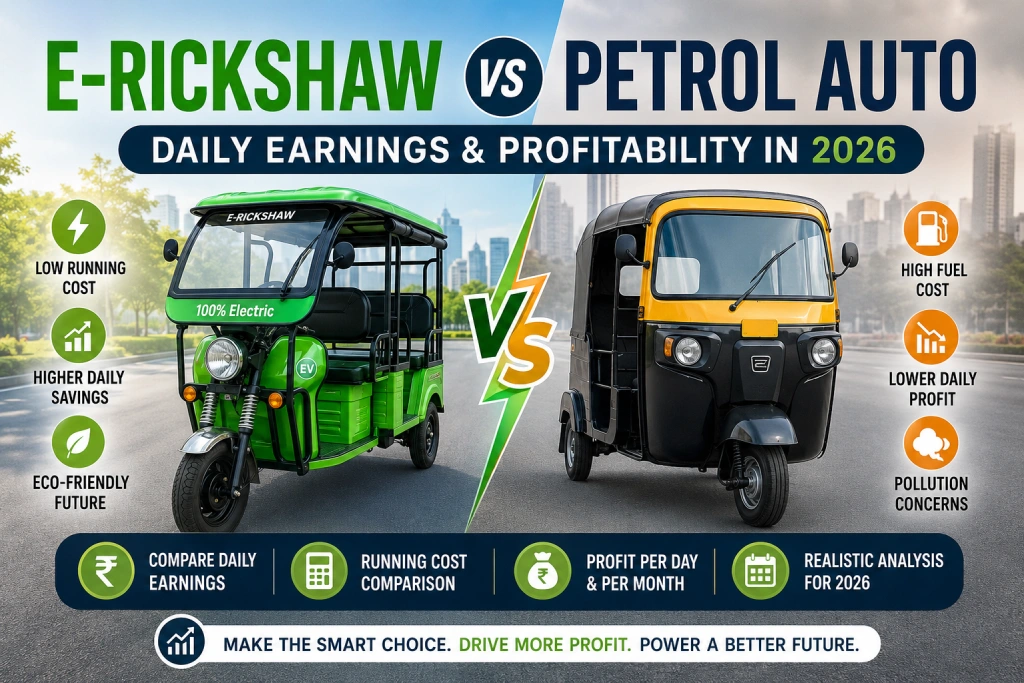
Meta description: E-rickshaw vs petrol auto: compare running costs, daily profit, EMI and break-even using a customizable 2026 calculator.
Quick Answer: Is an E-Rickshaw More Profitable Than a Petrol Auto?
An e-rickshaw is not automatically more profitable than a petrol auto. The better financial choice depends on daily kilometres, passenger revenue, electricity or fuel cost, maintenance, financing, battery replacement and utilisation.
The most reliable comparison is therefore not a single “average profit” figure. Instead, enter your actual daily revenue, kilometres, energy cost, maintenance and EMI into a profitability calculator and compare the resulting cash profit.
Electric three-wheelers are an increasingly important part of India's commercial EV market. Vahan data reported by EVreporter shows 40,198 E3W L5 Passenger registrations in July 2026, compared with 34,593 in June. EVreporter also reports 34,716 e-rickshaw registrations in July 2026. (EVreporter)
Quick comparison
| Factor | E-rickshaw | Petrol auto |
|---|---|---|
| Energy source | Electricity / battery swap | Petrol |
| Energy cost | Enter actual local cost | Calculate from petrol price and mileage |
| Passenger revenue | User input | User input |
| Maintenance | User input | User input |
| Battery replacement | Include where applicable | Not applicable |
| EMI | User input | User input |
| Daily profit | Calculated | Calculated |
| Monthly profit | Calculated | Calculated |
| Break-even | Calculator-derived | Calculator-derived |
The key point: lower energy expenditure does not by itself prove higher take-home profit. The vehicle's purchase cost, financing, utilisation, maintenance and passenger revenue also affect profitability.
E-Rickshaw vs Petrol Auto: What Actually Determines Profit?
Auto-rickshaw profitability is the amount of passenger revenue left after accounting for energy or fuel, maintenance, other operating expenses and financing costs. The same vehicle can produce very different monthly profits when utilisation, revenue or financing assumptions change.
For an owner-driver, the main variables are:
- Daily kilometres
- Passenger revenue per day
- Fuel or electricity cost
- Maintenance
- Battery replacement
- Insurance
- Parking, stand or permit-related expenses
- EMI
- Working days
- Downtime
The profitability calculation should therefore begin with revenue, not with fuel savings.
Why daily kilometres matter
A vehicle that travels more kilometres spreads fixed ownership costs over more kilometres. WRI India has specifically found that higher utilisation improves the economic case for electric three-wheelers in its TCO analysis. (WRI India)
That does not mean every driver who travels more will automatically earn more money. More kilometres only help when the additional kilometres generate sufficient passenger revenue relative to their operating cost.
Why passenger revenue matters
Fuel and electricity are only cost components.
For example, an owner-driver could have a low energy cost but still have weak monthly profit if passenger utilisation is low, working days are limited or EMI costs are high.
For that reason, this article does not publish an invented “average Indian e-rickshaw daily income” or “average petrol auto daily income.”
The calculator should instead ask the driver:
How much gross passenger revenue do you actually collect on a typical working day?
That input makes the calculation more useful than a national average that may not represent the driver's city, route or operating pattern.
Petrol Auto Running Cost
Petrol auto fuel cost depends on the kilometres driven, the vehicle's actual fuel consumption and the local petrol price. A simple calculator can therefore estimate fuel expenditure without assuming a universal national operating cost.
For a manufacturer-specific benchmark, TVS states that the petrol TVS King Deluxe delivers 38 ± 3 km/l under standard testing conditions. (TVS Motor Company)
That figure should not be silently presented as guaranteed real-world mileage for every petrol auto.
Petrol fuel-cost formula
Use:
Daily petrol cost = Daily kilometres ÷ Petrol mileage × Petrol price per litre
For example, if a user enters:
- Daily distance = user input
- Mileage = user input
- Petrol price = user input
the calculator can determine the daily fuel cost.
The calculation is deliberately user-driven because petrol prices vary by location and vehicle mileage varies with operating conditions.
A useful manufacturer benchmark
The TVS King Deluxe petrol model is a concrete example rather than a generic “all petrol autos” benchmark. TVS lists the King Deluxe petrol mileage at 38 ± 3 km/l under standard testing conditions. (TVS Motor Company)
TVS also lists a petrol fuel-tank capacity of 8.5 ± 0.5 litres for the petrol variant. (TVS Motor Company)
The calculator should use the user's actual mileage and local fuel price whenever available.
E-Rickshaw Running Cost
E-rickshaw operating cost should include more than electricity or battery-swap expenditure. A complete calculation should account for energy, maintenance, battery replacement and ownership costs.
WRI India notes that the battery constitutes approximately 30–40% of an e-rickshaw's upfront cost and affects both vehicle performance and operating cost. (WRI India)
That makes battery economics important to a profitability calculation.
Electricity or battery-swap cost
The calculator should provide separate input options for:
- Electricity cost per kWh
- Vehicle energy consumption
- Battery-swap cost per swap
- Number of swaps per day
The original brief's proposed ₹120–₹150 per 100 km swap-cost figure should not be published as a universal 2026 benchmark because the available evidence does not establish that figure as a national market standard.
Instead, the calculator should say:
Enter your actual charging or battery-swap cost.
This keeps the result location- and operator-specific.
A current model-specific electricity benchmark
Government PM E-DRIVE model records provide an example of why model-specific energy consumption is preferable to an invented universal number.
The PM E-DRIVE model database lists the Bajaj Riki C4005 e-rickshaw/e-cart with a stated electric energy consumption of 5.10 kWh per 100 km, a battery capacity of 5.40 kWh, and a stated range of 123 km for the listed model record. The record shown is valid from July 15, 2026 to December 21, 2026. (PM E-DRIVE)
That is a model-specific government-recorded figure, not a universal consumption figure for every e-rickshaw.
The calculator should therefore allow the user to select the vehicle model or manually enter actual consumption.
Calculate Your E-Rickshaw vs Petrol Auto Profit
Enter your actual daily kilometres and revenue to compare estimated daily and monthly cash profit.
Calculate NowWRI Evidence on Electric Three-Wheeler TCO
Total Cost of Ownership (TCO) measures vehicle ownership and operating costs over a defined period rather than simply measuring daily fuel or electricity expenditure.
WRI India's e-auto guidebook provides one of the most useful published comparisons for understanding electric and petrol three-wheeler economics. Its model considered vehicle cost, financing, insurance, energy/fuel, battery replacement and maintenance over a 10-year period. (WRI India)
WRI's 10-year model
Under WRI's stated assumptions, the model produced the following average TCO figures:
| Vehicle | WRI model average TCO |
|---|---|
| E-3W | ₹2.53/km |
| CNG-3W | ₹2.90/km |
| Petrol-3W | ₹3.31/km |
| Diesel-3W | ₹3.17/km |
These are WRI model outputs, not 2026 retail-market prices or guaranteed costs for an individual driver. (WRI India)
WRI's model used a 10-year holding period and included battery replacement for the E-3W. The model also used assumptions including ₹8/kWh electricity, ₹95/litre petrol and 100 vehicle-kilometres travelled per day. WRI explicitly notes that assumptions such as financing rates and charging costs can change with market conditions. (WRI India)
Why the WRI numbers are useful
The value of the WRI analysis is not that ₹2.53/km should be copied into every 2026 calculator.
The value is that the analysis demonstrates the importance of including:
- Capital cost
- Financing
- Energy cost
- Maintenance
- Battery replacement
- Utilisation
- Holding period
A calculator that only compares petrol expenditure with electricity expenditure would therefore be incomplete.
Daily Earnings and Profitability Calculator
What should the calculator ask?
The calculator should separate revenue, operating cost and financing.
Common inputs
- Daily kilometres
- Working days per month
- Gross passenger revenue per day
- Parking/stand expenses
- Other daily expenses
- Monthly insurance allocation
- Monthly maintenance
- Monthly EMI
E-rickshaw inputs
- Electricity cost
- Energy consumption
- Battery-swap cost, if applicable
- Battery replacement reserve
- Vehicle purchase price
- Down payment
- Loan tenure
- Interest rate
Petrol-auto inputs
- Petrol price
- Real-world mileage
- Vehicle purchase price
- Down payment
- Loan tenure
- Interest rate
- Maintenance
The input values should be labelled clearly as user input whenever they are not supported by a current authoritative source.
Daily Gross Revenue
Daily gross revenue = passenger revenue collected during the working day.
The user should enter actual or estimated daily passenger revenue.
Do not substitute an unsupported national “average daily earning” figure.
Monthly Gross Revenue
Monthly gross revenue = daily gross revenue × working days per month
For example, the calculator could allow:
Daily passenger revenue: Enter your amount
Working days: Enter your number of days
The result is then calculated automatically.
E-Rickshaw Energy Cost
For a charging-based vehicle:
Daily electricity cost = daily kilometres × electricity consumption per kilometre × electricity price per kWh
For a battery-swapping model:
Daily swap cost = number of swaps × cost per swap
The calculator should not assume that charging and battery swapping have identical economics.
Petrol Cost
Daily petrol cost = daily kilometres ÷ mileage × petrol price per litre
For the TVS King Deluxe petrol model, the manufacturer's stated benchmark is 38 ± 3 km/l under standard testing conditions. (TVS Motor Company)
For an individual calculation, however, the driver can replace the benchmark with actual observed mileage.
Monthly Operating Profit Before EMI
Monthly operating profit before EMI =
Monthly gross revenue − monthly fuel/energy cost − maintenance − other operating expenses
This is different from cash profit after financing.
Monthly Cash Profit After EMI
Monthly cash profit after EMI =
Monthly operating profit − monthly EMI
This distinction matters because two vehicles with similar operating economics can produce different monthly cash flow when their purchase prices and loan terms differ.
Example: 100 km Per Day
WRI's published three-wheeler TCO analysis uses 100 km/day as a representative utilisation assumption for its comparison. (WRI India)
The 100-km/day figure should therefore be treated as a research-model scenario, not as a claim that every Indian auto driver travels 100 km each day.
Under WRI's model, the following assumptions were used for the comparison:
- Petrol energy cost: ₹95/litre
- Petrol mileage: 20.1 km/l
- Electricity cost: ₹8/kWh
- E-3W mileage: 10 km/kWh
- Daily vehicle kilometres: 100 km
- Holding period: 10 years
WRI's model then calculated an average TCO of ₹2.53/km for the E-3W and ₹3.31/km for the petrol 3W. (WRI India)
What this example does not tell you
The WRI model does not tell an individual driver that an e-rickshaw will automatically generate a specific monthly profit.
The model does not know:
- The driver's actual passenger revenue
- The driver's city
- The driver's route
- Actual local electricity cost
- Actual petrol price
- Actual financing offer
- Actual vehicle purchase price
- Actual maintenance expenditure
- Actual working days
That is precisely why the EV Calculator should use WRI's research as context, while allowing users to replace assumptions with their own numbers.
At What Daily Kilometres Does an EV Advantage Become Significant?
There is no single universal 2026 break-even kilometre figure for every e-rickshaw and petrol auto. The answer changes with vehicle price, financing, energy cost, fuel price, maintenance, battery cost and utilisation.
WRI's research does, however, demonstrate the importance of utilisation. Its analysis found that higher utilisation improves the economic case for electric three-wheelers because fixed costs are spread across more kilometres and the operating-cost difference becomes more significant. (WRI India)
Break-even formula
A simplified operating-cost break-even calculation can be expressed as:
Break-even kilometres = Fixed monthly cost difference ÷ Per-km operating-cost saving
Where:
Per-km operating-cost saving = Petrol operating cost/km − EV operating cost/km
This formula is useful only when the inputs are comparable.
For a complete ownership comparison, the calculator should also consider:
- Purchase-price difference
- Down payment
- EMI
- Interest
- Maintenance
- Battery replacement
- Insurance
- Resale value, if reliable data is available
Why utilisation changes the result
Consider two drivers:
Driver A: Low daily utilisation
Driver B: High daily utilisation
If both drivers own vehicles with similar fixed monthly costs, the driver travelling more productive kilometres has more opportunity to spread those fixed costs.
WRI's published analysis similarly reports stronger economic viability for electric three-wheelers at higher utilisation. (WRI India)
The calculator should therefore show a sensitivity chart rather than a single fixed break-even number.
How Battery Replacement Changes the Calculation
Battery replacement is an ownership cost that should be included when calculating long-term e-rickshaw economics.
WRI's TCO model explicitly included battery replacement and assigned ₹1,83,956 to battery replacement in its 10-year E-3W model. (WRI India)
That figure is a historical/model assumption and should not be presented as the current replacement price of every e-rickshaw battery.
The appropriate calculator approach is:
Annual battery reserve = Expected replacement cost ÷ expected replacement interval
or, for a kilometre-based TCO:
Battery reserve per km = expected replacement cost ÷ expected kilometres before replacement
The user should be allowed to replace both inputs with actual battery quotations and expected battery life.
Battery technology also matters
WRI's 2025 research notes that e-rickshaws have historically relied heavily on lead-acid batteries while lithium-ion adoption has been increasing. WRI also reports that lithium-ion battery packs have higher energy density but higher upfront battery costs. (WRI India)
Therefore, an e-rickshaw profitability calculator should not assume that every electric three-wheeler has identical battery economics.
E-Rickshaw vs Petrol Auto: Cost Comparison
| Cost factor | E-rickshaw | Petrol auto |
|---|---|---|
| Energy source | Electricity or battery swap | Petrol |
| Energy/fuel formula | Consumption × electricity price or swap cost | Distance ÷ mileage × petrol price |
| Passenger revenue | User input | User input |
| Maintenance | User input | User input |
| Battery reserve | Include where applicable | Not applicable |
| Purchase price | Model-specific/user input | Model-specific/user input |
| Financing | EMI, interest and tenure | EMI, interest and tenure |
| Insurance | User input | User input |
| Daily profit | Calculator output | Calculator output |
| Monthly profit | Calculator output | Calculator output |
| Long-term TCO | Calculator output | Calculator output |
Important distinction: running cost vs profitability
Running cost is not the same as profitability.
A vehicle can have a lower energy cost per kilometre but still produce lower monthly cash profit if:
- Its purchase cost is higher
- EMI is higher
- Battery replacement is expensive
- Utilisation is low
- Revenue is lower
- Charging access causes downtime
Conversely, a petrol vehicle can have higher fuel expenditure but still be financially attractive for an owner who already owns the vehicle and therefore has no new purchase financing.
Who Should Consider an E-Rickshaw?
High-utilisation operators
High utilisation can strengthen the economics of electric three-wheelers because operating-cost savings are realised over more kilometres. WRI's analysis specifically identifies high assured utilisation as favourable for electric three-wheeler economics. (WRI India)
The strongest candidate is therefore not simply “someone who wants an EV.”
It is an operator whose:
- Daily utilisation is high
- Passenger revenue is reliable
- Charging or swapping is practical
- Energy cost is known
- Financing is manageable
- Battery replacement has been budgeted
Operators with convenient charging or swapping
Charging availability is an important operating consideration.
An EV that cannot be charged when needed can create downtime, even if its energy cost is low.
The decision should therefore consider both:
Cost per kilometre
and
Ability to keep the vehicle working.
Buyers evaluating long-term ownership
A buyer who intends to operate the vehicle for several years should consider TCO rather than only purchase price.
WRI's published model demonstrates why: its E-3W had a higher initial capital cost than the petrol 3W in the model, but lower long-term operating cost resulted in lower 10-year average TCO. (WRI India)
Compare EV and Petrol Running Costs for Your Daily Kilometres
Use actual local operating inputs rather than relying on a generic national cost-per-kilometre claim.
Calculate NowWho May Prefer a Petrol Auto?
A petrol auto may still make financial sense under certain circumstances.
Existing petrol-auto owners
A driver who already owns a petrol vehicle should compare the incremental cost of switching rather than comparing two new vehicles from zero.
The comparison should include:
- Remaining loan balance
- Resale value
- Cost of replacement
- New EMI
- Expected fuel savings
- Expected battery replacement
Low-utilisation operators
If the vehicle travels relatively few productive kilometres, fuel savings may not be sufficient to offset a higher purchase or financing cost.
This is not a universal rule; it is a reason to run the calculator using the operator's actual utilisation.
Charging constraints
If reliable charging or battery swapping is unavailable, operating practicality can outweigh theoretical energy-cost savings.
Financing differences
Two vehicles can have very different cash-flow profiles even when their energy costs appear favourable.
The calculator should therefore compare:
Operating profit before EMI
with:
Cash profit after EMI
How to Calculate Monthly E-Rickshaw Profit
Step 1: Calculate daily passenger revenue
Enter the actual average amount collected from passengers during a working day.
Daily gross revenue = user input
Step 2: Calculate energy expenditure
For charging:
Daily energy cost = kilometres × consumption/km × electricity price
For swapping:
Daily swap cost = swaps/day × swap price
Step 3: Add maintenance
Enter either:
- Actual monthly maintenance expenditure, or
- A clearly labelled maintenance assumption.
Do not present an unsupported national maintenance average as a fact.
Step 4: Add other operating costs
Depending on the driver's operation, the calculator can include:
- Parking
- Stand-related expenses
- Permits
- Insurance allocation
- Miscellaneous expenses
The exact amount should remain user-configurable.
Step 5: Deduct EMI
Monthly cash profit = monthly operating profit − monthly EMI
This provides a more practical cash-flow figure for an owner buying the vehicle with financing.
Step 6: Compare with the petrol auto
Run the same calculation for the petrol vehicle using:
- Same working days
- Same daily kilometres
- Actual passenger revenue
- Petrol price
- Actual mileage
- Maintenance
- EMI
- Insurance
- Other operating expenses
This creates a more meaningful apples-to-apples comparison.
Frequently Asked Questions
Is an e-rickshaw more profitable than a petrol auto in 2026?
Not necessarily. Profitability depends on daily kilometres, passenger revenue, energy or fuel cost, maintenance, battery replacement, financing and utilisation. Published WRI TCO research shows electric three-wheelers can have lower long-term TCO under its assumptions, but those historical model assumptions should not be treated as a guaranteed 2026 profit outcome. (WRI India)
How much does an e-rickshaw cost to run per km?
There is no single universal 2026 cost per kilometre for every e-rickshaw. The calculation depends on energy consumption, electricity price or battery-swap cost, maintenance and battery economics. Government PM E-DRIVE records, for example, list the Bajaj Riki C4005 at 5.10 kWh/100 km in the applicable model record. (PM E-DRIVE)
How much petrol does an auto-rickshaw consume per 100 km?
For the TVS King Deluxe petrol model, TVS states 38 ± 3 km/l under standard testing conditions. That translates to approximately 2.63 litres per 100 km at the stated 38 km/l midpoint, but actual consumption can differ from the manufacturer's test-condition figure. (TVS Motor Company)
How many kilometres should an e-rickshaw run per day to be profitable?
There is no universal profitability threshold. The answer depends on passenger revenue, vehicle cost, energy cost, maintenance, financing and other expenses. WRI research shows that higher utilisation can improve electric three-wheeler economics, but the appropriate break-even point should be calculated using the operator's actual inputs. (WRI India)
Does battery replacement reduce e-rickshaw profit?
Battery replacement can materially affect long-term ownership economics, which is why it should be included in a TCO calculation. WRI's 10-year E-3W model explicitly included battery replacement and assigned ₹1,83,956 to that component under its stated assumptions. (WRI India)
Should I buy an e-rickshaw or petrol auto on EMI?
Compare the two vehicles using the same daily kilometres, passenger revenue and working days, then include the actual purchase price, down payment, loan tenure, interest rate, maintenance and energy/fuel costs. The vehicle with the lower energy cost is not necessarily the vehicle with the higher monthly cash profit.
How do I calculate e-rickshaw monthly profit?
Use:
Monthly profit after EMI = monthly passenger revenue − monthly energy cost − maintenance − other operating expenses − EMI.
For long-term ownership, add battery replacement, insurance, capital cost and other relevant expenses to create a TCO calculation.
How do passenger fares affect auto-rickshaw profitability?
Passenger revenue is one of the most important variables because energy savings cannot compensate for insufficient revenue. The calculator should therefore allow users to enter their actual daily passenger revenue rather than relying on an unsupported national average.
Is an e-rickshaw cheaper than a petrol auto over 10 years?
WRI's published 10-year model calculated average TCO of ₹2.53/km for its E-3W versus ₹3.31/km for its petrol 3W under the model's assumptions. The result should be treated as historical/model evidence, not as a universal 2026 ownership-cost prediction. (WRI India)
Does higher utilisation improve EV economics?
WRI's research indicates that higher utilisation improves the economic viability of electric three-wheelers because the operating-cost advantage is realised across more kilometres. (WRI India)
Key Takeaways
- An e-rickshaw is not automatically more profitable than a petrol auto.
- Passenger revenue should be treated as a core calculator input.
- Daily kilometres affect the economics of both vehicles.
- Energy cost alone is not the same as total ownership cost.
- Battery replacement should be included in long-term e-rickshaw calculations.
- WRI's 10-year model produced ₹2.53/km for an E-3W and ₹3.31/km for a petrol 3W under its stated assumptions. (WRI India)
- TVS states 38 ± 3 km/l for the petrol King Deluxe under standard testing conditions. (TVS Motor Company)
- Vahan data reported by EVreporter recorded 40,198 E3W L5 Passenger registrations in July 2026. (EVreporter)
- Model-specific electric consumption is preferable to an invented national average. The PM E-DRIVE database, for example, lists 5.10 kWh/100 km for the Bajaj Riki C4005 record shown for 2026. (PM E-DRIVE)
- The best decision comes from replacing generic assumptions with the operator's actual kilometres, revenue, energy price, maintenance and financing.
Conclusion: Calculate Your Own E-Rickshaw vs Petrol Auto Profit
The question is not simply whether electricity costs less than petrol.
The better question is:
After revenue, energy, maintenance, battery replacement, financing and other operating costs are included, which vehicle leaves more cash profit for the owner-driver?
India's electric three-wheeler market provides evidence that electric passenger vehicles are becoming an important commercial category. Vahan data reported by EVreporter recorded 40,198 E3W L5 Passenger registrations in July 2026, while WRI research has documented the potential for lower long-term TCO under specific operating assumptions. (EVreporter)
But neither registration numbers nor historical TCO figures can tell an individual driver exactly how much money they will earn.
That calculation requires the driver's own:
- Daily kilometres
- Passenger revenue
- Working days
- Petrol price
- Electricity or swap cost
- Maintenance
- Vehicle price
- EMI
- Battery replacement assumptions
External Authority References
Vahan-based July 2026 EV registration data
EVreporter reports July 2026 electric vehicle registration data sourced from the Vahan Dashboard, including 40,198 E3W L5 Passenger registrations and 34,716 e-rickshaw registrations. (EVreporter)
EVreporter's July 2026 Vahan analysis
WRI India E-Auto Guidebook
WRI's guidebook provides the detailed TCO methodology and assumptions used for its electric, petrol, CNG and diesel three-wheeler comparison. (WRI India)
WRI India: Electric Three-Wheeler Economics
WRI's analysis explains how utilisation affects the economics of electric three-wheelers and provides historical TCO comparisons. (WRI India)
WRI India's electric three-wheeler economic analysis
WRI India: E-Rickshaw Battery Economics
WRI's 2025 technical note discusses e-rickshaw battery technology and reports that the battery represents approximately 30–40% of an e-rickshaw's upfront cost. (WRI India)
WRI India's e-rickshaw battery research
TVS King Deluxe
TVS provides the manufacturer mileage benchmark of 38 ± 3 km/l for the petrol King Deluxe under standard testing conditions. (TVS Motor Company)
TVS King Deluxe specifications and FAQ
PM E-DRIVE
The Ministry of Heavy Industries' PM E-DRIVE database provides current scheme and model information, including model-specific e-three-wheeler records. (PM E-DRIVE)
Recommended calculator outputs
The article will be considerably stronger if the calculator displays these results side-by-side:
| Output | E-rickshaw | Petrol auto |
|---|---|---|
| Daily revenue | Calculated | Calculated |
| Daily energy/fuel cost | Calculated | Calculated |
| Daily operating cost | Calculated | Calculated |
| Daily profit before EMI | Calculated | Calculated |
| EMI/day | Calculated | Calculated |
| Daily cash profit after EMI | Calculated | Calculated |
| Monthly cash profit | Calculated | Calculated |
| Annual cash profit | Calculated | Calculated |
| Break-even km | Calculated | — |
Important editorial correction
I have not carried forward the brief's ₹120–150/100 km battery-swap claim or ₹2.2/km ICE operating-cost claim as factual 2026 figures. The original brief itself correctly flagged those figures as insufficiently verified.
I have also avoided presenting historical WRI assumptions as current market prices. WRI explicitly notes that assumptions such as interest rates and charging costs can change. (WRI India)
This keeps the article aligned with the requested 100% data-backed / no-hallucination standard.