EV Insurance in India 2026: Why Your Premium Is Higher and How to Cut It
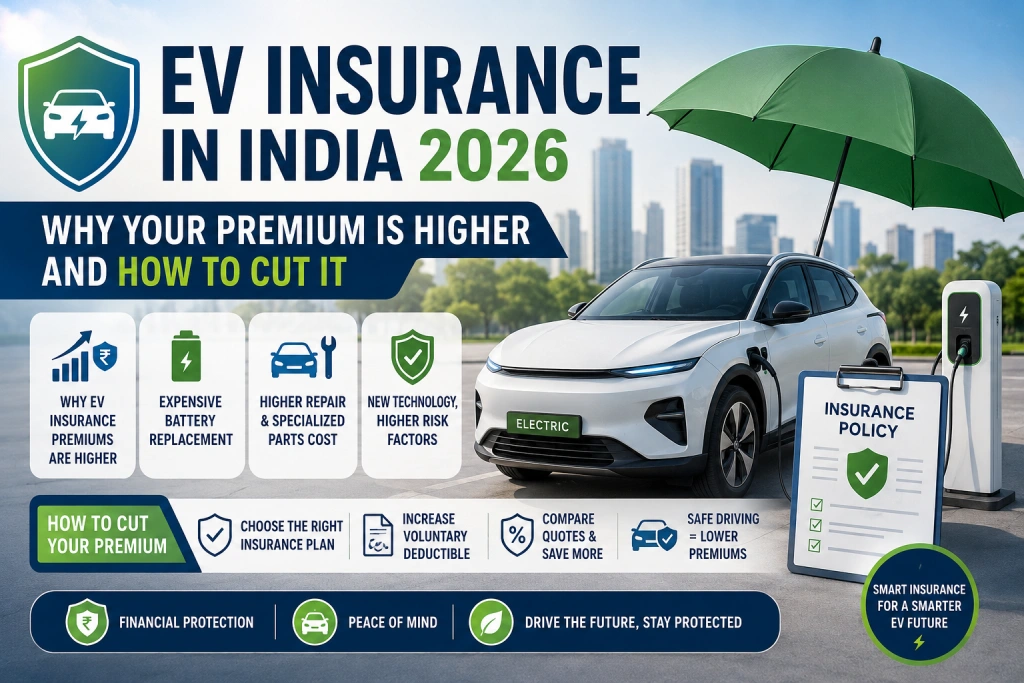
Quick Answer: Why Can EV Insurance Cost More?
EV insurance is not automatically more expensive than petrol or diesel car insurance. In India, Own Damage (OD) premiums are rated by individual insurers, and different insurers can charge different premiums for similar coverage. Factors such as vehicle age, IDV, past claims, discounts or loadings, deductibles and selected add-ons can affect the final premium.
EV insurance can also include EV-specific optional covers. Current insurer documentation shows examples such as battery, charger and accessories cover, electric motor cover, electric surge protection and battery-specific zero-depreciation cover. These are insurer-specific products, not universal features of every EV policy.
Estimate your EV insurance premium
Before renewing, compare IDV, deductibles, NCB, exclusions and EV-specific add-ons—not just the headline premium.
Calculate Now| Factor | Why it matters |
|---|---|
| Third Party Liability | Mandatory liability protection for vehicles plying on public roads in India. |
| Own Damage | Protects the insured vehicle against covered loss or damage under the policy. |
| IDV | The sum insured for the vehicle under Own Damage cover and should reflect current market value. |
| NCB | Applies to the Own Damage premium, not the Liability premium. |
| Deductible | Changes the amount the policyholder bears during an eligible claim and is one of the factors IRDAI says consumers should compare. |
| Add-ons | Extend the base policy for an additional premium. Different insurers offer different add-ons. |
| Insurer rating | Different insurers can charge different Own Damage premiums for similar coverage. |
Bottom line: Don't judge an EV insurance policy by premium alone. Compare the premium alongside IDV, deductibles, coverage, exclusions and add-ons. IRDAI specifically recommends obtaining three or more comparison quotes.
What Is EV Insurance in India?
EV insurance is motor insurance for an electric vehicle that can provide Third Party Liability protection, Own Damage protection or both, depending on the policy selected. A comprehensive/package policy can combine liability and Own Damage protection, while a Liability Only policy covers Third Party Liability. IRDAI also recognises Standalone Own Damage insurance as an option alongside liability cover.
Third Party Liability insurance
Third Party Liability insurance is mandatory for vehicles plying on public roads in India. The cover protects against specified liabilities arising from injury or damage caused to third parties, subject to the applicable policy and law.
Own Damage insurance
Own Damage cover relates to loss or damage to the insured vehicle under the applicable policy terms. IRDAI states that Own Damage pricing is left to individual insurers rather than being one identical price across insurers.
Comprehensive or package insurance
A comprehensive/package policy can combine Third Party Liability and Own Damage protection for the insured vehicle, subject to the policy terms, exclusions and conditions.
Standalone Own Damage
Standalone Own Damage insurance can cover damage to the insured vehicle separately from liability-only protection. IRDAI lists Standalone Own Damage as an available motor-insurance structure.
Why Can EV Insurance Cost More?
An EV may receive a higher insurance quote for several reasons, but there is no universal rule that every EV costs more to insure. IRDAI states that different insurers charge different Own Damage premiums for similar coverage, with vehicle age, discounts or loadings, past claims experience and IDV among the factors used in determining Own Damage premium.
EVs have specialised components
Electric vehicles contain components that can require specialised insurance treatment. Insurer documentation demonstrates this through EV-specific covers.
For example, HDFC ERGO's EV-specific motor add-on documentation lists:
- Battery, Charger and Accessories Cover
- Electric Motor Cover
- Zero Depreciation Claim for Battery, Charger and Accessories Cover
The same documentation requests information such as battery details, battery serial number, annual kilometres and battery sum insured when these EV-specific covers are selected.
That does not mean every EV insurance policy must include these covers. It means consumers should check whether the policy being considered provides the protection required for the particular vehicle and risk.
Battery-related protection may require additional cover
A common mistake is assuming that a comprehensive policy automatically covers every possible battery problem.
That assumption is unsafe.
Coverage depends on the policy wording, the cause of damage, exclusions and any selected add-ons.
For example, ICICI Lombard's published Battery Protect Cover describes cover for specified consequential damage arising from water ingress or short circuit affecting the battery, drive motor/electric motor and hybrid-electric vehicle system, subject to the product's terms.
TATA AIG also currently documents EV-specific covers including Electric Surge Secure and Zero Depreciation on Battery. Its published description states that the battery depreciation add-on applies to an admissible Own Damage claim and is subject to the number of claims specified in the policy schedule; it also states that the add-on is not applicable if battery cost is not part of IDV.
The lesson is simple:
Never assume that “comprehensive insurance” means every type of EV battery damage is automatically covered. Read the policy wording and add-on terms.
Own Damage premiums are insurer-specific
This is one of the most important facts for anyone comparing EV insurance.
IRDAI states that different insurance companies can charge different premiums for similar Own Damage coverage and recommends shopping around. IRDAI specifically suggests obtaining three or more comparison quotes and comparing deductibles, coverage and IDV as well as premium.
Therefore, two EV owners with similar vehicles can receive different quotes without either quote necessarily being incorrect.
What Makes Up an EV Insurance Premium?
There is no single public formula that can be used to calculate every EV insurance premium across every insurer.
Instead, separate components and rating factors need to be considered.
1. Third Party Liability
Third Party Liability insurance is mandatory for vehicles plying on public roads in India. IRDAI states that Third Party Liability premium rates are laid down by the regulator, while Own Damage coverage is rated by individual insurers.
For this reason, this article does not publish a supposedly universal “2026 EV Third Party premium” figure without verifying the applicable regulatory rate schedule.
IRDAI's rules database currently lists the Motor Vehicles (Third Party Insurance Base Premium and Liability) Rules, 2022, reference G.S.R. 394(E).
2. Own Damage
Own Damage premium is insurer-rated.
IRDAI identifies several factors that can be used in determining Own Damage premium, including:
- age of vehicle;
- discounts and loadings;
- appropriate bonus or discounts;
- past claims experience;
- IDV.
The exact rating formula should therefore not be presented as a universal EV insurance formula.
3. Add-ons
An add-on extends the cover under the base policy for an additional premium. IRDAI identifies Nil Depreciation, Return to Invoice and No Claim Bonus Protection among common motor-insurance add-ons, while noting that different insurers offer different add-ons.
EV-specific insurer offerings can include additional battery, charging-equipment, electric-motor or electrical protection.
4. GST
GST is applicable to motor insurance according to prevailing law. IRDAI's consumer motor-insurance guidance states that GST applies as per the prevailing rule of law.
What Is IDV in EV Insurance?
IDV, or Insured Declared Value, is the sum insured for the vehicle under Own Damage insurance. IRDAI states that the IDV should reflect the vehicle's current market value.
IDV matters because it is not simply another number displayed on an insurance quote. It forms part of the protection being purchased.
Why IDV matters
Suppose two policies appear similar but one has:
- a higher IDV;
- a lower deductible;
- broader coverage; and
- more relevant add-ons.
The second policy may cost more but may also provide a different level of protection.
IRDAI specifically warns consumers not to compare premium alone because a lower premium may come with a higher deductible, lower coverage or lower IDV, which can adversely affect claim settlement.
Should you reduce IDV to get a cheaper premium?
Not simply for the purpose of making the quote look cheaper.
The right approach is to check whether the selected IDV appropriately reflects the vehicle's current market value and whether the policy's coverage matches the vehicle and risk being insured.
IDV and the EV battery
The battery question makes IDV particularly important for EV owners.
TATA AIG's current EV insurance material states that its Zero Depreciation on Battery add-on is not applicable if the battery cost is not part of the IDV.
HDFC ERGO's EV-specific documentation similarly includes a separate battery sum-insured field when its Battery, Charger and Accessories Cover is selected.
Therefore, an EV owner should check:
- how the battery is treated in the policy;
- whether battery cost forms part of the relevant IDV/sum insured;
- whether a separate battery-related add-on is required;
- what causes of battery damage are covered;
- what exclusions apply.
What Is NCB and How Can It Reduce EV Insurance Cost?
NCB, or No Claim Bonus, is a benefit earned by the insured for making no claims during the previous policy period. IRDAI states that NCB applies to the Own Damage premium, not the Liability premium. Under the current norms described by IRDAI, NCB ranges from 20% and progressively increases to a maximum of 50% based on successive claim-free years.
That distinction is important.
If your insurance price contains both Liability and Own Damage components, NCB does not simply reduce the entire premium by the NCB percentage.
How NCB works
IRDAI states that:
- NCB is earned for nil claims during the previous policy period;
- it applies to Own Damage premium, not Liability premium;
- the current range described by IRDAI starts at 20% and can progressively reach 50%;
- NCB belongs to the insured person rather than the vehicle.
What happens if you make a claim?
IRDAI's consumer guidance states that if a claim is lodged, the No Claim Bonus is lost in the subsequent policy period. The precise operation can depend on the policy and any NCB protection add-on selected.
Can you carry NCB when changing insurers?
Yes.
IRDAI states that an insured can avail of NCB when changing insurers at renewal, provided appropriate proof of the earned NCB is supplied. The regulator gives examples including a renewal notice or a letter confirming NCB entitlement from the previous insurer.
This means changing insurers does not automatically mean starting from zero NCB.
What Is Battery Protect Cover?
Battery Protect Cover is an EV-specific insurance product or add-on whose exact coverage depends on the insurer and policy wording. It should not be treated as a universal form of unlimited battery replacement insurance.
Different insurers can structure EV battery protection differently.
Example: consequential battery damage
ICICI Lombard's published Battery Protect Cover describes protection for specified consequential damage caused by water ingress or short circuit involving the battery, drive motor/electric motor and HEV system, subject to its terms and conditions.
That wording is important because it illustrates how a battery add-on can be tied to:
- a specified cause of damage;
- consequential damage;
- particular EV components;
- conditions and exclusions.
Example: electric surge protection
TATA AIG currently describes its Electric Surge Secure add-on as covering specified electrical damage involving the EV or charging equipment, including events such as short circuits, arcing, self-heating or water entering during charging, subject to its product terms.
The same insurer's current EV material states that manufacturing defects and use of non-approved chargers or batteries are not covered under that add-on.
What should you check before buying battery protection?
1. Covered causes of damage
Find out whether the product covers the specific risks you are concerned about.
2. Battery scope
Check whether the cover applies to the traction battery and what terminology the insurer uses.
3. Electric motor scope
Some products separately identify the electric motor or drive motor.
4. Charging equipment
Some EV-specific products cover chargers or charging accessories, but the exact equipment and conditions need to be checked. HDFC ERGO's EV-specific documentation, for example, expressly lists Battery, Charger and Accessories Cover.
5. Exclusions
Read exclusions relating to:
- wear and tear;
- manufacturing defects;
- non-approved equipment;
- charging practices;
- maintenance;
- pre-existing damage;
- other policy-specific conditions.
6. Claim limits
Some add-ons may specify the number of eligible claims or other limits. TATA AIG's published Zero Depreciation on Battery description, for example, refers to the number of claims specified in the policy schedule.
7. IDV or sum insured
Check whether battery cost is included in the relevant IDV or whether a separate sum insured applies.
EV Insurance Add-Ons You Should Compare
| Add-on | What to investigate | Why an EV owner may consider it |
|---|---|---|
| Battery protection | Covered causes, exclusions, limits and battery scope | Can provide additional protection for specified battery-related risks |
| Battery zero depreciation | Whether battery is included in IDV and claim limits | Can reduce depreciation deductions on eligible battery claims |
| Electric surge protection | Electrical events, charging equipment and exclusions | Relevant to specified electrical/charging risks |
| Electric motor cover | Covered motor components and exclusions | Provides additional protection for specified electric-motor risks |
| Charger/accessories cover | Eligible equipment and sum insured | Relevant when charging equipment is separately insured |
| NCB protection | Claim and NCB-retention conditions | Can protect NCB under specified circumstances |
| Return to Invoice | Theft/total-loss conditions | Can bridge the specified difference between IDV and eligible invoice-related amount |
| Roadside assistance | Towing and assistance scope | Useful where roadside support is important |
The availability and exact terms of these covers vary by insurer. HDFC ERGO's EV-specific documentation lists battery, charger/accessories and electric-motor covers, while TATA AIG currently describes EV-specific electric-surge and battery depreciation products.
How to Cut Your EV Insurance Premium
The goal should not be “get the lowest possible premium.”
The better goal is:
Get the appropriate coverage at a competitive premium without sacrificing IDV or important protection.
1. Compare multiple insurers
IRDAI explicitly recommends shopping around for Own Damage insurance because insurers can charge different premiums for similar coverage. It says obtaining three or more comparison quotes is worthwhile.
Compare:
- premium;
- IDV;
- deductibles;
- coverage;
- exclusions;
- add-ons;
- claim conditions.
2. Protect your NCB
NCB applies to the Own Damage component rather than the Liability component. Maintaining an eligible claim-free record can therefore reduce the Own Damage premium at renewal.
3. Don't buy every add-on
Add-ons extend the base policy for an additional premium. IRDAI notes that insurers offer different add-ons.
TATA AIG's current EV insurance material also states that add-ons can increase the overall insurance cost and recommends selecting add-ons based on the coverage actually needed.
A practical approach is to ask:
“What specific risk does this add-on cover, and is that risk relevant to my vehicle and usage?”
4. Compare IDV carefully
A lower premium can sometimes reflect a lower IDV.
IRDAI specifically advises consumers to compare IDV because a lower IDV can adversely affect claim settlement.
Therefore:
Lower premium ≠ automatically better value.
5. Compare deductibles
A deductible affects the amount the policyholder bears under an eligible claim.
IRDAI explicitly tells consumers to compare deductibles along with premium, coverage and IDV.
6. Check EV-specific coverage
Don't assume that two comprehensive EV policies provide identical battery, charger, motor or electrical protection.
Check the actual policy wording.
Calculate your EV insurance cost
Calculate Now
Third Party vs Comprehensive EV Insurance
| Policy type | Third Party Liability | Own Damage |
|---|---|---|
| Third Party / Liability Only | Yes | No |
| Comprehensive / Package | Yes | Yes, subject to policy terms |
| Standalone Own Damage | Separate liability cover is required | Yes |
Third Party Liability insurance is mandatory for vehicles plying on public roads in India. IRDAI describes comprehensive/package cover as combining liability and Own Damage protection, while Standalone Own Damage is available as a separate structure.
Third Party insurance
Third Party insurance primarily addresses liability arising from injury or damage caused to others.
It does not provide the same Own Damage protection for your own EV as a comprehensive/package policy.
Comprehensive EV insurance
A comprehensive/package policy can combine Third Party Liability and Own Damage cover, subject to policy terms.
Optional add-ons can extend the base coverage further.
Why Two EV Insurance Quotes Can Be Different
Consider two conceptual quotes rather than assuming any particular rupee premium.
Quote A
- Higher IDV
- Battery protection
- Zero depreciation
- Roadside assistance
- Different deductible
- NCB
Quote B
- Lower IDV
- Fewer add-ons
- Different deductible
- Different insurer
- NCB
Quote B could display a lower headline premium.
But that does not automatically mean Quote B offers better value.
IRDAI specifically advises consumers to compare premium, IDV, deductibles and coverage because a cheaper premium can be accompanied by lower IDV, higher deductibles or lower coverage.
The right comparison question
Don't ask:
“Which insurance policy is cheapest?”
Ask:
“Which policy gives me the coverage I need at the most competitive premium?”
Compare EV insurance coverage
Calculate NowUse the EV Insurance Estimator
This is where an EV insurance calculator becomes useful.
An estimator can help you understand how different inputs may affect an estimated premium rather than forcing you to compare one headline number.
Suggested calculator inputs
- Vehicle type
- Make and model
- Registration year
- Vehicle age
- IDV
- NCB percentage
- Policy type
- Previous claims
- Voluntary deductible
- Battery protection
- Zero depreciation
- Electric surge protection
- Roadside assistance
- Return to Invoice
- Other selected add-ons
These inputs reflect the types of vehicle, policy, rating and add-on information relevant to motor-insurance pricing and EV-specific coverage. IRDAI identifies vehicle details, previous claims, age, discounts/loadings and IDV among Own Damage rating considerations, while current insurer documentation demonstrates the existence of EV-specific add-ons.
Suggested calculator outputs
The estimator can display:
- estimated Own Damage component;
- estimated Third Party component, where applicable;
- estimated add-on impact;
- NCB impact;
- total estimated premium;
- GST line where applicable;
- selected IDV;
- selected deductible.
Important calculator disclaimer
This calculator provides an estimate and is not an insurance quote. Actual premiums are determined by insurers and can vary based on vehicle details, policy terms, IDV, claims history, discounts, deductibles, add-ons and insurer-specific pricing.
This distinction is essential because IRDAI states that Own Damage premiums are rated by individual insurers and that different insurers can charge different premiums for similar coverage.
EV Insurance Cost: What You Should Not Assume
| Claim | Verdict | Why |
|---|---|---|
| “Every EV costs more to insure.” | Too broad | Own Damage premiums vary between insurers and depend on rating factors. |
| “NCB reduces the entire insurance premium.” | Incorrect | IRDAI states that NCB applies to Own Damage premium, not Liability premium. |
| “The cheapest quote is the best.” | Incorrect | IDV, deductibles and coverage must also be compared. |
| “Comprehensive insurance covers every battery problem.” | Unsafe assumption | Battery protection depends on policy wording, exclusions and applicable add-ons. |
| “Battery Protect means unlimited battery replacement.” | Incorrect | Product terms can specify causes, exclusions, conditions and limits. |
| “Changing insurers means losing NCB.” | Incorrect | IRDAI says NCB can be availed when changing insurers at renewal with appropriate proof. |
| “Reducing IDV is an easy way to save money.” | Poor strategy | IRDAI warns that lower IDV can adversely affect claim settlement. |
Frequently Asked Questions
Is EV insurance more expensive than petrol-car insurance?
It can be, but there is no universal percentage that applies to every EV. IRDAI states that Own Damage premiums are rated by individual insurers and that different insurers can charge different premiums for similar coverage. Vehicle age, IDV, past claims, discounts or loadings and other factors can affect Own Damage pricing.
Why is EV insurance expensive in India?
An EV may have EV-specific insurance requirements or optional covers involving components such as the battery, charger, accessories or electric motor. Insurers also use their own Own Damage rating approaches. Therefore, the final premium can vary by insurer, vehicle and selected coverage.
Is Third Party insurance mandatory for an EV in India?
Yes. IRDAI states that Third Party Liability insurance is mandatory for vehicles plying on public roads in India.
What is IDV in EV insurance?
IDV stands for Insured Declared Value. It is the sum insured for the vehicle under Own Damage insurance, and IRDAI says it should reflect the vehicle's current market value. Consumers should compare IDV along with premium, deductibles and coverage.
Does NCB reduce EV insurance premium?
NCB reduces the Own Damage premium, not the Third Party Liability premium. IRDAI's current consumer guidance describes NCB as starting at 20% and progressively increasing to a maximum of 50% based on successive claim-free years.
Can I transfer NCB to another insurer?
Yes. IRDAI states that NCB can be availed when changing insurers at renewal, provided proof of NCB entitlement is supplied.
Do EVs need battery protection?
Not every EV owner necessarily needs the same battery add-on, but the coverage should be examined carefully. Battery-related products differ in their covered events, conditions and exclusions. Current insurer documentation demonstrates that battery protection can be structured as an EV-specific cover or add-on.
Does comprehensive insurance cover an EV battery?
The answer depends on the policy wording and the type of damage. You should not assume that every type of battery failure, water ingress, short circuit or charging-related damage is automatically covered. Some insurers offer specific battery or electrical add-ons with defined coverage and exclusions.
Does zero depreciation cover an EV battery?
It depends on the insurer and the specific add-on. TATA AIG currently offers a Zero Depreciation on Battery add-on and states that it is subject to policy conditions and is not applicable when battery cost is not part of IDV. HDFC ERGO separately documents Zero Depreciation Claim for Battery, Charger and Accessories Cover alongside its EV-specific battery cover.
How can I reduce my EV insurance premium?
Compare multiple insurers, maintain eligible NCB, review IDV carefully, compare deductibles and avoid paying for add-ons that do not provide relevant protection. IRDAI specifically recommends comparing multiple quotes together with IDV, deductibles and coverage.
Does a lower IDV always mean a better deal?
No. A lower IDV can reduce the quoted premium, but IRDAI warns that lower IDV can adversely affect claim settlement. Compare the IDV with the vehicle's current market value and the overall coverage rather than choosing the lowest number.
Can I buy Standalone Own Damage insurance for an EV?
Yes. IRDAI recognises Standalone Own Damage insurance as an option alongside Liability Only coverage. The appropriate structure depends on the insurance already held and the protection required.
Should I buy every EV insurance add-on?
No. Add-ons extend the base policy for additional premium, and insurers offer different products. Choose an add-on based on the specific risk it covers, its exclusions and whether that risk is relevant to your vehicle and usage.
Key Takeaways
- EV insurance does not have one universal India-wide price. Own Damage premiums are rated by individual insurers.
- Third Party Liability insurance is mandatory for vehicles plying on public roads in India.
- IDV represents the vehicle's Own Damage sum insured and should reflect current market value.
- Don't reduce IDV simply to chase a lower premium. IRDAI warns that lower IDV can adversely affect claim settlement.
- NCB applies to Own Damage premium, not Liability premium. IRDAI currently describes an NCB range beginning at 20% and progressing to a maximum of 50%.
- NCB can be availed when changing insurers at renewal with appropriate proof.
- Battery protection is not a universal standard product. Coverage differs by insurer and policy wording.
- EV-specific covers can include battery, charger/accessories and electric-motor protection, depending on the insurer.
- Compare at least three quotes where practical, and compare IDV, deductibles and coverage alongside premium.
- The cheapest EV insurance quote is not necessarily the best-value policy.
Conclusion: Compare Coverage, Not Just Price
The right way to evaluate EV insurance in India is to stop thinking about the premium as a single number.
Your comparison should consider:
Insurer + Own Damage rating + IDV + NCB + deductible + coverage + exclusions + relevant add-ons
IRDAI itself advises consumers to compare multiple quotes and look beyond premium to IDV, deductibles and coverage.
For EV owners, the comparison deserves an additional check: how does the policy treat the battery, electric motor, charger and other EV-specific components?
Current insurer products demonstrate that EV-specific protection can vary substantially in structure and conditions. HDFC ERGO, for example, documents separate battery/charger/accessories and electric-motor covers, while TATA AIG documents electric-surge and battery-specific depreciation products.
So, instead of asking only:
“How much does EV insurance cost?”
ask:
“What coverage am I getting for the premium, what is the IDV, what deductible will I bear, what happens to my NCB, and how is my EV battery covered?”
Then use the EV Insurance Estimator to see how those inputs can change the estimated premium.
Calculate Your EV Insurance Cost
Estimate your EV insurance premium by entering your vehicle details, IDV, NCB and selected add-ons.
Important: The estimator should be presented as an estimate, not an insurance quote. Actual premiums are determined by insurers and can vary according to vehicle details, policy terms, IDV, claims history, discounts, deductibles, add-ons and insurer-specific pricing.
Calculate NowExternal Authority References
IRDAI — Motor Insurance
Primary regulator source for mandatory Third Party insurance, Own Damage pricing, IDV, NCB, deductibles, comparison shopping, add-ons and GST.
IRDAI — Motor Vehicle Third Party Insurance Rules
IRDAI's rules database lists the Motor Vehicles (Third Party Insurance Base Premium and Liability) Rules, 2022, reference G.S.R. 394(E).
HDFC ERGO — EV-Specific Motor Add-ons
Documents Battery, Charger and Accessories Cover, Electric Motor Cover and Zero Depreciation Claim for Battery, Charger and Accessories Cover.
TATA AIG — Electric Car Insurance
Provides current insurer-specific examples of EV insurance, Electric Surge Secure, Zero Depreciation on Battery, Return to Invoice and NCB Protection.
ICICI Lombard — Battery Protect Cover
Provides an insurer-specific example of Battery Protect Cover addressing specified consequential damage from water ingress or short circuit involving EV battery/electric-motor systems, subject to product terms.
The strongest conversion point is immediately after the reader understands IDV + NCB + add-ons, because the calculator then has a clear explanatory purpose rather than appearing as an unrelated promotional element.