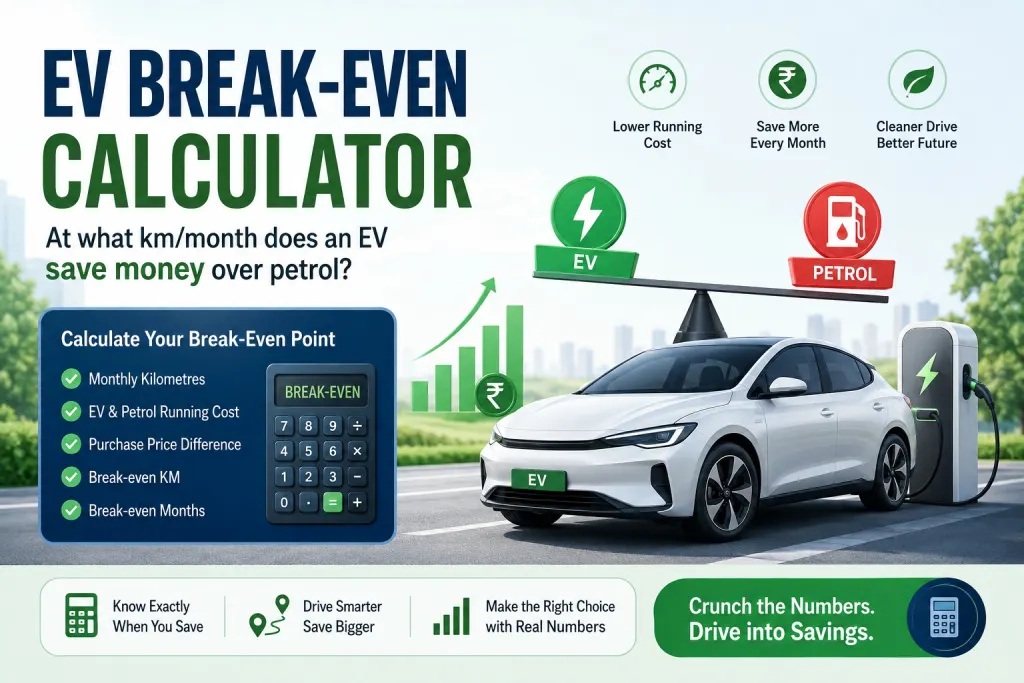
EV Break-Even Calculator: At What KM/Month Does an EV Save Money Over Petrol?
Last updated: 24 August 2026
Quick Answer
An EV break-even calculator estimates how many kilometres, months or years it may take for an electric car's lower running costs to recover a higher upfront purchase price compared with a comparable petrol car.
The calculation depends primarily on five user inputs:
- Monthly driving distance
- EV efficiency in km/kWh
- Electricity cost in ₹/kWh
- Petrol mileage in km/litre
- Petrol price in ₹/litre
If you also enter the EV price and comparable petrol-car price, the calculator can estimate purchase-price break-even.
The key distinction is simple:
| Measure | What it answers |
|---|---|
| EV cost/km | How much does the EV cost to operate per kilometre? |
| Petrol cost/km | How much does the petrol car cost to operate per kilometre? |
| Saving/km | How much operating cost does the EV avoid? |
| Break-even km | How far must the EV travel to recover its purchase-price premium? |
| Break-even months | How long does that distance take at your monthly usage? |
The calculation does not produce one universal Indian answer. Petrol prices vary by location, and electricity tariffs differ by consumer category and jurisdiction. IndianOil itself notes that petrol prices can vary from outlet to outlet within a city, town or sales area. The Central Electricity Authority publishes state- and category-specific electricity tariff information rather than one national household electricity tariff.
Introduction: When Does an EV Actually Pay for Itself?
The common EV-versus-petrol argument is straightforward: electricity can cost less per kilometre than petrol under a given set of assumptions.
But lower running cost is not the same thing as purchase-price break-even.
Suppose a comparable EV costs more to buy than a petrol car. Every kilometre driven may generate an operating-cost saving, but the EV has to accumulate enough of those savings to recover the initial price difference.
That is the question this EV break-even calculator is designed to answer:
How many kilometres do I need to drive before the EV's lower running cost offsets its higher purchase price?
The answer is personal rather than universal.
A driver covering 500 km a month will accumulate savings more slowly than a driver covering 2,000 km a month, assuming the same saving per kilometre. Likewise, changing petrol price, petrol mileage, electricity tariff or EV efficiency changes the result.
This is why a useful EV break-even calculator should expose its assumptions rather than simply displaying a headline saving.
How the EV Break-Even Calculator Works
An EV break-even calculator converts energy costs into a common ₹/km figure and then uses the difference between EV and petrol running costs to estimate potential savings.
The basic calculation has four stages:
- Calculate EV electricity cost per kilometre.
- Calculate petrol fuel cost per kilometre.
- Calculate the saving per kilometre.
- If the EV has a purchase-price premium, divide that premium by the saving per kilometre.
The underlying formulas are mathematical relationships derived from the user's inputs; they are not assumptions about Indian vehicle prices or driving behaviour.
Step 1: Enter Your Monthly Driving Distance
Start with your expected monthly kilometres.
For example, you might test:
- 500 km/month
- 800 km/month
- 1,200 km/month
- 2,000 km/month
These are illustrative scenarios, not claims about average Indian driving distance.
Monthly driving matters because the same saving per kilometre produces different annual savings at different usage levels.
For example, if a hypothetical vehicle saves ₹5 per kilometre:
- 500 km/month = ₹2,500 monthly saving
- 1,000 km/month = ₹5,000 monthly saving
- 2,000 km/month = ₹10,000 monthly saving
Those figures are simple calculations from the assumed ₹5/km saving; they are not market estimates.
EV Cost Per KM: The First Calculation
What is EV electricity cost per kilometre?
EV electricity cost per kilometre is the electricity price divided by the vehicle's efficiency in kilometres per kWh.
Formula
EV cost/km = Electricity tariff ÷ EV efficiency
For an illustrative example, assume:
- Electricity = ₹8/kWh
- EV efficiency = 6 km/kWh
The calculation is:
₹8 ÷ 6 = ₹1.33/km
This is an assumption-driven example, not a national EV electricity-cost average.
A published BharatREVOLT calculator example also uses ₹8/kWh and 6 km/kWh and demonstrates the same basic calculation methodology.
Why efficiency matters
An EV consuming fewer kWh for every kilometre will have a lower electricity cost per kilometre when the electricity tariff is unchanged.
For example, at a hypothetical ₹8/kWh tariff:
| EV efficiency | Electricity cost/km |
|---|---|
| 4 km/kWh | ₹2.00 |
| 5 km/kWh | ₹1.60 |
| 6 km/kWh | ₹1.33 |
| 7 km/kWh | ₹1.14 |
| 8 km/kWh | ₹1.00 |
These figures are mathematical examples based on ₹8/kWh.
The calculator should therefore allow the user to enter the efficiency applicable to the vehicle being evaluated rather than assuming one universal EV efficiency.
Petrol Cost Per KM: The Second Calculation
What is petrol fuel cost per kilometre?
Petrol cost per kilometre is the petrol price per litre divided by the vehicle's fuel efficiency in kilometres per litre.
Formula
Petrol cost/km = Petrol price ÷ Petrol mileage
For an illustrative example:
- Petrol = ₹100/litre
- Petrol mileage = 15 km/litre
The calculation is:
₹100 ÷ 15 = ₹6.67/km
Again, ₹100/litre and 15 km/litre are assumptions for demonstrating the formula.
Petrol price should remain an editable calculator input. IndianOil's official petrol and diesel price page provides location-specific pricing information and explicitly states that prices can vary from outlet to outlet within a city, town or sales area. The page currently identifies its latest update as 13 August 2026.
Why petrol mileage matters
At the same petrol price, a more fuel-efficient petrol vehicle has a lower fuel cost per kilometre.
For example, at an assumed ₹100/litre:
| Petrol mileage | Petrol cost/km |
|---|---|
| 10 km/l | ₹10.00 |
| 12 km/l | ₹8.33 |
| 15 km/l | ₹6.67 |
| 18 km/l | ₹5.56 |
| 20 km/l | ₹5.00 |
These are mathematical illustrations using ₹100/litre.
EV vs Petrol Cost Per KM
Once both calculations are available, compare them directly.
Formula
Saving/km = Petrol cost/km − EV cost/km
Using the illustrative assumptions above:
- EV = ₹1.33/km
- Petrol = ₹6.67/km
Therefore:
₹6.67 − ₹1.33 = ₹5.34/km
The EV would have a hypothetical operating-cost advantage of approximately ₹5.34 per kilometre under those assumptions.
That does not mean every EV saves ₹5.34/km.
Change the electricity tariff, EV efficiency, petrol price or petrol mileage and the result changes immediately.
Running-Cost Break-Even vs Purchase-Price Break-Even
This is the most important distinction in an EV break-even calculator.
Running-cost break-even
Running-cost comparison asks which vehicle costs less to operate per kilometre.
If:
EV cost/km < petrol cost/km
the EV has the lower energy cost per kilometre under the selected assumptions.
There may therefore be no meaningful “running-cost break-even distance.” The EV can have a lower operating cost from the first kilometre.
Purchase-price break-even
Purchase-price break-even asks how many kilometres of operating savings are required to recover the EV's additional upfront cost.
This is the calculation that matters when an EV is more expensive to purchase than a comparable petrol car.
Formula
Break-even km = EV purchase-price premium ÷ saving/km
Then:
Break-even months = Break-even km ÷ monthly kilometres
And:
Break-even years = Break-even months ÷ 12
These are mathematical calculations based on the user's purchase-price and running-cost assumptions.

Worked EV Purchase-Price Break-Even Example
Consider this purely illustrative scenario:
- EV electricity cost = ₹8/kWh
- EV efficiency = 6 km/kWh
- Petrol price = ₹100/litre
- Petrol mileage = 15 km/litre
- EV purchase-price premium = ₹3,00,000
The first calculation gives:
EV cost/km = ₹8 ÷ 6 = ₹1.33/km
The petrol calculation gives:
Petrol cost/km = ₹100 ÷ 15 = ₹6.67/km
The difference is:
₹6.67 − ₹1.33 = ₹5.34/km
Now calculate the purchase-price payback distance:
₹3,00,000 ÷ ₹5.34 ≈ 56,180 km
At 1,200 km/month:
56,180 ÷ 1,200 ≈ 46.8 months
That is approximately:
3.9 years
These figures are entirely dependent on the assumptions above. They should not be presented as the expected payback period for EVs generally.
At 1,200 KM/Month, How Much Can an EV Save?
The 1,200-km/month scenario is useful because published EV calculators use similar worked examples, but 1,200 km/month should not be described as India's average driving distance without independent evidence.
For example, BharatREVOLT publishes an example using:
- 1,200 km/month
- ₹105/litre petrol
- 15 km/litre petrol mileage
- ₹8/kWh electricity
- 6 km/kWh EV efficiency
Its calculation produces approximately ₹81,648 in annual fuel savings under those assumptions.
That number is a scenario result, not a universal EV saving.
Using those published assumptions:
Petrol cost/km = ₹105 ÷ 15 = ₹7/km
EV cost/km = ₹8 ÷ 6 ≈ ₹1.33/km
Difference ≈ ₹5.67/km
At 1,200 km/month:
Monthly saving ≈ ₹6,804
Annualised:
₹6,804 × 12 = ₹81,648
The figures above reproduce the arithmetic of the published example.
The lesson is more important than the headline number:
An EV does not automatically save ₹81,648 or ₹84,000 every year. The annual saving is a function of the assumptions entered into the calculator.
If petrol costs less, petrol mileage is higher, electricity costs more, or EV efficiency is lower, the saving falls.
How Monthly Driving Changes EV Payback
Monthly driving distance directly affects how quickly cumulative operating savings can recover an upfront purchase premium.
Assume, purely for illustration:
- EV purchase premium = ₹3,00,000
- Saving = ₹5/km
The resulting break-even distance is:
₹3,00,000 ÷ ₹5 = 60,000 km
Now change only the monthly driving distance:
| Monthly driving | Time to 60,000 km |
|---|---|
| 500 km | 120 months / 10 years |
| 800 km | 75 months / 6.25 years |
| 1,200 km | 50 months / 4.17 years |
| 2,000 km | 30 months / 2.5 years |
These are mathematical scenarios, not forecasts of actual EV ownership.
The conclusion is straightforward:
When saving per kilometre remains constant, higher monthly utilisation accelerates recovery of the purchase-price premium.
That is why a high-mileage commuter, taxi operator or fleet user can get a materially different financial result from a low-mileage private owner.
Home Charging vs Public Charging
Why the charging input matters
An EV calculator should distinguish between home charging electricity cost and the price paid at a public charging station.
The Ministry of Power's 2024 EV charging infrastructure guidelines apply to private, semi-restricted and public charging infrastructure and were issued on 17 September 2024.
For public charging stations, the Ministry of Power states that the total fee charged by an EV charging-station operator can comprise:
- Electricity supply tariff
- Service charge
- Land cost
- Applicable GST
The Ministry also states that the electricity tariff for EV charging stations is to be a single-part tariff and not exceed Average Cost of Supply until 31 March 2028, with provisions for different solar-hour and non-solar-hour tariff multiples.
Therefore:
Electricity tariff ≠ necessarily the final public charging price.
For home charging, the calculator should allow the user to enter the applicable household electricity cost or the relevant charging tariff.
The CEA publishes electricity tariff information by state and consumer category and also includes information on tariffs applicable to public charging stations.
How to Enter Your Electricity Cost
A practical calculator should not permanently hard-code a single “India electricity rate.”
Instead, provide:
Home electricity tariff: ₹____/kWh
Then allow the user to enter the rate applicable to the electricity connection being used for charging.
This approach is more transparent because electricity tariffs differ across jurisdictions and consumer categories. The CEA's tariff publications compile retail tariffs from State Electricity Regulatory Commissions and Joint Electricity Regulatory Commissions.
For public charging, provide a separate input:
Public charging price: ₹____/kWh
That prevents the calculator from incorrectly treating a household electricity tariff as the amount necessarily paid at a commercial charging station.
How Petrol Price Affects EV Break-Even
Petrol price has a direct effect on the calculated EV saving.
If petrol becomes more expensive while all other assumptions remain unchanged, the calculated petrol cost per kilometre increases.
Formula
Petrol cost/km = Petrol price ÷ petrol mileage
For example, at an assumed 15 km/litre:
| Petrol price | Petrol cost/km |
|---|---|
| ₹90/litre | ₹6.00 |
| ₹100/litre | ₹6.67 |
| ₹110/litre | ₹7.33 |
| ₹120/litre | ₹8.00 |
These are mathematical examples.
Because actual petrol prices vary geographically, the calculator should encourage users to enter their local price rather than relying on a permanent national default. IndianOil's official pricing page specifically warns that prices may vary from outlet to outlet within a city, town or sales area.
How EV Efficiency Affects Break-Even
EV efficiency is another major input.
Suppose electricity costs an assumed ₹8/kWh:
| EV efficiency | EV cost/km |
|---|---|
| 4 km/kWh | ₹2.00 |
| 5 km/kWh | ₹1.60 |
| 6 km/kWh | ₹1.33 |
| 7 km/kWh | ₹1.14 |
| 8 km/kWh | ₹1.00 |
These are calculated examples.
The calculator should therefore let the user enter the efficiency applicable to the EV being compared.
It is better to expose the efficiency assumption than to claim that one kWh-per-kilometre figure represents every EV.
How Petrol Mileage Affects Break-Even
Petrol mileage affects the competing vehicle's operating cost.
At a hypothetical ₹100/litre:
- 10 km/l = ₹10/km
- 15 km/l = ₹6.67/km
- 20 km/l = ₹5/km
Those values are direct calculations.
This is why an EV should ideally be compared with a reasonably comparable petrol vehicle rather than an arbitrarily selected petrol model.
A ₹3 lakh purchase-price premium against one petrol vehicle may produce a completely different payback period from a ₹3 lakh premium calculated against another vehicle with different fuel efficiency.
Does Maintenance Change the EV Break-Even Point?
Yes, if maintenance differences are explicitly included in the model.
For a basic calculator, running-cost break-even can be calculated using energy costs alone.
A more comprehensive total-cost-of-ownership calculator can additionally model maintenance and other ownership costs.
The important point is to avoid inserting an unsupported generic maintenance saving.
If the calculator includes maintenance, it should clearly state:
- Which vehicles are being compared
- What maintenance assumptions are used
- Whether the figures come from manufacturer/service information
- Whether tyres, consumables or other costs are included
A maintenance saving can shorten the calculated payback period, while an additional EV-related cost can lengthen it.
What an EV Break-Even Calculator Should Include
A useful calculator should expose its assumptions.
Recommended inputs
| Input | Unit | Purpose |
|---|---|---|
| Monthly driving | km/month | Determines utilisation |
| EV efficiency | km/kWh | Calculates EV energy cost |
| Home electricity tariff | ₹/kWh | Calculates charging cost |
| Public charging price | ₹/kWh | Optional alternative charging cost |
| Petrol mileage | km/litre | Calculates petrol cost |
| Petrol price | ₹/litre | Calculates petrol cost |
| EV purchase price | ₹ | Determines EV upfront cost |
| Comparable petrol-car price | ₹ | Determines purchase premium |
| EV annual maintenance | ₹/year | Optional TCO input |
| Petrol annual maintenance | ₹/year | Optional TCO input |
The calculator should not automatically assume a “national average” for any of these values unless an appropriate current source supports that assumption.
What the Calculator Should Show
Immediate running-cost result
The first result should show:
- EV cost/km
- Petrol cost/km
- Saving/km
- EV monthly running cost
- Petrol monthly running cost
- Monthly saving
- Annual saving
Monthly calculation
EV monthly cost = Monthly kilometres × EV cost/km
Petrol calculation
Petrol monthly cost = Monthly kilometres × petrol cost/km
Annual saving
Annual saving = Monthly saving × 12
These are mathematical relationships.
Purchase-Price Break-Even Result
If the user enters both vehicle prices, the calculator should additionally display:
- EV purchase premium
- Break-even kilometres
- Break-even months
- Break-even years
Purchase premium
EV purchase premium = EV price − comparable petrol-car price
Break-even distance
Break-even km = Purchase premium ÷ saving/km
Break-even time
Break-even months = Break-even km ÷ monthly kilometres
If the saving per kilometre is zero or negative, a conventional operating-cost payback calculation should not be presented as a positive break-even result.
Compare Your EV's 5-Year Running Cost
Calculate NowOptional Total Cost of Ownership Calculation
A more advanced calculator can go beyond energy costs and model:
- Purchase price
- Energy cost
- Maintenance
- Insurance
- Financing
- Depreciation
- Resale value
- Charging equipment
- Public charging fees
- Taxes and registration
- Other ownership costs
However, each additional variable needs a clearly stated assumption or source.
A calculator should never create a false impression of precision simply by adding more inputs.
For example, if depreciation or resale value is not supported by a current vehicle-specific source, the calculator should allow the user to enter the assumption instead of presenting an unsupported national percentage.
What the Basic Calculator Does NOT Include
Unless explicitly modelled, the basic EV break-even calculation does not automatically account for:
- Financing interest
- Insurance
- Depreciation
- Resale value
- Battery replacement
- Charger installation
- Public charging service fees
- Taxes or registration
- Opportunity cost of capital
These exclusions matter because a running-cost calculation is not automatically a complete total-cost-of-ownership analysis.
The final result should therefore be labelled accurately.
For example:
Estimated energy-cost break-even
is more precise than:
Your EV will definitely be cheaper after X years.
When Does an EV Make Financial Sense?
There is no single monthly-kilometre threshold that makes every EV financially worthwhile.
The answer depends on:
- EV purchase price
- Comparable petrol-car price
- Petrol price
- Petrol mileage
- Electricity tariff
- EV efficiency
- Monthly driving
- Charging method
- Maintenance assumptions
- Other ownership costs included in the calculation
Low-mileage driver
A low-mileage driver may accumulate operating savings slowly. If the EV has a large purchase premium, the calculated payback period can become long.
Medium-mileage driver
A driver with moderate monthly usage may achieve a more balanced result, depending on the purchase-price difference and energy-cost advantage.
High-mileage driver
A high-mileage user accumulates more kilometres every month. When the EV has a positive saving per kilometre, higher utilisation can shorten the time needed to recover the upfront premium.
Fleet or taxi user
A vehicle driven heavily can have a very different economic profile from a private car that covers relatively few kilometres.
The calculator should therefore answer the user's specific usage scenario rather than declaring a universal “EV break-even mileage.”
Why ₹84,000 Per Year Should Not Be Presented as a Universal EV Saving
A headline such as:
“An EV saves ₹84,000 per year at 1,200 km/month”
is misleading if the assumptions are not shown.
Published calculator examples demonstrate why.
BharatREVOLT publishes a 1,200-km/month scenario using ₹105/litre petrol, 15 km/litre petrol mileage, ₹8/kWh electricity and 6 km/kWh EV efficiency, producing approximately ₹81,648 annual fuel savings.
The calculation changes immediately if any input changes.
For example, using an assumed ₹100/litre petrol price instead of ₹105/litre while retaining the other assumptions produces:
Petrol = ₹100 ÷ 15 = ₹6.67/km
EV = ₹8 ÷ 6 = ₹1.33/km
Saving ≈ ₹5.34/km
At 1,200 km/month:
Annual saving ≈ ₹76,896
That is a mathematical scenario, not a market forecast.
The correct editorial message is therefore:
At 1,200 km/month, an EV can produce substantial annual running-cost savings under some assumptions, but the exact saving depends on petrol price, petrol mileage, electricity tariff and EV efficiency.
How Accurate Is an EV Break-Even Calculator?
An EV break-even calculator can be mathematically accurate while still producing a result that is only as realistic as its inputs.
For example, if the user enters:
- An unusually high petrol price
- An unrealistic petrol mileage
- An optimistic EV efficiency
- An electricity tariff that does not apply to the charging arrangement
- An incorrect purchase-price comparison
the mathematical result may still be correct, but the real-world conclusion will be misleading.
The best calculator therefore makes every major assumption visible.
A transparent result should say:
Based on your inputs
rather than:
The EV will save you exactly ₹X.
This is especially important because electricity tariffs vary by consumer category and location, while petrol prices can vary between outlets. CEA publishes tariff information from state and joint electricity regulators, while IndianOil explicitly notes outlet-level variation in petrol prices.
A Practical EV Break-Even Checklist
Before accepting the calculator result, check:
- Did you enter your actual monthly kilometres?
- Did you use a realistic EV efficiency figure?
- Did you use the electricity tariff applicable to your charging arrangement?
- Did you distinguish home charging from public charging?
- Did you enter a current local petrol price?
- Did you use realistic petrol mileage?
- Did you compare reasonably comparable vehicles?
- Did you calculate the actual EV purchase premium?
- Did you include maintenance only when supported by reliable data?
- Did you check whether financing, insurance, depreciation and resale value are included?
- Did you review the assumptions before treating the result as a buying decision?
Frequently Asked Questions
How many km per month make an EV worthwhile?
There is no universal monthly-kilometre threshold. The answer depends on the EV's purchase-price premium, electricity cost, efficiency, petrol price, petrol mileage and other ownership assumptions. Higher monthly driving can accelerate recovery of an upfront premium when the EV has a positive operating-cost saving.
What is the break-even point for an EV vs petrol car?
The purchase-price break-even point is the distance or time at which cumulative EV operating-cost savings equal the EV's additional purchase price. The basic formula is purchase-price premium ÷ saving per kilometre.
Is an EV cheaper than petrol per kilometre?
An EV can have a lower energy cost per kilometre when its electricity cost per kilometre is below the petrol vehicle's fuel cost per kilometre. The result depends on the electricity tariff, EV efficiency, petrol price and petrol mileage entered into the calculation.
How is EV cost per kilometre calculated?
EV cost/km = electricity tariff in ₹/kWh ÷ EV efficiency in km/kWh. For example, an assumed ₹8/kWh tariff and 6 km/kWh efficiency produce approximately ₹1.33/km.
How is petrol cost per kilometre calculated?
Petrol cost/km = petrol price in ₹/litre ÷ petrol mileage in km/litre. An assumed ₹100/litre petrol price and 15 km/litre mileage produce approximately ₹6.67/km.
Does home charging make an EV cheaper?
Home charging can produce a different cost from public charging because public charging fees can include electricity supply tariff, service charges, land costs and applicable GST. The Ministry of Power specifically identifies these components in its EV charging guidance.
Does public charging change EV payback?
Yes. If the effective price paid for public charging is higher than the electricity cost assumed for home charging, the EV's calculated operating-cost advantage can become smaller. The calculator should therefore allow public charging to be modelled separately.
How do I calculate EV purchase-price payback?
First calculate the difference between petrol and EV running cost per kilometre. Then divide the EV's additional purchase price by that saving.
Break-even km = EV purchase premium ÷ saving/km.
Finally divide the break-even kilometres by monthly driving to estimate the number of months.
Does maintenance affect EV break-even?
Yes, if maintenance costs are included in the model. Lower assumed EV maintenance costs can shorten calculated payback, while higher costs can lengthen it. Maintenance assumptions should be supported by appropriate vehicle or service data rather than an unsupported generic figure.
Can I calculate EV savings using my city's petrol price?
Yes. In fact, using a current local petrol price is preferable to relying on a permanent national default because IndianOil states that petrol prices can vary from outlet to outlet within a city, town or sales area.
How accurate is an EV break-even calculator?
The arithmetic can be precise, but the real-world result depends on the quality of the inputs. Electricity tariff, petrol price, vehicle efficiency, mileage, purchase price and other ownership assumptions should therefore be made visible.
Does 1,200 km/month represent the average Indian car owner's usage?
The calculator should not make that claim without an appropriate source. In this article, 1,200 km/month is a scenario used to demonstrate how utilisation affects savings and payback.
Does an EV have a running-cost break-even point?
Not necessarily. If the EV already has a lower cost per kilometre than the petrol car, the EV has an operating-cost advantage from the first kilometre. The separate question is whether those savings eventually recover the EV's purchase-price premium.
Key Takeaways
- EV running-cost advantage and EV purchase-price break-even are different calculations.
- EV cost/km = electricity tariff ÷ EV efficiency.
- Petrol cost/km = petrol price ÷ petrol mileage.
- Saving/km = petrol cost/km − EV cost/km.
- Purchase-price break-even km = EV purchase premium ÷ saving/km.
- Higher monthly driving can accelerate recovery of an EV purchase premium when the EV has a positive saving per kilometre.
- Petrol price should be entered using a current local figure because IndianOil notes that prices can vary between outlets within a city, town or sales area.
- Electricity costs should reflect the applicable charging arrangement; CEA publishes electricity tariff information by jurisdiction and consumer category.
- Home charging and public charging should not automatically be treated as the same price.
- The Ministry of Power states that public charging-station fees can comprise electricity supply tariff, service charge, land cost and applicable GST.
- A published ₹81,648 annual saving at 1,200 km/month is an example based on specified assumptions, not a universal EV saving.
- A calculator should expose its assumptions rather than presenting one universal EV payback period.
Calculate Your EV Break-Even Point
Don't ask only whether an EV is cheaper to run. Calculate how many kilometres you need to drive before the lower running cost offsets the purchase-price premium.
Calculate Your EV Break-Even PointExternal Authority References
IndianOil — Petrol and Diesel Prices
Use IndianOil for current petrol-price information and the important qualification that prices can vary by location/outlet.
IndianOil Petrol and Diesel Price
Central Electricity Authority — Electricity Tariff Information
CEA publishes electricity tariff and duty information compiled from State Electricity Regulatory Commissions and Joint Electricity Regulatory Commissions, including information relating to public EV charging tariffs.
Central Electricity Authority — Tariff and Duty of Electricity Supply in India
Ministry of Power — EV Charging Infrastructure Guidelines
The Ministry of Power issued the 2024 EV charging infrastructure guidelines covering private, semi-restricted and public charging infrastructure.
Ministry of Power — EV Charging Infrastructure Guidelines 2024
Ministry of Power — Public Charging Station Pricing
The Ministry of Power's parliamentary answer explains the components of public charging-station fees and the applicable electricity-tariff framework through 31 March 2028.
Ministry of Power — Public Charging Stations for EVs
BharatREVOLT — EV Calculator Methodology Example
BharatREVOLT provides an illustrative 1,200-km/month scenario using ₹105/litre petrol, 15 km/litre petrol mileage, ₹8/kWh electricity and 6 km/kWh EV efficiency, producing approximately ₹81,648 annual fuel savings under those assumptions.
BharatREVOLT EV Cost & Savings Calculator Hub
Editorial Accuracy Note
The calculations in this article deliberately distinguish source-backed facts from illustrative mathematics.
Current/source-dependent claims—such as IndianOil's pricing methodology, CEA tariff information, Ministry of Power charging rules and BharatREVOLT's published example—are cited inline.
Numerical examples using ₹8/kWh, ₹100/litre, ₹3 lakh, 6 km/kWh, 15 km/litre, 500/800/1,200/2,000 km per month and similar values are explicitly presented as assumptions or mathematical scenarios, not as national averages or market-wide facts.