PM E-DRIVE Subsidy 2026: Eligibility, ₹5,000 Cap, E-Voucher & Calculator
Last updated: 24 August 2026
Important: PM E-DRIVE rules changed again on 10 August 2026. The latest Ministry of Heavy Industries notification extends the e-2W incentive framework through 31 March 2028. Therefore, older pages saying that the e-2W incentive ended on 31 July 2026 are no longer the current position. (PM E-DRIVE)
Quick answer
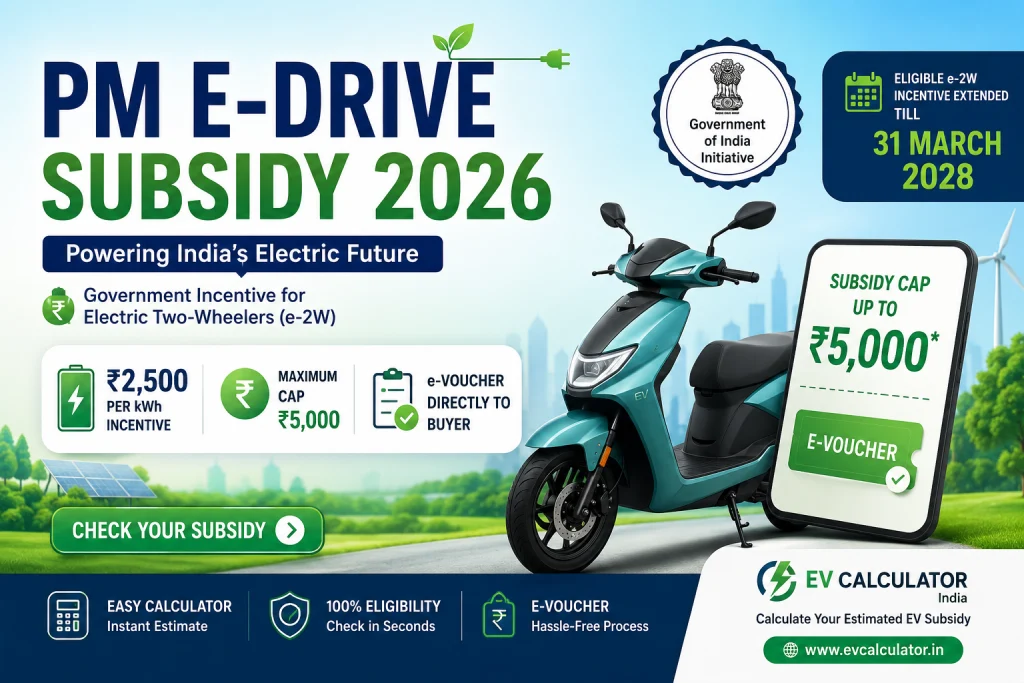
PM E-DRIVE subsidy for eligible electric two-wheelers registered from 1 April 2025 to 31 March 2028 is ₹2,500 per kWh, capped at ₹5,000 per vehicle. The incentive is also limited to 15% of the vehicle's ex-factory price, whichever applicable limit is lower. The maximum ex-factory price for an eligible e-2W is ₹1.5 lakh. (Gazette Tracker)
The ₹5,000 figure is a maximum cap, not an automatic flat subsidy. The actual incentive depends on the applicable battery-capacity calculation and the scheme's other eligibility and price restrictions. (Gazette Tracker)
The latest amendment provides support for up to 45,79,120 registered e-2Ws, with ₹2,767 crore allocated to the e-2W component. The overall PM E-DRIVE scheme outlay is ₹11,900 crore. (Gazette Tracker)
PM E-DRIVE e-2W rules at a glance
| Item | Current position |
|---|---|
| Current e-2W incentive period | 1 April 2025–31 March 2028 (Gazette Tracker) |
| Incentive rate | ₹2,500/kWh (Gazette Tracker) |
| Maximum incentive | ₹5,000 per vehicle (Gazette Tracker) |
| Maximum ex-factory price | ₹1.5 lakh (Gazette Tracker) |
| Additional price limitation | 15% of ex-factory price, with the lower applicable amount governing (Gazette Tracker) |
| Maximum e-2Ws supported under latest amendment | 45,79,120 (Gazette Tracker) |
| e-2W fund support | ₹2,767 crore (Gazette Tracker) |
| Overall PM E-DRIVE outlay | ₹11,900 crore (Gazette Tracker) |
| Current e-2W terminal date | 31 March 2028 (PM E-DRIVE) |
Calculate your estimated PM E-DRIVE incentive before relying on a dealer's headline discount.
Calculate NowWhat is PM E-DRIVE subsidy?
PM E-DRIVE subsidy is a government demand incentive administered under the Ministry of Heavy Industries' PM Electric Drive Revolution in Innovative Vehicle Enhancement scheme. For eligible electric two-wheelers, the current incentive is linked to battery capacity and is subject to a vehicle-level cap, an ex-factory-price limitation and other scheme conditions. (PM E-DRIVE)
The PM E-DRIVE scheme was originally notified on 29 September 2024. The latest August 2026 amendment states that the scheme has an overall outlay of ₹11,900 crore and is being implemented from 1 April 2024 through 31 March 2028, with the earlier EMPS-2024 period subsumed into PM E-DRIVE. (Gazette Tracker)
For e-2Ws, the important point for a buyer is not simply the overall scheme end date. The applicable e-2W registration period, eligible model, battery capacity, ex-factory price and other conditions determine whether the incentive can be claimed. (Gazette Tracker)
What changed in PM E-DRIVE on 10 August 2026?
The 10 August 2026 amendment changed the e-2W position again. It extended the e-2W incentive period to 31 March 2028 and increased the e-2W support framework to 45,79,120 vehicles and ₹2,767 crore, while retaining the ₹2,500/kWh rate and ₹5,000 vehicle cap for the period beginning 1 April 2025. (Gazette Tracker)
This change matters because an earlier notification dated 27 March 2026 had set 31 July 2026 as the terminal date for registered e-2Ws. That March notification also specified ₹2,500/kWh, capped at ₹5,000 per vehicle, for e-2Ws registered from 1 April 2025 through 31 July 2026. (PM E-DRIVE)
The Ministry's current PM E-DRIVE portal now explicitly states:
“Terminal date for e-2Ws is extended till 31.03.2028. Amendment notification dated 10.08.2026.” (PM E-DRIVE)
The official scheme-notification page also lists the 10 August 2026 notification as the latest PM E-DRIVE scheme notification. (PM E-DRIVE)
The timeline in simple terms
| Period / event | What the official rules said |
|---|---|
| FY 2024-25 | ₹5,000/kWh, capped at ₹10,000 per e-2W (Gazette Tracker) |
| 1 April 2025 onward | ₹2,500/kWh, capped at ₹5,000 per e-2W (Gazette Tracker) |
| 27 March 2026 amendment | e-2W terminal date set at 31 July 2026 (PM E-DRIVE) |
| 10 August 2026 amendment | e-2W terminal date extended to 31 March 2028 (Gazette Tracker) |
| Current position | ₹2,500/kWh, ₹5,000 cap for the applicable 1 April 2025–31 March 2028 period (Gazette Tracker) |
How much PM E-DRIVE subsidy can an electric scooter get?
For the current e-2W period, the headline calculation is ₹2,500 multiplied by eligible battery capacity in kWh, but the resulting amount cannot simply be treated as the final subsidy. The incentive is capped at ₹5,000 per vehicle and is also limited by the applicable 15% ex-factory-price condition. (Gazette Tracker)
For example, the battery-based calculation for a hypothetical eligible vehicle with a 2 kWh battery would be:
2 kWh × ₹2,500 = ₹5,000
That mathematical result reaches the current vehicle cap. The example does not, by itself, establish that a particular real-world vehicle is eligible; model approval, price and other scheme conditions must still be checked. The ₹2,500/kWh rate and ₹5,000 cap come from the latest amendment. (Gazette Tracker)
For a hypothetical 1.5 kWh eligible battery:
1.5 kWh × ₹2,500 = ₹3,750
Again, the calculation is only an illustration of the published formula. Actual eligibility must be established under the PM E-DRIVE rules applicable to the vehicle and transaction. (Gazette Tracker)
Why battery capacity alone is not enough
The latest amendment states that the incentive is limited to the specified incentive amount or 15% of the ex-factory price, whichever is lower. (Gazette Tracker)
Therefore, a calculator should not simply use:
Battery capacity × ₹2,500 = final subsidy
A more appropriate calculation workflow is:
- Confirm that the vehicle is an eligible e-2W.
- Confirm that the model/variant is approved under PM E-DRIVE.
- Confirm the applicable registration period.
- Determine the eligible battery capacity.
- Calculate the battery-based incentive at ₹2,500/kWh for the current period.
- Apply the ₹5,000 vehicle cap.
- Apply the 15% ex-factory-price limitation.
- Confirm that the vehicle's ex-factory price does not exceed ₹1.5 lakh.
- Confirm the applicable buyer and authentication conditions. (Gazette Tracker)
What is the PM E-DRIVE ₹1.5 lakh price limit?
The latest PM E-DRIVE amendment sets ₹1.5 lakh as the maximum ex-factory price for a registered electric two-wheeler to avail the applicable demand incentive. (Gazette Tracker)
The important term is ex-factory price.
The ₹1.5 lakh figure should therefore not automatically be interpreted as an electric scooter's advertised ex-showroom or on-road price. The scheme notification specifically uses the term ex-factory price. (Gazette Tracker)
For this reason, a consumer calculator should avoid asking only for the vehicle's on-road price and then assuming eligibility.
The calculator should preferably use the relevant scheme input or clearly label any user-entered price as an estimate.
Who is eligible for PM E-DRIVE e-2W incentive?
The PM E-DRIVE portal states that commercial e-2Ws are eligible and that privately or corporately owned registered e-2Ws are also eligible. The portal also states that only e-2Ws equipped with advanced batteries qualify for the demand incentive. (PM E-DRIVE)
The official FAQ similarly states that privately or corporately owned registered e-2Ws can qualify in addition to commercial use. (PM E-DRIVE)
The vehicle also needs to satisfy the relevant PM E-DRIVE model and technical requirements. The official operational guidelines require approved models to maintain eligibility and undergo revalidation; the guidelines state that model registration can be cancelled if revalidation requirements are not met within the prescribed period. (PM E-DRIVE)
Key eligibility checks
A buyer should verify:
- Vehicle category: The vehicle must fall within the eligible e-2W category. (PM E-DRIVE)
- Battery: The PM E-DRIVE portal states that e-2Ws must be equipped with advanced batteries to qualify. (PM E-DRIVE)
- Model approval: The vehicle/model should be checked against the official PM E-DRIVE model database. (PM E-DRIVE)
- Ex-factory price: The latest e-2W limit is ₹1.5 lakh. (Gazette Tracker)
- Registration period: The applicable incentive depends on the registration period specified in the scheme. (Gazette Tracker)
- Individual eligibility: An individual can receive the incentive for only one EV of a specific category. (PM E-DRIVE)
Can a private buyer claim PM E-DRIVE subsidy?
Yes, privately owned registered electric two-wheelers are included in the PM E-DRIVE e-2W eligibility framework. The official portal specifically states that, in addition to commercial use, privately or corporately owned registered e-2Ws are eligible. (PM E-DRIVE)
This is an important distinction because the rules for other vehicle categories are different. The official PM E-DRIVE portal states, for example, that the e-3W category is subject to commercial-use conditions, while e-2W eligibility includes private and corporate ownership. (PM E-DRIVE)
How many electric two-wheelers can one individual claim?
The official PM E-DRIVE FAQ states that only one electric vehicle of a specific category per individual will qualify for incentives. It also states that individuals must validate Aadhaar authentication linked to their mobile number, and that each mobile number can be used only once for incentive purposes. (PM E-DRIVE)
The operational guidelines provide the same basic control: the dealer must ensure that only one vehicle per category per individual is allowed to claim the demand incentive. For individual buyers, the dealer carries out Aadhaar e-KYC using face authentication through the PM E-DRIVE app. (PM E-DRIVE)
How does the PM E-DRIVE e-voucher work?
The PM E-DRIVE e-voucher is part of the government's digital process for providing the demand incentive. The official portal states that an e-KYC Aadhaar face-authenticated e-voucher is generated through the scheme portal at the time of purchase and that a download link is sent to the customer's registered mobile number. (PM E-DRIVE)
The official operational guidelines provide more detail on the process.
Step 1 — Vehicle purchase and scheme processing
The buyer purchases an eligible vehicle through the applicable dealer/OEM process. The incentive is intended to be reflected as an upfront reduction in the purchase price rather than as a later cash payment to the consumer. (Press Information Bureau)
Step 2 — Aadhaar face authentication for individuals
For individual buyers, the dealer carries out Aadhaar e-KYC authentication using face modality through the PM E-DRIVE app. (PM E-DRIVE)
Step 3 — Vehicle registration
The operational guidelines state that after registration of the vehicle with the Regional Transport Office, the dealer generates an e-voucher with a unique identification number through the PM E-DRIVE portal. (PM E-DRIVE)
Step 4 — E-voucher generation
The PM E-DRIVE portal generates the e-voucher as part of the scheme process. The portal describes the voucher as e-KYC Aadhaar FACE authenticated. (PM E-DRIVE)
Step 5 — Download link
The official portal states that a link to download the e-voucher is sent to the customer's registered mobile number. (PM E-DRIVE)
Step 6 — Buyer signs the voucher
The scheme documentation states that the buyer signs the e-voucher and submits it to the dealer to avail the demand incentive. (Vikaspedia)
Step 7 — Dealer processes the voucher
The dealer signs and uploads the e-voucher through the PM E-DRIVE portal. The signed voucher is part of the documentation required for OEM reimbursement of the demand incentive. (Vikaspedia)
Do you personally apply for the PM E-DRIVE subsidy?
The PM E-DRIVE mechanism is not described as a conventional consumer reimbursement application in which the buyer pays the full amount and later receives a government cash transfer. The government describes the demand incentive as an upfront reduction in the purchase price, followed by reimbursement to the OEM by the Ministry of Heavy Industries. (Press Information Bureau)
This distinction matters.
A buyer should therefore separate:
- PM E-DRIVE demand incentive
- Manufacturer discount
- Dealer discount
- Exchange offer
- Financing offer
- Any applicable state-level incentive
The central PM E-DRIVE incentive itself is described by the government as an upfront reduction in the purchase price, subsequently reimbursed to OEMs. (Press Information Bureau)
What happens if Aadhaar authentication fails?
The Ministry reported that some users may experience Aadhaar authentication problems, including situations where the mobile number used for face authentication is not linked with the beneficiary's Aadhaar or where biometric authentication cannot be completed because of outdated or mismatched biometric records. (Press Information Bureau)
The government also stated that the e-voucher system records transactions after successful completion of Aadhaar face authentication; unsuccessful or pending authentication attempts are not recorded as completed transactions. (Press Information Bureau)
The safest approach is therefore to work through the authorised dealer and PM E-DRIVE process rather than relying on unofficial claims about a guaranteed workaround.
How do you check whether your EV model is eligible?
The PM E-DRIVE website provides an official model database that should be used to verify model-level scheme status instead of assuming that every electric scooter sold in India automatically qualifies. (PM E-DRIVE)
The operational guidelines also show why model status matters: approved models are subject to revalidation and continuing eligibility requirements. (PM E-DRIVE)
Recommended verification process
- Identify the exact manufacturer.
- Identify the exact model.
- Identify the relevant variant where applicable.
- Check the model in the official PM E-DRIVE database.
- Check the applicable validity/status information.
- Confirm the vehicle's ex-factory price and other eligibility parameters.
- Ask the dealer to confirm the PM E-DRIVE incentive reflected in the transaction documentation.
The official PM E-DRIVE portal is the appropriate starting point for model verification. (PM E-DRIVE)
Check Whether Your EV Model Is Eligible
How is PM E-DRIVE subsidy calculated?
The current e-2W calculation can be understood through three main limits.
Limit 1 — Battery-based incentive
For e-2Ws registered from 1 April 2025 to 31 March 2028, the notified rate is:
₹2,500 × eligible battery capacity in kWh (Gazette Tracker)
Limit 2 — Vehicle-level cap
The calculated amount cannot exceed:
₹5,000 per vehicle (Gazette Tracker)
Limit 3 — Ex-factory-price limitation
The incentive is limited to the specified amount or 15% of the ex-factory price, whichever is lower. (Gazette Tracker)
Example 1: 1.2 kWh battery
Hypothetical calculation:
1.2 × ₹2,500 = ₹3,000
The battery-based amount is ₹3,000, which is below the ₹5,000 vehicle cap. The 15% ex-factory-price limitation would still need to be checked. (Gazette Tracker)
Example 2: 2 kWh battery
Hypothetical calculation:
2 × ₹2,500 = ₹5,000
The calculation reaches the vehicle-level cap. It does not mean that every 2 kWh vehicle automatically receives ₹5,000 because the 15% limitation, ₹1.5 lakh ex-factory-price condition and other eligibility rules still apply. (Gazette Tracker)
Example 3: 3 kWh battery
Hypothetical calculation:
3 × ₹2,500 = ₹7,500
The current vehicle cap reduces the battery-based result to no more than ₹5,000, before considering the other applicable limitations. (Gazette Tracker)
These examples demonstrate the formula only. They are not claims that any particular scooter qualifies.
Why does ₹5,000 appear in PM E-DRIVE searches?
₹5,000 appears because the current e-2W incentive is ₹2,500/kWh with a maximum vehicle-level incentive of ₹5,000 for the 1 April 2025–31 March 2028 period. The earlier FY 2024-25 structure was ₹5,000/kWh, capped at ₹10,000 per vehicle. (Gazette Tracker)
That means the statement:
“PM E-DRIVE gives ₹5,000 subsidy”
is incomplete.
A more accurate statement is:
“The current PM E-DRIVE e-2W incentive is ₹2,500/kWh, capped at ₹5,000 per vehicle, subject to the scheme's other limits and eligibility conditions.” (Gazette Tracker)
This distinction is particularly important for a subsidy calculator.
Is PM E-DRIVE available until March 2028?
Yes, the latest 10 August 2026 amendment extends the e-2W incentive framework through 31 March 2028. The official PM E-DRIVE portal now explicitly states that the e-2W terminal date has been extended to 31 March 2028. (PM E-DRIVE)
However, 31 March 2028 should not be interpreted as a guarantee that every eligible vehicle will receive an incentive until that exact date.
The latest amendment explicitly describes PM E-DRIVE as a fund-limited scheme. If the scheme or a relevant sub-component exhausts its funds before the terminal date, that scheme component can close and further claims will not be entertained. (Gazette Tracker)
The latest notification also says that no payments will be made by MHI/PMA after 31 March 2028 and specifies 31 December 2027 as the last date for submission of claims to MHI/PMA for scheme components. That deadline concerns scheme claim submission and should not be presented as a consumer purchase deadline without qualification. (Gazette Tracker)
PM E-DRIVE subsidy: current versus older information
The following distinction can help prevent confusion when comparing search results.
| Claim you may see online | Current interpretation |
|---|---|
| “PM E-DRIVE ended 31 March 2026” | Outdated for the overall scheme. The scheme was extended, and the latest amendment places the overall terminal date at 31 March 2028. (Gazette Tracker) |
| “e-2W incentive ended 31 July 2026” | This was the position under the 27 March 2026 amendment, but the 10 August 2026 amendment subsequently extended the e-2W terminal date to 31 March 2028. (PM E-DRIVE) |
| “Every EV gets ₹5,000” | Incorrect. ₹5,000 is the current e-2W vehicle-level cap, not a universal flat amount. (Gazette Tracker) |
| “Subsidy is ₹5,000/kWh in 2026” | Not the current rate for the 1 April 2025–31 March 2028 period. The current notified rate is ₹2,500/kWh. (Gazette Tracker) |
| “The subsidy is battery kWh × ₹2,500 with no other restrictions” | Incomplete. The ₹5,000 cap, 15% ex-factory-price limitation, ₹1.5 lakh maximum ex-factory price and eligibility conditions also matter. (Gazette Tracker) |
How many electric two-wheelers have already received PM E-DRIVE incentive?
As of 22 July 2026, the Government of India reported 20,56,831 e-2Ws incentivised under PM E-DRIVE and ₹1,505.30 crore reimbursed to OEMs for the e-2W category. (Press Information Bureau)
Across the listed e-2W and e-3W categories, the government reported 23,22,878 EVs incentivised and ₹2,281.94 crore in incentive reimbursements to OEMs as of 22 July 2026. (Press Information Bureau)
These are government-reported programme figures and should not be confused with total EV sales in India.
What does the PM E-DRIVE e-voucher prove?
The e-voucher forms part of the documented demand-incentive process.
The official operational guidelines include a customer acknowledgement in which the buyer confirms purchase details and that the admissible incentive has been received as an upfront reduction in vehicle cost reflected in the dealer invoice. (PM E-DRIVE)
The same documentation captures transaction information including manufacturer, dealer, vehicle model, variant, chassis number, invoice number and incentive amount adjusted in the purchase. (PM E-DRIVE)
For that reason, buyers should retain the relevant purchase documentation and e-voucher records supplied through the official process.
How to verify a PM E-DRIVE e-voucher
The PM E-DRIVE portal provides an official e-voucher verification facility.
Use the official PM E-DRIVE verification system rather than relying on a third-party calculator or an unofficial voucher-checking website.
The verification page should be treated as the authoritative destination for checking the status of an e-voucher generated through the scheme.
PM E-DRIVE subsidy calculator: what should you enter?
A useful calculator should not ask for only battery capacity.
At minimum, the calculation logic should account for:
- Vehicle category
- Manufacturer/model
- Applicable registration period
- Battery capacity
- Ex-factory price
- PM E-DRIVE model eligibility
- Current incentive rate
- Vehicle-level cap
- 15% ex-factory-price limitation
- Applicable buyer eligibility conditions (Gazette Tracker)
The calculator should clearly label its result as an estimate, because the calculator itself does not approve government incentives.
Recommended calculator disclaimer
PM E-DRIVE rules and incentive amounts can change through government notifications. This calculator is intended to help estimate the applicable incentive using the scheme parameters available at the time of calculation. Always verify the final eligible amount and vehicle eligibility through the official PM E-DRIVE process.
Important: PM E-DRIVE subsidy vs manufacturer discount
A manufacturer or dealer discount should not automatically be described as PM E-DRIVE subsidy. The government describes the PM E-DRIVE demand incentive as an upfront reduction in the eligible EV's purchase price, with subsequent reimbursement to the OEM by the Ministry of Heavy Industries. (Press Information Bureau)
When comparing an EV quotation, ask the dealer for a clear breakup of:
- Vehicle price
- PM E-DRIVE demand incentive
- Manufacturer discount
- Dealer discount
- Exchange-related offer, if any
- Other applicable charges or benefits
Only the first two items should be treated as directly relevant to understanding the PM E-DRIVE calculation, and the actual incentive should be supported by the applicable scheme process and documentation.
Frequently Asked Questions
Is PM E-DRIVE subsidy still available for electric scooters in 2026?
Yes. The latest 10 August 2026 amendment extends the registered e-2W incentive framework through 31 March 2028. The current rate for the 1 April 2025–31 March 2028 period is ₹2,500/kWh, capped at ₹5,000 per vehicle, subject to other scheme conditions. (Gazette Tracker)
Is the PM E-DRIVE subsidy exactly ₹5,000?
No. ₹5,000 is the current maximum vehicle-level incentive. The current rate is ₹2,500/kWh, and the amount is also subject to the 15% ex-factory-price limitation and other eligibility requirements. (Gazette Tracker)
What is the PM E-DRIVE subsidy per kWh in 2026?
For the current e-2W period beginning 1 April 2025, the notified rate is ₹2,500 per kWh, with a maximum incentive of ₹5,000 per vehicle. (Gazette Tracker)
What is the maximum ex-factory price for an eligible e-2W?
The latest amendment specifies ₹1.5 lakh as the maximum ex-factory price for a registered e-2W to avail the demand incentive. (Gazette Tracker)
Can a privately owned electric scooter qualify?
Yes. The official PM E-DRIVE portal states that privately or corporately owned registered e-2Ws are eligible in addition to commercial e-2Ws, subject to the applicable scheme requirements. (PM E-DRIVE)
Can one person claim the incentive on two electric scooters?
The official FAQ states that only one EV of a specific category per individual will qualify for incentives. It also states that each mobile number can only be used once for incentive purposes. (PM E-DRIVE)
Is Aadhaar authentication required?
For individual beneficiaries, the official FAQ requires Aadhaar authentication linked to the individual's mobile number, and the operational guidelines specify Aadhaar e-KYC using face authentication through the PM E-DRIVE app. (PM E-DRIVE)
Does PM E-DRIVE pay the subsidy directly into my bank account?
The government describes the incentive as an upfront reduction in the purchase price, which is subsequently reimbursed to the OEM by the Ministry of Heavy Industries. It should therefore not be described as a standard post-purchase direct bank transfer to the buyer. (Press Information Bureau)
How does the e-voucher work?
The PM E-DRIVE portal generates an Aadhaar face-authenticated e-voucher as part of the purchase process. The download link is sent to the registered mobile number; the buyer signs the voucher, submits it to the dealer, and the dealer signs and uploads it through the PM E-DRIVE process. (PM E-DRIVE)
Why do some websites say the e-2W subsidy ended on 31 July 2026?
That date came from the 27 March 2026 amendment, which set 31 July 2026 as the e-2W terminal date. The Ministry subsequently issued another amendment on 10 August 2026 extending the e-2W terminal date to 31 March 2028. (PM E-DRIVE)
Does a larger battery automatically mean a larger subsidy?
Not necessarily. The current rate is linked to battery capacity, but the incentive is capped at ₹5,000 per vehicle and is also limited by the 15% ex-factory-price rule. The vehicle must also satisfy the applicable eligibility conditions. (Gazette Tracker)
How do I check whether my electric scooter is eligible?
Use the official PM E-DRIVE model database to check the applicable model information and status. Do not assume eligibility solely from a manufacturer's claim or a third-party EV calculator. (PM E-DRIVE)
Can the PM E-DRIVE component close before 31 March 2028?
Yes. The latest amendment describes PM E-DRIVE as a fund-limited scheme and states that if the scheme or relevant sub-components exhaust their funds before the terminal date, those components can close and no further claims will be entertained. (Gazette Tracker)
Is a used electric scooter eligible for the original PM E-DRIVE incentive?
The official PM E-DRIVE FAQ states that resold EVs are not eligible for incentives and that only the original purchase qualifies. (PM E-DRIVE)
What is the current PM E-DRIVE scheme outlay?
The latest 10 August 2026 amendment sets the overall PM E-DRIVE scheme outlay at ₹11,900 crore. The same amendment allocates ₹2,767 crore to the e-2W component. (Gazette Tracker)
PM E-DRIVE 2026: Key takeaways
- Current e-2W rate: ₹2,500/kWh for the applicable 1 April 2025–31 March 2028 period. (Gazette Tracker)
- Current maximum e-2W incentive: ₹5,000 per vehicle. (Gazette Tracker)
- Maximum e-2W ex-factory price: ₹1.5 lakh. (Gazette Tracker)
- 15% limitation: the incentive is limited to the specified amount or 15% of ex-factory price, whichever is lower. (Gazette Tracker)
- Current e-2W terminal date: 31 March 2028. (PM E-DRIVE)
- Maximum e-2Ws supported under the latest amendment: 45,79,120. (Gazette Tracker)
- e-2W fund support: ₹2,767 crore. (Gazette Tracker)
- Overall scheme outlay: ₹11,900 crore. (Gazette Tracker)
- Private and corporate registered e-2Ws: included in the e-2W eligibility framework. (PM E-DRIVE)
- Individual limit: one EV of a specific category per individual. (PM E-DRIVE)
- E-voucher: generated through the PM E-DRIVE process with Aadhaar face authentication for individual beneficiaries. (PM E-DRIVE)
- Buyer benefit mechanism: upfront reduction in purchase price, with reimbursement to eligible OEMs by MHI. (Press Information Bureau)
- Fund limitation: the scheme/component can close before the terminal date if funds are exhausted. (Gazette Tracker)
Conclusion
The biggest mistake when researching the PM E-DRIVE subsidy 2026 is to treat ₹5,000 as a guaranteed flat payment.
The current rule is more precise: ₹2,500/kWh, capped at ₹5,000 per eligible e-2W, with the additional 15% ex-factory-price limitation and a ₹1.5 lakh maximum ex-factory price for the applicable e-2W incentive. (Gazette Tracker)
The other major point is the August 2026 amendment. The March 2026 notification had placed the e-2W terminal date at 31 July 2026, but the latest 10 August 2026 amendment extended the e-2W framework through 31 March 2028. (PM E-DRIVE)
Because eligibility depends on the vehicle, model, registration period, battery capacity, price and scheme conditions, a calculator should be used as an estimation tool, not as a government approval mechanism.
Calculate Your PM E-DRIVE Incentive
Before relying on the calculated amount, verify the vehicle through the official PM E-DRIVE model database and follow the dealer/OEM's official e-voucher process. (PM E-DRIVE)
Sources & methodology
This article prioritises Ministry of Heavy Industries / PM E-DRIVE and Press Information Bureau material over third-party automotive content.
Primary sources
- PM E-DRIVE official portal — current scheme status, e-2W terminal date, categories and current programme information. (PM E-DRIVE)
- PM E-DRIVE scheme notifications — official notification index, including the 10 August 2026 amendment. (PM E-DRIVE)
- PM E-DRIVE FAQs — beneficiary, Aadhaar, mobile-number and resale rules. (PM E-DRIVE)
- PM E-DRIVE model database — official model verification resource. (PM E-DRIVE)
- PM E-DRIVE e-voucher verification — official voucher-verification resource.
- PM E-DRIVE operational guidelines — e-voucher, dealer and Aadhaar-process details. (PM E-DRIVE)
- PIB — PM E-DRIVE scheme and promotion of electric mobility — government-reported scheme status as of 22 July 2026. (Press Information Bureau)
- PIB — PM E-DRIVE implementation and reimbursement mechanism — upfront buyer incentive and OEM reimbursement mechanism. (Press Information Bureau)
Editorial note: The article intentionally does not state unsupported processing times, direct-bank-transfer claims, automatic UPI/DBT claims, or a universal ₹5,000 entitlement. Where the official material does not establish a point, the article does not present it as fact.