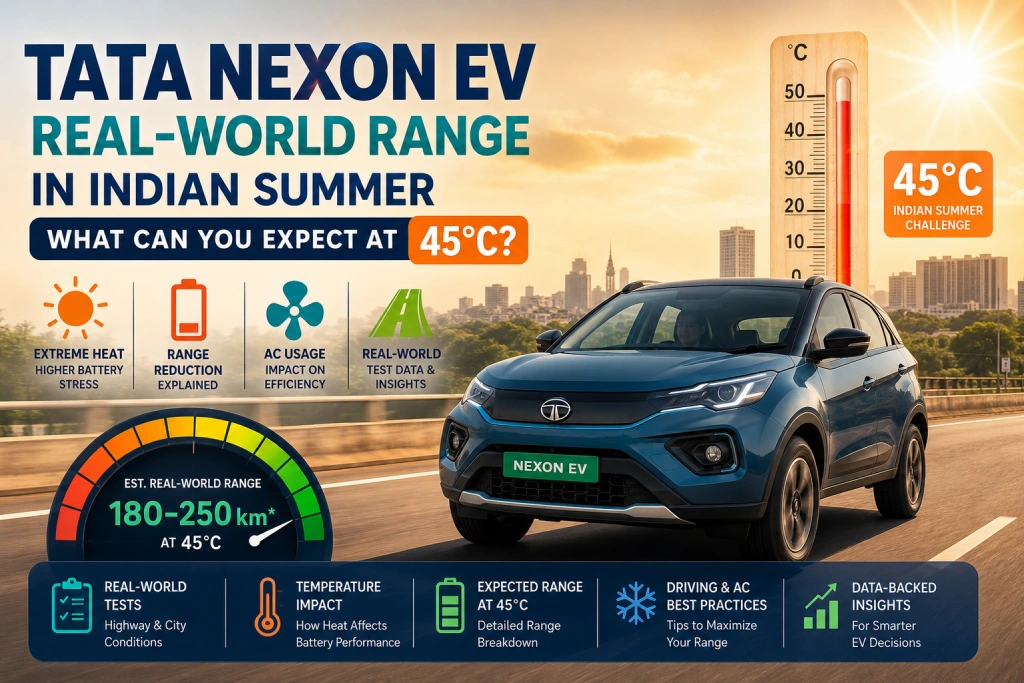
Tata Nexon EV Real-World Range in Indian Summer: What Can You Expect at 45°C?
Last updated: 26 August 2026
Quick Answer
What is the real-world range of the Tata Nexon EV 45?
The current Tata Nexon EV 45 has a 489 km MIDC-certified range. Tata lists a 350–375 km C75 real-world range, while Autocar India's independent testing recorded 350 km overall, comprising 355 km in city driving and 345 km on the highway. Actual range varies with speed, traffic, temperature, climate-control use, load and driving style. (Tata Motors Electric)
The important point is that these numbers represent different types of evidence. A certified range, Tata's C75 figure and an independent road test should not be treated as interchangeable.
Tata Nexon EV range at a glance
| Range figure | What it means | Nexon EV 45 |
|---|---|---|
| MIDC-certified range | Official certified figure | 489 km |
| Tata C75 range | Tata's stated practical range | 350–375 km |
| Autocar independent test | Tested real-world result | 350 km |
| Autocar city test | Independent city result | 355 km |
| Autocar highway test | Independent highway result | 345 km |
| 45°C range | Verified current-model test | No precise figure established |
The 45°C figure deserves special caution. There is evidence that extreme heat can increase EV energy consumption, but there is no sound basis for turning that general evidence into a precise "Nexon EV 45 gets X km at 45°C" claim. (Autocar)
For your own driving conditions, use the EV Range Calculator rather than relying on one universal number.
What Is the Tata Nexon EV Real-World Range?
Tata Nexon EV real-world range is the distance the vehicle can actually travel under particular driving conditions, rather than the laboratory-certified MIDC figure. Real-world range changes according to driving speed, traffic, temperature, HVAC use, road conditions, vehicle load and driving behaviour.
For the current 45-kWh Nexon EV, the strongest directly relevant independent evidence is Autocar India's testing. Autocar recorded 350 km on a full charge, with 355 km in its city test and 345 km in its highway test. The measured average efficiency was 7.79 km/kWh. (Autocar)
That makes approximately 350 km a useful independent benchmark for the current 45-kWh model.
However, 350 km should not be treated as a guaranteed range for every driver.
A person driving predominantly at higher highway speeds, carrying a heavier load or using more climate control may obtain a different result. Conversely, a driver travelling at moderate speeds in favourable conditions may achieve a different result.
That is why the most useful question is not simply:
"What is the Nexon EV's range?"
The better question is:
"What range should I plan for under my particular driving conditions?"
What Is the Official Tata Nexon EV Range?
The current Tata Nexon EV is offered with 30-kWh and 45-kWh battery options. Tata lists MIDC-certified ranges of 275 km for the 30-kWh Nexon EV MR and 489 km for the 45-kWh Nexon EV. Tata also lists C75 ranges of 210–230 km and 350–375 km respectively. (Tata Motors Electric)
For the Nexon EV 45, Tata's official documentation lists:
- Battery capacity: 45 kWh
- MIDC Part 1 + Part 2 certified range: 489 km
- C75 real-world range: 350–375 km
- Liquid-cooled thermal management system
Tata's documentation also identifies the 45-kWh vehicle as having a liquid-cooled thermal management system. (Tata Motors Electric)
The 489 km figure is therefore useful as the official certified reference, but it should not be interpreted as a promise that every owner will travel 489 km between charges.
What Is Tata's C75 Real-World Range?
Tata's C75 range is a practical-range figure intended to represent a real-world driving scenario, and Tata lists 350–375 km for the Nexon EV 45. C75 should not be confused with an independently measured road-test result. (Tata Motors Electric)
For the Nexon EV 45, Tata's current support information gives:
C75 range: 350–375 km. (Tata Motors Electric)
This is particularly interesting because the C75 range overlaps closely with Autocar India's independently tested 350 km result.
However, the two numbers should still be described separately.
Why?
Because they come from different methodologies.
Tata C75: manufacturer's stated practical-range figure.
Autocar 350 km: independent test result under Autocar's defined test conditions.
A technically accurate article should never write:
"Tata's C75 range proves the Nexon EV gets 350–375 km in every real-world situation."
Nor should it write:
"The Nexon EV's real-world range is exactly 350 km."
The correct interpretation is that 350–375 km is a useful evidence-based planning band, while actual results remain condition-dependent.
What Has Independent Testing Shown?
Current Nexon EV 45: Autocar's test
Autocar India independently tested the current Nexon EV 45 and recorded 350 km overall, with 355 km in city driving and 345 km in highway driving. The measured battery efficiency was 7.79 km/kWh. (Autocar)
Autocar's testing methodology is important when interpreting the numbers.
The test vehicle was fully charged and tyre pressures were maintained according to the manufacturer's recommendations. The vehicle was driven on fixed city and highway routes at specified average speeds. Climate control was set to 22°C, with the fan in automatic mode, while normal electrical equipment was used. (Autocar)
Autocar's earlier detailed test of the Nexon EV 45 also reported city efficiency of 7.9 km/kWh and highway efficiency of 7.67 km/kWh, resulting in a mixed range of approximately 350 km. (Autocar)
This is currently one of the most useful independently tested benchmarks for someone researching the current 45-kWh Nexon EV.
What About the Older 40.5-kWh Nexon EV Test?
Historical testing of the 40.5-kWh Nexon EV should not be used as though it were testing the current 45-kWh model.
This distinction matters.
The older Nexon EV 40.5-kWh version had a different battery capacity and is no longer the current 45-kWh model. Autocar explicitly identifies the 40.5-kWh version as a discontinued variant. (Autocar)
ZigWheels' historical testing of the 40.5-kWh Nexon EV is still useful when discussing hot-weather testing, but it belongs in the article as historical evidence.
The reported test range was approximately 284.2–299 km, with one test conducted at approximately 41°C. (Autocar)
That evidence can answer an important question:
Have Nexon EVs previously been tested under very hot conditions?
Yes.
But it cannot answer this question:
How many kilometres will the current 45-kWh Nexon EV deliver at exactly 45°C?
It does not provide enough evidence for that conclusion.
What Happens to Nexon EV Range in Very Hot Weather?
Very high ambient temperatures can increase energy consumption in battery-electric vehicles, particularly because cabin cooling and battery thermal management require electrical energy. However, general EV temperature research should not be converted into a Nexon EV-specific percentage without Nexon-specific testing.
This distinction is essential.
Research on EVs has found that high temperatures can affect energy consumption. A large real-world study of 300 EVs and more than 345,000 trips in the Phoenix area found that energy use increased by approximately 25–28% when temperatures rose from 26–30°C to 46–50°C. That is evidence about EVs generally, not a test of the Tata Nexon EV. (ScienceDirect)
Other research has also identified HVAC energy consumption as an important contributor to EV range changes under different ambient temperatures. (ScienceDirect)
There is also India-relevant technical research examining integrated battery and cabin thermal management under ambient temperatures up to 40°C. The research found that the power demand of the thermal-management system increased as ambient temperature increased. Again, the research is not a Tata Nexon EV road test, so it should be used only to explain the underlying principle. (ScienceDirect)
What does this mean for the Nexon EV?
It means that hot weather is a legitimate range consideration.
It does not mean that:
- the Nexon EV loses a fixed percentage at 40°C;
- the Nexon EV loses a fixed percentage at 45°C;
- the Nexon EV loses a specific number of kilometres per degree;
- a general EV study can be converted into a Nexon-specific range prediction.
Those claims require direct vehicle-specific evidence.
What Range Can You Expect at 45°C?
A precise 45°C range for the current Tata Nexon EV 45 should be treated as an estimate unless a documented independent test of that vehicle at approximately 45°C is available. Existing evidence does not justify publishing a precise "X km at 45°C" figure.
This is where many EV range articles can become misleading.
Suppose a vehicle delivers 350 km in an independent test.
It would be tempting to say:
"Extreme heat causes a 15% loss, so at 45°C the Nexon EV will deliver 298 km."
That calculation would create a number, but it would not create reliable evidence.
The problem is that the 15% figure would have to come from a comparable test involving:
- the same vehicle;
- the same battery;
- similar road conditions;
- similar speeds;
- similar payload;
- comparable HVAC settings;
- comparable battery state;
- comparable tyre pressures;
- and a controlled temperature difference.
Without that evidence, the resulting number is simply an assumption.
So what should a Nexon EV owner do at 45°C?
Use the 350 km independent benchmark as a reference point, not as a guaranteed 45°C result.
Then adjust your own estimate based on your actual:
- city/highway mix;
- average speed;
- AC usage;
- traffic;
- passenger and luggage load;
- route;
- driving style;
- desired battery reserve.
For a journey where arriving at a charger is critical, planning with a conservative reserve is more sensible than assuming the advertised 489 km figure.
City vs Highway: Which Gives Better Nexon EV Range?
Autocar's independent test of the Nexon EV 45 recorded 355 km in city driving and 345 km on its highway test. The small difference demonstrates why driving conditions matter, but it does not establish a universal city-versus-highway percentage. (Autocar)
The current test results are:
| Test condition | Autocar result |
|---|---|
| City | 355 km |
| Highway | 345 km |
| Overall | 350 km |
| Tested efficiency | 7.79 km/kWh |
(Autocar)
Highway driving can increase energy consumption because aerodynamic drag rises substantially with speed.
City driving introduces a different set of variables, including:
- traffic;
- frequent acceleration;
- idling at signals;
- regenerative braking;
- lower average speeds;
- AC usage.
Therefore, "city is always better" or "highway is always worse" is too simplistic.
The Autocar test provides a useful benchmark under its own methodology. It should not be turned into a universal percentage applicable to every driver.
How Does AC Affect Tata Nexon EV Range?
Air conditioning consumes electrical energy from an EV's high-voltage system, so intensive cabin cooling can reduce the energy available for propulsion. The size of the effect depends on ambient conditions, cabin temperature, HVAC settings, vehicle insulation, solar load and driving conditions.
This becomes particularly relevant in Indian summer conditions.
At a mild temperature, maintaining cabin comfort may require relatively little energy compared with propulsion.
At an extremely high ambient temperature, the cabin may start significantly hotter and the cooling system has a larger thermal load.
Research on EV climate-control systems confirms that HVAC operation can materially affect driving range. (SAE Mobilus)
However, the article should not claim:
"AC reduces Nexon EV range by exactly X%."
There is insufficient Nexon-specific evidence for a universal percentage.
The more accurate approach is to make AC usage an input in a range calculator.
How Do Traffic, Speed and Load Affect Range?
Speed
Higher sustained speeds generally require more energy because aerodynamic resistance becomes increasingly important.
For that reason, a highway trip at substantially higher speeds cannot be expected to reproduce a lower-speed city test.
Traffic
Heavy traffic creates repeated acceleration and deceleration.
Regenerative braking can recover some energy during deceleration, but recovered energy does not eliminate the energy required for acceleration.
Vehicle load
More passengers and luggage increase vehicle mass. More mass means the motor has to provide more energy for acceleration and climbing.
The effect will depend on the route and driving pattern rather than a universal percentage.
Road gradient
A route involving significant climbing can consume substantially more energy than a flat route.
Some of that potential energy can be recovered during descent through regenerative braking, but recovery is not perfectly lossless.
Driving style
Aggressive acceleration and high speeds generally increase energy consumption.
Smooth acceleration, appropriate speed and efficient use of regenerative braking can help reduce consumption.
Tata Nexon EV 30 kWh vs 45 kWh Range
The current Tata support information lists two Nexon EV battery options: 30 kWh MR and 45 kWh. (Tata Motors Electric)
| Specification | Nexon EV MR | Nexon EV 45 |
|---|---|---|
| Battery | 30 kWh | 45 kWh |
| MIDC range | 275 km | 489 km |
| Tata C75 range | 210–230 km | 350–375 km |
The larger battery provides substantially greater certified and C75 range.
The practical choice depends on the driver's normal travel pattern.
For predominantly short urban journeys where charging is convenient, the 30-kWh version may provide sufficient range.
For users who regularly travel longer distances or want greater charging flexibility between stops, the 45-kWh version provides a larger range buffer.
The important point is to compare realistic travel requirements, not simply the maximum certified number.
Tata Nexon EV Range Calculator: How Should You Estimate Your Own Range?
An EV range calculator should produce an estimated range from transparent assumptions; calculator output should never be presented as a tested range.
A simple energy-based model is:
Estimated range = available energy ÷ estimated energy consumption per kilometre
For example, if a calculator assumes a particular energy consumption value, the result should clearly identify that value as an assumption unless it comes directly from a published test.
A useful calculator can allow users to enter or select:
- Battery version
- Expected efficiency
- City/highway driving mix
- Average speed or driving pattern
- AC usage
- Ambient-temperature scenario
- Desired battery reserve
- Battery condition, where supported
The calculation should then produce:
Estimated range
not:
Tested range
That distinction protects the user from false precision.
How to Plan a Long-Distance Tata Nexon EV Trip
Long-distance EV planning should begin with expected energy consumption rather than the manufacturer's maximum certified range. The driver should estimate the required energy, identify charging opportunities and maintain an appropriate reserve for traffic, weather and route uncertainty.
A simple planning process is:
Step 1: Estimate your realistic efficiency
Use a documented test where applicable, or enter your own historical efficiency.
Step 2: Calculate the expected travel distance
Use:
Expected range = available energy ÷ expected consumption
Step 3: Compare range with your route
Do not assume that the complete theoretical range is available for every trip.
Step 4: Allow a reserve
Your reserve should account for unexpected traffic, weather, detours and charger availability.
Step 5: Check charging infrastructure
Charging-stop planning depends on the actual route and available chargers.
A charging plan should therefore not be generated from the Nexon EV's range figure alone.
Key Takeaways
- The current Tata Nexon EV 45 has a 489 km MIDC-certified range. (Tata Motors Electric)
- Tata lists 350–375 km as the C75 practical range for the Nexon EV 45. (Tata Motors Electric)
- Autocar's independent testing recorded 350 km overall, including 355 km city and 345 km highway. (Autocar)
- Autocar measured approximately 7.79 km/kWh in its Nexon EV 45 testing. (Autocar)
- Historical testing of the older 40.5-kWh Nexon EV at approximately 41°C is useful evidence about hot-weather testing, but it is not a test of today's 45-kWh vehicle.
- Extreme heat can affect EV energy consumption, particularly through HVAC and thermal-management loads, but general EV research should not be converted into a Nexon-specific temperature penalty. (ScienceDirect)
- There is no defensible basis for publishing a precise current Nexon EV 45 range at 45°C without a documented 45°C test.
- A calculator-based estimate is more useful for individual trip planning than one universal range number.
❓ Frequently Asked Questions
What is the real-world range of the Tata Nexon EV?
The current Tata Nexon EV 45 delivered 350 km in Autocar India's independent testing, with 355 km in the city and 345 km on the highway. Tata separately publishes a C75 practical range of 350–375 km. Actual owner range will vary according to speed, traffic, temperature, AC use, load and driving behaviour. (Autocar)
What is the official range of the Nexon EV 45?
The Tata Nexon EV 45 has an official 489 km MIDC Part 1 + Part 2 certified range according to Tata's current support information. The 489 km figure is a certified figure and should not be interpreted as a guaranteed real-world driving distance. (Tata Motors Electric)
What is Tata's C75 range for the Nexon EV 45?
Tata currently lists the Nexon EV 45's C75 range as 350–375 km. C75 is a manufacturer-provided practical-range figure and is distinct from an independently conducted road test. (Tata Motors Electric)
Does hot weather affect EV range?
Yes. General EV research shows that extreme heat can increase energy consumption, with HVAC and thermal-management requirements being important factors. However, the exact effect varies by vehicle and conditions, so general temperature studies should not be converted into a fixed Tata Nexon EV percentage. (ScienceDirect)
Was the Tata Nexon EV tested at approximately 41°C?
Yes, a historical ZigWheels test of the 40.5-kWh Nexon EV included testing at approximately 41°C. The reported result was about 284.2 km under those conditions. That vehicle was not the current 45-kWh Nexon EV, so the number should not be presented as a current-model 45-kWh result.
Is there a verified Tata Nexon EV 45 test at exactly 45°C?
A precise, directly documented current Nexon EV 45 test at approximately 45°C was not identified in the evidence reviewed for this article. Therefore, a precise "45°C range" should be labelled as an estimate rather than presented as measured data.
How much range does the Nexon EV 45 get in city driving?
Autocar recorded 355 km in city testing with the Nexon EV 45. The result came from Autocar's specific test methodology, including controlled test routes and climate-control settings, so it should be treated as a benchmark rather than a guaranteed result for every city driver. (Autocar)
How much range does the Nexon EV 45 get on the highway?
Autocar recorded 345 km in its highway test of the Nexon EV 45. Highway range depends strongly on speed, road conditions, traffic and climate-control use, so the 345 km result should not be treated as a universal highway range. (Autocar)
Does AC reduce Tata Nexon EV range?
AC consumes electrical energy and can reduce the energy available for propulsion, particularly when substantial cabin cooling is required. The exact effect depends on ambient temperature, cabin heat load, HVAC settings and driving conditions. No fixed Nexon-specific AC penalty should be assumed without supporting test data.
Is ARAI range the same as real-world range?
No. ARAI/MIDC certification is a standardized certification result, while real-world range depends on actual driving conditions. For the Nexon EV 45, the difference is clear: Tata lists 489 km MIDC, while Autocar independently measured 350 km overall. (Tata Motors Electric)
Is the 40.5-kWh Nexon EV the same as the current 45-kWh model?
No. The 40.5-kWh Nexon EV is an older variant. Tata's current Nexon EV range includes a 30-kWh MR and 45-kWh model. Historical 40.5-kWh test results should therefore be labelled as historical evidence. (Tata Motors Electric)
How can I calculate my expected Nexon EV range?
Use an EV range calculator with clearly identified assumptions for battery version, efficiency, driving mix, AC usage, temperature, load and reserve. The result should be labelled estimated range, because calculator output is not equivalent to an independently tested result.
Conclusion
The Tata Nexon EV 45 illustrates why certified range and real-world range are two different measurements.
Tata's official figure is 489 km MIDC, while Tata's C75 figure is 350–375 km. Independent Autocar testing of the current 45-kWh Nexon EV produced 350 km overall, including 355 km in city driving and 345 km on the highway. (Tata Motors Electric)
The most important conclusion for an Indian driver is that there is no single universal Nexon EV real-world range.
Temperature, AC use, speed, traffic, load and driving conditions all matter.
The 45°C question requires even more caution. General EV research supports the conclusion that extreme heat can increase energy consumption, but that evidence does not justify inventing a precise Nexon EV range at 45°C. (ScienceDirect)
So instead of asking:
"Will my Nexon EV give exactly X km at 45°C?"
the more useful question is:
"What range should my Nexon EV deliver under my battery, speed, traffic, AC and temperature conditions?"
Use the EV Range Calculator to estimate your expected Tata Nexon EV range based on your actual driving conditions before planning a long-distance journey.
External Authority References
1. Tata Motors / Tata.ev — Primary source
Use Tata's official Nexon EV support information for:
- 30-kWh and 45-kWh battery variants
- 275 km and 489 km MIDC ranges
- C75 ranges
- Current model information
Tata.ev official Nexon EV support
2. Tata Nexon EV 45 official brochure
Use the official Tata brochure for:
- 45-kWh battery
- liquid-cooled thermal management
- 489 km MIDC range
- 350–375 km C75 range
Tata Nexon.ev 45 official brochure
3. Autocar India — Current independent test
Use for:
- 350 km overall
- 355 km city
- 345 km highway
- 7.79 km/kWh
- testing methodology
Autocar India Nexon EV 45 real-world range test
4. ZigWheels — Historical hot-weather evidence
Use only for the historical 40.5-kWh/approximately-41°C evidence, with the variant clearly identified.
ZigWheels Tata EV real-world range testing
5. Peer-reviewed EV temperature research
Use general research only to explain the principle that extreme heat can affect EV energy consumption. Do not use it to manufacture a Nexon-specific 45°C penalty. (ScienceDirect)
Editorial fact-check status
The article deliberately does NOT make these unsupported claims:
- ❌ "Nexon EV gets X km at 45°C"
- ❌ "Nexon EV loses X% range at 45°C"
- ❌ "AC reduces Nexon EV range by exactly X%"
- ❌ "The 41°C ZigWheels test was the current 45-kWh Nexon EV"
- ❌ "489 km is the real-world range"
- ❌ "350 km is guaranteed for every owner"
- ❌ "City range is always X% higher than highway range"
Instead, the article separates manufacturer-certified data, manufacturer C75 data, independent testing, historical testing and calculator estimates. That distinction is the central credibility feature of the article.